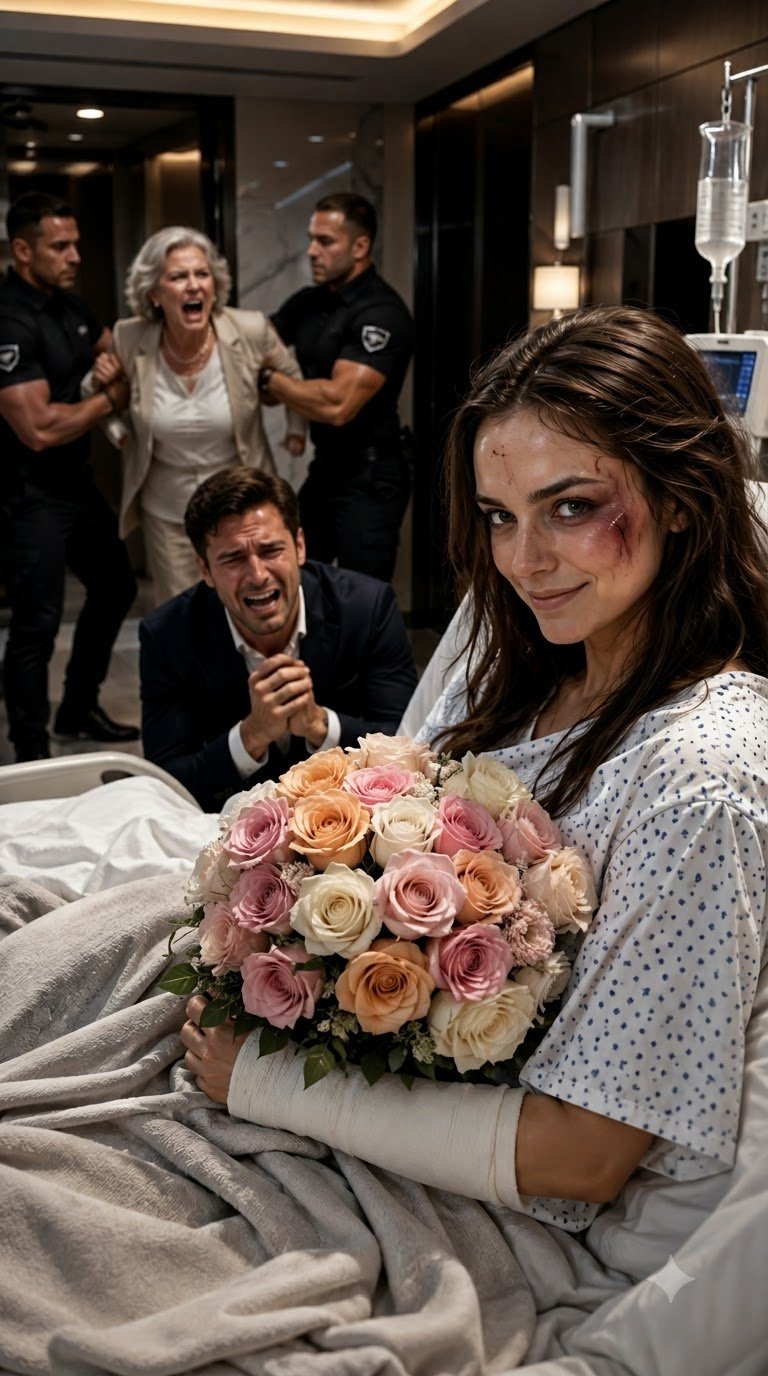
The harsh, sterile scent of hospital grade bleach is something that never quite leaves your olfactory memory. It clings to the back of your throat, a constant, chemical reminder of absolute vulnerability. I lay perfectly still, staring up at the water-stained acoustic ceiling tiles of Mercy General Hospital, listening to the rhythmic, synthetic beep of the heart monitor. Every time my heart beat, a dull, throbbing ache radiated from my fractured left wrist and the thick gauze bandage wrapped tightly around my forehead.
But the physical pain—the broken bone, the mild concussion, the bruises blooming across my shoulders—was nothing compared to the ice-cold clarity crystalizing in the center of my chest.
I gingerly picked up my phone with my good hand. The screen glared back at me in the dim, twilight illumination of the recovery room. There it was. The digital message that would become the cornerstone of my entire coup d’état.
It was from my husband, Jason Carter.
“You deserved it.”
That was the first text. If he had stopped there, I might have spent the next year agonizing over where our marriage went wrong. I would have likely drowned in the misplaced guilt of a chronically gaslit wife, wondering if I had pushed his mother too far, if I had been too aggressive. But Jason had always been hasty. He was a man who acted entirely on impulse before his brain could catch up, a fatal flaw that had just handed me the keys to his absolute destruction.
A second text had arrived mere seconds later. It was painfully obvious it had been meant for his mother, Linda Carter.
“The lawyer said once she’s discharged, we can pressure her to sign the deed over. Just lay low and don’t answer her calls. We’ve almost got the trust.”
My breath caught in my throat. The words blurred, then sharpened, etching themselves permanently into my retinas.
Everything that had transpired the night before at Linda’s sprawling, ostentatious suburban estate finally made brutal, terrifying sense. The Sunday dinner hadn’t just devolved into a dramatic family argument because Linda thought I wasn’t “good enough” for her precious son. It hadn’t been about my career, or my cooking, or my lack of a pedigree.
It had exploded because I had spent that Sunday afternoon casually reviewing the quarterly statements for The Heritage Trust, the substantial financial inheritance my late grandfather had left solely to me.
I had noticed the discrepancies. They were small at first, expertly camouflaged—a few thousand dollars here, a subtle transfer there, disguised as routine maintenance fees or tax escrows—all routed through a newly formed shell LLC that I didn’t recognize. When I brought up the missing funds over roast beef and red wine, the temperature in the dining room had plummeted so fast I practically saw my own breath.
Linda’s heavily powdered face had drained of color, leaving her looking like a wax figure. Jason had stared intensely at his porcelain plate, his jaw tight, his knuckles white around his heavy crystal wine glass.
When I pushed harder, opening my leather briefcase to produce the printed financial documents, Linda hadn’t just yelled. She had panicked. It was the feral, desperate panic of a trapped animal. The verbal confrontation escalated into a sudden, physical frenzy to stop me from leaving the house with those papers. She lunged across the rug. She shoved me with a force I didn’t know she possessed.
I went backward, my heels catching on the fringe of the Persian rug, crashing violently through her vintage glass coffee table.
Jason had stood there. He watched the heavy glass shatter into a thousand jagged pieces. He watched my head strike the mahogany floorboard with a sickening crack. He didn’t pull his phone out to call an ambulance. He didn’t kneel down to offer his wife a hand, or even a towel to stem the bleeding.
Instead, he simply reached down, grabbed my briefcase containing the financial ledgers, looked at his mother with cold complicity, and walked out the front door. He left me there, bleeding on the rug, until a neighbor who had heard the violent crash peered through the window and called emergency services.
They thought they had silenced me. They thought I was a naive, heartbroken woman lying in a hospital bed, entirely dependent on her husband’s mercy and terrified of his family’s influence. They thought the concussion would make my memory fuzzy, making me compliant and easy to manipulate.
I slowly locked my phone screen. The hot tears I had been holding back dried up instantly, replaced by a profound, terrifying calm that settled over my bones like a suit of armor. I wasn’t just a grieving wife anymore. I was a massive financial liability they were actively trying to manage.
I pressed the call button for the night nurse. When she arrived, pushing open the heavy wooden door, her face softened with professional pity. “Do you need more pain medication, Mrs. Carter? You’re scheduled for another dose.”
“No, thank you,” I said, my voice steady, sounding entirely foreign even to my own ears. “But I do need my laptop from the personal belongings locker. And a quiet, secure place to make a phone call. I need to speak to my attorney.”
I wasn’t going to cry. I was going to war. And Jason had just handed me the nuclear codes.
As I dialed the private cell phone number for Evelyn Vance, the most ruthless, heavily feared family law and financial litigation attorney in the city, my hand didn’t shake once.
“Evelyn,” I said when she answered on the second ring, her voice thick with sleep. “I need you at Mercy General. Now. Bring a forensic accountant.”
There was a pause on the line. Then, the sound of rustling sheets. “Claire? I’m on my way. What did you find?”
“I found out why they let me bleed,” I whispered into the receiver. “And Evelyn… I think they’ve been draining my grandfather’s trust for years.”
“Don’t say another word on an unsecured hospital line,” Evelyn commanded, her tone instantly shifting from sleepy friend to wartime general. “I am pulling your file now. But Claire… if what you’re implying is true, the trust isn’t the only thing they’ve compromised.”
“Are you absolutely certain about this, Claire?” Evelyn’s voice was sharp and analytical, cutting through the sterile hum of my private hospital room. She had arrived just before dawn, impeccably dressed in a charcoal suit, clutching a thick leather portfolio.
“I have never been more certain of anything in my entire life,” I replied, awkwardly signing the stack of expedited legal authorizations she had spread out over my rolling overbed table. My fractured wrist ached with every stroke of the pen, but I welcomed the pain. It kept me focused. It kept me angry.
We were working desperately against the clock. According to Jason’s accidental text, he assumed I would be under medical observation for at least another forty-eight hours. He was busy “laying low” at his mother’s house, avoiding my calls, entirely confident in his own twisted plan. That gave me exactly two days to quietly dismantle a five-year marriage, secure my considerable assets, and build a fortress he couldn’t penetrate.
My name remained on the primary deed to the Sterling Heights penthouse, a luxurious, panoramic apartment overlooking the city skyline that we ostensibly owned jointly. However, Evelyn and her on-call forensic accountant, a quiet man named David, had spent the last four hours working furiously on their laptops in the hospital cafeteria.
They had already proven the impossible.
“Every significant piece of equity in that penthouse,” Evelyn explained, adjusting her glasses, “every piece of custom designer furniture, the expensive modern artwork, the Persian rugs, and that antique grand piano in the foyer… it was all purchased exclusively with your documented, pre-marital funds. Jason’s financial contributions over the last five years amount to paying the cable bill and occasionally buying groceries.”
Under Evelyn’s rapid-fire legal maneuvering, a sympathetic family court judge had just granted an emergency, ex-parte protective order. The judge based his immediate ruling on the hospital’s severe injury records, the police report filed by the frantic neighbor, and the chilling, undeniable screenshot of Jason’s accidental text confession.
“The logistics are entirely in place,” Evelyn said, checking her gold wristwatch. “The moving company I use for high-net-worth asset recovery is on standby. They are heavily bonded, fully insured, and they work like ghosts.”
While I lay in that hospital bed, sipping lukewarm chamomile tea and projecting the image of a broken, sedated woman for the morning nursing staff, an orchestrated symphony of absolute destruction was occurring across town.
Professional movers, flanked by a court-appointed inventory specialist and an armed security guard, entered the Sterling Heights penthouse. They didn’t just pack up the apartment; they performed a surgical extraction. Evelyn’s senior paralegal walked through with a 4K video camera, meticulously documenting every single room before, during, and after the process.
The grand piano was carefully disassembled by specialists and hoisted out via the freight elevator. The custom Italian leather sectionals, the imported silk curtains, my massive collection of first-edition books—all vanished into the cavernous bellies of three unmarked moving trucks.
I had given them very strict, unwavering instructions regarding Jason’s personal belongings. I wanted to stay entirely and unquestionably within the confines of the law.
“Leave his things,” I had told Evelyn. “His cheap suits, his gaming console, his golf clubs, his protein powders. Leave them exactly where they are. Do not touch a single item that he bought with his own money.”
Simultaneously, the building’s head of security, presented with the emergency court order signed in blue ink by a judge, wiped Jason’s fingerprint access from the penthouse biometric scanner. His electronic key fobs were deactivated in the system. The physical deadbolts on the heavy oak doors were drilled out and replaced.
By the time the sun set on my second day in the hospital, the operation was complete. The penthouse was a shell.
The following morning, I arranged for my own quiet, unannounced discharge. A private, tinted town car was waiting at the underground loading dock of the hospital to whisk me away to a secure, temporary townhouse Evelyn had leased under an LLC.
Just as my driver pulled out into the city traffic, my phone vibrated violently against my leg. It was a push alert from the hospital’s front desk security camera—a feed Evelyn had requested temporary access to, citing severe domestic safety concerns.
Jason and Linda were walking through the automatic sliding glass doors of the hospital lobby.
Linda was holding a pathetic, cheap bouquet of yellow carnations, her face perfectly arranged into a sickening mask of maternal concern. Jason walked slightly behind her, looking nervous but resolute. From what Evelyn had gathered from their intercepted emails, they were coming to do exactly what the text message had promised: they were bringing a notary. They intended to pressure me, while I was heavily medicated, into signing a document framing the incident as a “clumsy, tragic accident” and transferring the penthouse deed to the trust they now controlled.
They marched confidently toward the main elevator bank, ascending to the fourth floor.
I watched the live, grainy video feed on my phone screen, my heart pounding a steady, triumphant, war-drum rhythm against my ribs. I could perfectly picture the exact moment they would push open the heavy door to room 412. They would expect to find me bruised, weeping, and entirely pliable.
Instead, they would find a perfectly made, stark white, meticulously empty hospital bed.
And resting perfectly centered on the pristine pillow was a single, sealed envelope addressed to Jason. I knew exactly what would happen when he tore it open and read the single line of text printed on my heavy, monogrammed cardstock.
“You should check your desk. Hurry home.”
My phone buzzed again, interrupting the video feed. It was Evelyn. “Claire,” she said, her voice unusually tight. “David just cracked the secondary shell company’s ledger. Jason didn’t just steal the trust money, Claire. He used your social security number to secure the loans for his mother’s debts. If they default, the federal government isn’t coming for them. They’re coming for you.”
The frantic, breathless phone call from the Sterling Heights building manager came exactly twenty-two minutes after Jason and Linda discovered my empty hospital room.
I was sitting in the plush, velvet armchair of my new, undisclosed living room, a cup of Earl Grey tea warming my hands. On the coffee table in front of me sat a laptop streaming a live, encrypted audio feed. Evelyn’s team had legally set up a small recording device in the apartment’s foyer with the court’s explicit permission, citing the protection of my remaining assets.
“Mr. Carter, you need to come back to the building immediately,” the manager’s voice was tense, completely devoid of its usual sycophantic, high-end customer-service warmth.
“What the hell happened? Did someone break in? Call the police!” Jason demanded. Through the audio feed, I could hear the aggressive squeal of tires in the background; Linda was clearly driving, and she was driving erratically.
“I cannot discuss the details over the phone, sir. Just get here. Now.” The manager hung up.
When Jason and Linda finally burst through the gilded, revolving doors of the Sterling Heights lobby, they were met not by an apologetic concierge offering them sparkling water, but by two broad-shouldered, uniformed police officers.
“What the hell is going on here? This is my property! I want to see the security footage!” Jason shouted, his voice echoing loudly off the imported Italian marble pillars.
“It’s jointly owned, sir,” the manager corrected quietly, stepping back behind the safety of the mahogany front desk.
One of the officers stepped forward, his face an unreadable mask of authority, and handed Jason a thick, heavy manila folder. “Mr. Carter, you are being served with an emergency protective order. You are legally prohibited from contacting your wife, Claire Carter, directly or indirectly, until the preliminary hearing next Tuesday. You are to remain five hundred feet away from her at all times.”
Linda’s voice shrilled through the audio feed, piercing my ears. “This is an absolute setup! She’s a hysterical liar! She tripped on a rug and fell! She’s trying to steal my son’s home!”
“Ma’am,” the officer said, his tone utterly flat and unimpressed. “We have time-stamped hospital photographs of defensive wounds, sworn statements from three separate neighbors who heard the violent altercation, and a text message confession retrieved directly from your son’s cellular provider. Now, I suggest you step back and lower your voice.”
I closed my eyes, sinking deeper into my armchair, savoring the profound, suffocating silence that followed Linda’s realization that she was entirely caught.
The audio feed picked up the soft ding of the private elevator arriving on our floor. I heard Jason’s heavy footsteps rushing down the carpeted hallway. Then came the rapid, desperate tapping of his plastic key card against the electronic reader. Beep-boop. Access denied. He slammed his thumb onto the biometric scanner, trying again and again. Red light. Red light. Red light.
“Open this damn door!” Jason commanded the manager, his voice cracking with panic.
A locksmith, hired by my legal team and waiting in the stairwell, stepped forward. He calmly turned the newly installed deadbolt for them, allowing the police to escort Jason inside so he could collect his legally allotted personal items.
The heavy, solid oak door swung open with a soft creak.
Jason gasped. It was a sharp, pathetic, hollow intake of air.
The sprawling, three-thousand-square-foot luxury penthouse was a cavernous tomb. The mid-morning sun poured through the massive floor-to-ceiling windows, illuminating absolutely nothing. Every single piece of art, every plush rug, every crystal lamp, the massive dining table where we had hosted Thanksgiving, the velvet chairs—gone. The echo of their breathing in the massive room was deafening.
In the exact center of the vast, empty expanse of hardwood floor in the living room sat a single, sad cardboard box. It contained his video games, a stack of his folded novelty t-shirts, and his gym bag.
“She… she took everything,” Linda whispered, her voice trembling violently with a potent mixture of rage and terror.
“She took what she legally owned, ma’am,” the officer corrected, tapping his pen against his clipboard. “Everything else was removed under a court-approved asset preservation order.”
But I knew Jason wasn’t looking at the empty living room anymore. His footsteps, heavy and frantic, echoed loudly as he sprinted down the hallway toward his home office.
He stopped dead in his tracks in the doorway.
His massive mahogany desk, the one that had belonged to my grandfather and that he had claimed as his own, was gone. In its place, sitting directly on the bare, polished hardwood floor, was a single, small stack of papers.
Resting perfectly on top of the papers was a silver external hard drive.
“Your laptop was purchased with Mrs. Carter’s business account,” the officer explained, following him into the room. “It has been legally repossessed. However, her attorneys copied your personal files—your resumes, your photos—onto that drive.”
But Jason wasn’t listening to the officer. The hidden wide-angle camera I had legally installed in the office prior to my departure captured his face perfectly on my laptop screen. All the blood drained from his cheeks, leaving him looking like a corpse. His knees actually buckled slightly, forcing him to lean against the doorframe for support.
He wasn’t looking at the silver hard drive. He was looking at the papers placed deliberately beneath it.
They were high-resolution printed copies of the shell LLC bank statements. The very same accounts he and Linda had used to secretly funnel my trust money. I had highlighted every single fraudulent transfer, every fake invoice, every wire sent to an offshore casino, in blinding, neon yellow marker.
Next to the damning statements was a formal, legal notice of a civil lawsuit for massive financial fraud, alongside copies of the criminal assault charges filed against Linda.
Jason slowly picked up the papers. His hands were shaking so violently that the papers rattled, and he dropped the hard drive onto the floor with a clatter. He realized in that agonizing, breathless second that I hadn’t just packed up and left him. I had investigated him. I had mathematically, legally, and permanently destroyed him.
He turned slowly to his mother, who was standing in the doorway behind him, her mouth hanging open in shock as she read the top sheet over his shoulder. The realization of their impending, total ruin hung heavy in the dust motes dancing in the empty apartment.
Suddenly, Jason’s phone rang. He fumbled to answer it on speakerphone, his hands trembling. It was his own lawyer.
“Jason,” the lawyer’s voice came through, sounding grim and entirely exhausted. “I just got a call from the District Attorney’s office. They aren’t just looking at the trust money anymore. Because you used your wife’s social security number across state lines to secure those loans… the FBI just took over the case.”
Three agonizing, transformative months later, the heavy oak doors of Courtroom 4B swung shut, sealing us all inside a wood-paneled theater of absolute accountability.
The courtroom air conditioning hummed, a low, steady drone beneath the palpable, suffocating tension. I sat at the plaintiff’s table, wearing a sharply tailored, impenetrable navy blue suit, my posture perfect and unyielding. My fractured wrist was fully healed, leaving only a faint, silver ache when it rained—a daily physical reminder of the price of my blindness, and the harsh catalyst for my sudden awakening.
Across the wide center aisle, Jason and Linda sat at the defense table. They looked ragged, hollowed out by fear and impending doom. Jason’s designer suits hung loosely on his shrinking frame, his eyes darting nervously around the room, unable to meet my gaze. Linda had entirely lost her haughty, country-club sheen; her hair was dull and unstyled, her heavily manicured hands constantly wringing a shredded tissue in her lap.
The civil lawsuit and our divorce proceedings had been combined by the judge due to the heavily overlapping nature of the financial fraud and the extreme marital misconduct. The mountain of evidence sitting on Evelyn’s desk was insurmountable.
Evelyn Vance was a maestro. She didn’t just present the dry facts; she conducted a devastating symphony of truth.
First, the neighbors took the stand, testifying to the screaming, the sound of shattering glass, and Jason’s chillingly calm, unhurried departure from the house. Then, my medical experts documented the full extent of my injuries, surgically dismantling Linda’s absurd, eleventh-hour claim that she had acted in “self-defense” against me.
But the true spectacle—the moment the oxygen was sucked out of the room—began when the financial records were formally introduced into evidence.
Evelyn dimmed the lights and projected the heavily highlighted bank statements onto the massive screen positioned directly above the judge’s bench. With a laser pointer, she methodically traced the stolen money from The Heritage Trust, through the labyrinth of Jason’s fake shell company, straight into an offshore banking account Linda had secretly opened to cover her crippling, secretly accrued gambling debts.
The judge, an older, notoriously stern woman with absolutely zero tolerance for perjury or financial abuse, peered fiercely over her reading glasses at the defense table. “Mr. Carter, are you sitting there suggesting to this court that you were entirely unaware that nearly four hundred thousand dollars of your wife’s inheritance was funneled into an account bearing your direct signature?”
The atmospheric pressure in the room became microscopic. Jason looked desperately at his lawyer, a mid-tier, exhausted attorney he could barely afford after I successfully froze all of our marital assets. The lawyer gave him nothing but a grim, tight-lipped nod. There was nothing he could do.
It was every man for himself.
Jason suddenly stood up, his chair scraping loudly against the floor. His voice shook with raw panic. “Your Honor… I didn’t orchestrate this! I swear to God! It was her!” He pointed a trembling, accusatory finger directly at his own mother.
Linda gasped loudly, clutching her chest as if she had been physically shot.
“She begged me!” Jason practically shouted, his carefully constructed façade crumbling entirely into dust. “She was in massive debt to private, dangerous creditors. She said she would lose the family house! She told me to set up the LLC, she gave me the forged paperwork to sign. I only sent that text message because she explicitly told me to lay low so she could coerce Claire into signing the deed to pay off the rest of the debt!”
Absolute pandemonium erupted at the defense table. Linda slammed both of her hands violently onto the polished wood. “You ungrateful, spineless coward! You took a massive cut! You bought that stupid, flashy sports car with her money! Don’t you dare put this all on me to save your own skin!”
“You pushed her into a glass table, you psycho!” Jason screamed back, his face turning a deep, dangerous shade of purple. “You tried to kill her over money!”
“Order! Order in this court!” the judge bellowed, banging her heavy wooden gavel sharply against the block. “One more outburst like that from either of you, and I will hold you both in criminal contempt and have the bailiff remove you in handcuffs!”
I sat completely still, my hands folded neatly on the table, watching the spectacular implosion. I didn’t smile. I didn’t gloat. I didn’t feel a shred of pity. I just watched two toxic, parasitic entities turn their deadly venom on each other the exact moment their host was removed. It was a brutal, ugly display of cowardice, entirely validating every single drastic, cold-blooded measure I had taken from that hospital bed.
The judge’s ruling was swift, comprehensive, and entirely merciless.
Because of the blatant, documented financial fraud and the severe physical altercation, the marital assets were divided with extreme prejudice. I retained one hundred percent of the real estate, all of my remaining inheritance, and all of the joint savings as immediate restitution. Jason was ordered to pay all of my exorbitant legal fees.
Furthermore, the judge slammed her gavel down and announced she was immediately forwarding the unsealed financial transcripts to the district attorney. Linda was not only facing massive civil damages for the physical attack, but now both mother and son were staring down the barrel of federal wire fraud and identity theft indictments.
As court finally adjourned, Jason stood frozen in the aisle, completely stripped of his arrogance, his unearned wealth, and his future. He looked at me as I walked past, his eyes pleading, desperate for a shred of the soft, accommodating woman who used to love him.
I didn’t give him a second glance. I picked up my leather briefcase, the exact same one he had callously abandoned the night he left me bleeding, and walked confidently out into the bright, blinding afternoon sun.
As I reached the courthouse steps, Evelyn’s phone rang. She answered it, listened for a moment, and turned to me with a dark, triumphant look in her eye. “Claire,” she said. “The FBI didn’t wait. They’re at Linda’s house right now.”
A single year changes a lot of things. It can crush a person into dust, or it can forge a shattered woman into an absolute fortress.
I stood confidently by the expansive, floor-to-ceiling windows of my newly acquired corner office at Vanguard Innovations, looking out over the sprawling, pulsing city skyline. A heavy thunderstorm was lashing rain against the thick glass, but inside, it was warm, quiet, and perfectly under my total control. After the trial, I had thrown myself entirely into my career. I accepted a massive promotion, moved into a beautiful, highly secure townhouse in a gated community, and channeled every ounce of my residual anger and betrayal into building an empire.
My executive assistant, a bright-eyed, fiercely loyal young woman named Sarah, knocked softly on the heavy glass door and walked in, holding a silver tray with a small stack of mail.
“Morning, Claire. Mostly vendor contracts for you to sign for the new quarter, but this one came to the front desk. It doesn’t have a return address, but it’s marked highly personal.”
She handed me a slightly crumpled, cheap paper envelope. I recognized the frantic, sloppy handwriting instantly. It was a handwriting I used to see on grocery lists and anniversary cards.
Jason.
I stood there for a moment, waiting for the familiar, suffocating spike of anxiety, the cold dread that used to accompany his very existence. But there was nothing. No fear. No anger. Just a mild, incredibly clinical curiosity, like examining a bug under a microscope.
I slid a silver letter opener under the flap and unfolded the cheap, lined notebook paper.
Claire,
I don’t expect you to ever forgive me. I know I ruined everything we had. The federal investigation completely drained whatever money I had left paying for defense attorneys. My lawyer dropped me when the retainer ran out. Mom was sentenced to three years in federal prison for the wire fraud, and she refuses to even speak to me or put my name on her visitor list. I’m living out of my car, Claire. I sleep in parking lots. I have absolutely nothing.
I know I have no right to ask, and I know I don’t deserve it, but I finally have a job interview next week at a warehouse. I just need a small loan. Even just a thousand dollars for a security deposit on a cheap motel room so I have a place to shower and sleep in a bed before the interview. Please. I am begging you. Remember who we used to be.
Jason.
I read the desperate, pathetic words twice. I looked at the smudged blue ink, vividly imagining him sitting in the cramped passenger seat of whatever beat-up, rusting sedan he was driving now, penning this pathetic plea in the freezing cold to the woman he had once left bleeding on a floor to protect a lie.
He was asking me to remember who we used to be.
But that was his critical, fatal mistake. I remembered exactly who we used to be. I remembered a woman who constantly made herself small so his fragile ego could be big. I remembered a woman who willfully ignored blaring red flags because she desperately wanted to believe in the warm, fuzzy illusion of a family. I remembered the woman who almost lost everything because she trusted a coward.
I walked slowly over to the heavy-duty, industrial paper shredder sitting discreetly next to my massive mahogany desk.
I didn’t hesitate for a fraction of a second. I didn’t feel a single, fleeting pang of guilt or remorse. I fed the letter into the machine and listened to the deeply satisfying, aggressive mechanical whir as his pathetic words were sliced into a thousand illegible ribbons of confetti.
People always say you have to forgive to move on. But forgiveness is a comfortable concept invented by the guilty to make themselves feel better. Healing, true, indestructible healing, simply means refusing to let another person’s toxic choices tether you to their sinking ship.
I turned my back on the shredder, walked over to my desk, picked up my favorite, heavy gold fountain pen, and began signing the multimillion-dollar vendor contracts that would securely guarantee Vanguard’s financial future for the next decade. My life was extraordinarily full, my home was fiercely safe, and my legacy was mine and mine alone.
Looking back, the physical pain of that Sunday night has faded into a dull, entirely distant memory. But the specific moment I woke up in that sterile hospital bed, looked at that text message, and decided I deserved absolute justice? That moment burns in my chest as bright and hot as the sun. It was the brutal, necessary end of a tragedy, yes, but far more importantly, it was the magnificent beginning of an empire.
If you want more stories like this, or if you’d like to share your thoughts about what you would have done in my situation, I’d love to hear from you. Your perspective helps these stories reach more people, so don’t be shy about commenting or sharing.