The silence in our house after my mother, Kathy, died wasn’t empty. It was heavy, like the air right before a thunderstorm, thick with the scent of her lavender soap that still lingered in the hallway bathroom. I used to stand in the doorway just to breathe it in, a pathetic attempt to convince my grieving teenage brain that she was just in the next room.
My father, Thomas, handled the silence by filling it with noise. Specifically, the noise of Shirley.
Shirley had been my mother’s best friend since college. She was the woman who brought casseroles during the chemo rounds, the one who held my mother’s frail hand when my father was too busy—or too cowardly—to stay in the hospital room. When she moved into our home barely eight months after the funeral, the narrative she spun for the neighborhood was one of noble sacrifice. She was the devoted friend, stepping in to mend a broken family.
But I knew the truth. Or rather, I was beginning to piece together the sickening puzzle my father desperately wanted to keep hidden.
The real shift didn’t happen when Shirley unpacked her bags. It happened in the microscopic moments. It was the way she knew exactly which floorboards creaked outside my father’s bedroom. It was the familiarity with which she navigated the kitchen, replacing my mother’s chipped blue mug with a sleek porcelain cup without having to ask where the trash bags were. Looking back, the timeline of their grief was too perfect, too rehearsed. The foundation of their romance hadn’t been built on the ashes of my mother’s passing; it had been poured while she was still fighting for her life in the guest room downstairs.
My only sanctuary was my bedroom closet. Inside a thick vinyl garment bag hung my mother’s final masterpiece: a dusty pink silk prom dress.
During her last weeks, when the pain was so severe it made her teeth chatter, Mom had insisted on sewing it herself. I remember sitting on the edge of her bed, watching her trembling, pale fingers coax the needle through the delicate fabric, attaching tiny, intricate silk flowers around the neckline.
“When you wear this, Delilah,” she had whispered, her breath rattling in her chest, “promise me you won’t spend the night hiding in a corner.”
I promised. And Shirley, who had been sitting in the corner armchair reading a magazine that afternoon, had heard every word.
Three days before my senior prom, I came home early from school. The house was quiet, but it was a predatory quiet. I walked upstairs and stopped dead in my tracks. My bedroom door was cracked open.
A cold dread coiled in my gut. I pushed the door open.
Shirley was standing by my bed, casually smoothing the wrinkles out of my bedspread. She looked up, offering a serene, patronizing smile.
“Just tidying up, sweetie,” she purred. “I noticed your closet was a bit of a mess. You really should keep that garment bag zipped tight. Moths are terrible this time of year.”
I didn’t say a word. I ordered her out with a point of my finger, my heart hammering a frantic rhythm against my ribs. As soon as the door clicked shut, I scrambled to the closet.
The bag was zipped, but poorly. I pulled it down and laid the dress on my bed. At first glance, the dusty pink silk looked untouched. I let out a breath I didn’t know I was holding. But as I leaned closer to inspect the bodice, a strange, sharp odor stung my nostrils.
It smelled like bleach mixed with something metallic.
Frowning, I ran my hands over the inner lining, the part that would sit directly against my skin. The fabric felt slightly damp, almost sticky. I held my fingers up to the light. They were slick with a clear, pungent residue.
Panic seized my throat. I grabbed a damp washcloth from my bathroom and desperately tried to dab the area, but the moment the water touched the inner lining, the silk hissed. A small, ragged hole dissolved right before my eyes, the fibers melting away like spun sugar in the rain.
She didn’t just try to tear it.
The realization hit me with the force of a physical blow. Shirley had sprayed it with a chemical compound. A corrosive solvent. I had taken AP Chemistry; I knew exactly what this was designed to do. It was diluted just enough so it wouldn’t eat through the dress immediately on the hanger. It was waiting for a catalyst.
It was waiting for my body heat.
Had I worn this to prom, within an hour of dancing and sweating, the chemical would have activated. The dress would have literally dissolved off my body in the middle of the gymnasium floor, leaving me half-naked, humiliated, and covered in severe chemical burns.
I fell to my knees, clutching the unruined edges of the fabric, a sob tearing through my throat. She wasn’t just trying to erase my mother’s memory. She was trying to permanently scar me, to break me down to a level from which I could never rebuild.
I heard my father’s heavy footsteps on the stairs. I wiped my face, grabbing the ruined silk. If I showed him this, if I explained the sheer, sociopathic malice behind it, he would have to see her for the monster she was. Right?
But as the doorknob turned, the sickening scent of the chemicals burning into my mother’s final gift filled the room, and I realized with terrifying clarity that I was entirely alone in this house.
I didn’t show my father the dress.
When he poked his head into my room, asking what was for dinner, I shoved the garment bag under my bed and lied, saying I was just doing homework. The exhaustion in his eyes, the way he immediately turned his head to call out for Shirley to order takeout—it confirmed my darkest fear. He wouldn’t protect me. He was too deeply entangled in Shirley’s web, too desperate to maintain the illusion of a happy, rebuilt family.
The next morning, I skipped first period. My boyfriend, Gary, picked me up at the corner of my street. I threw the duffel bag containing the dress into his backseat.
“Where are we going?” he asked, taking one look at my pale, set face.
“Mrs. Howard’s Alterations,” I said, my voice hollow.
Eleanor Howard was a stern, eagle-eyed woman who had known my mother for over a decade through the local community theater. When we walked into her shop, it smelled comfortingly of hot iron and starch.
I unzipped the bag and laid the dress on her cutting table. “I need you to look at the lining. Don’t touch it with your bare hands.”
Mrs. Howard adjusted her thick glasses. She leaned in, and instantly, her nose wrinkled. She pulled a pair of heavy cotton gloves from a drawer and gently turned the bodice over. She stared at the dissolved hole, then looked up at me, her expression hardening from professional curiosity to absolute fury.
“Who did this, Delilah?” she demanded, her voice dropping to a harsh whisper.
“Shirley.”
Gary swore under his breath. “Can you fix it? Prom is tomorrow night.”
Mrs. Howard was silent. She walked over to the front door, flipped the sign to Closed, and locked the deadbolt. A shiver chased down my spine.
“I can cut out the contaminated lining and replace it,” she murmured, returning to the table. “But… Delilah, you need to understand the magnitude of what you’re dealing with.”
She pulled up a stool and gestured for us to sit.
“Three weeks ago,” Mrs. Howard began, her eyes flashing with a righteous anger, “your stepmother came into my shop. She reeked of expensive perfume and entitlement. She brought a stack of covertly taken, high-resolution photographs of this exact dress.”
My stomach plummeted. “She wanted a copy?”
“A replica. Sized up for a grown woman,” Mrs. Howard confirmed. “She offered me a thousand dollars in cash to rush the order. But that wasn’t the worst part.”
She reached under the counter and pulled out a heavy, locked strongbox.
“She told me that if you brought the original dress in for last-minute alterations, I was to tell you the fabric was ‘dry-rotting’ and couldn’t be saved. She wanted me to convince you to throw it away. When I threw her out of my shop, she smiled and said she’d find a more ‘cooperative’ factory in the city to make her dress, and that she’d deal with yours herself.”
The room tilted. The chemical sabotage wasn’t just a sudden crime of passion. It was Plan B.
“I’m wearing it,” I said, my voice suddenly stripped of all fear. A cold, absolute clarity washed over me. “Cut out the poison. Replace the lining. I am wearing my mother’s dress.”
Mrs. Howard smiled, a grim, satisfied line. “I already planned to. Because your mother was a brilliant seamstress, Delilah. And brilliant seamstresses never leave their art unsigned.”
She carefully peeled back the outer layer of the hem, near the bottom of the skirt. “She brought this to me to press during her final week because she was too weak to stand at the ironing board. She asked me to help her sew something in.”
I expected to see a monogram. A tiny letter or a heart.
Instead, stitched into the heavy inner seam with microscopic, shimmering blue thread, was a densely packed line of text, practically invisible unless you knew exactly where to look and pulled the fabric taut.
“Your mother wasn’t a fool,” Mrs. Howard said softly. “She knew exactly who Shirley was. She knew about the affair, Delilah. She knew Thomas was slipping away while she was dying.”
My breath hitched. The ugly truth I had suspected was suddenly real, spoken aloud in the quiet shop.
“Kathy didn’t just make a dress,” Mrs. Howard continued, unlocking the strongbox. “She built a trap. And she entrusted me with the trigger.”
Inside the box was a thick manila envelope, sealed with red wax.
“What is that?” Gary asked, his hand finding mine.
“Bank statements. Hotel receipts. Private investigator logs,” Mrs. Howard listed grimly. “Proof of the affair, dating back a year before Kathy passed. Proof that Shirley has been siphoning money from your father’s business accounts for months. And…” She looked directly into my eyes. “…your mother’s final letter to you.”
I reached for it, but Mrs. Howard gently placed her hand over mine.
“Not yet. Kathy’s instructions were very specific. I am only to give this to you, and to the authorities, if Shirley attempts to steal your spotlight by wearing the replica in public.”
“She’s going to wear it to the prom,” I realized, the pieces snapping together into a horrifying picture. “She’s a parent chaperone.”
“Then tomorrow night,” Mrs. Howard said, her eyes gleaming with a fierce, protective fire, “we burn her to the ground.”
The high school gymnasium had been transformed into a twilight wonderland, draped in silver tulle and glittering fairy lights. The bass of the music vibrated through the floorboards, thick with the electric energy of hundreds of teenagers.
I walked in clutching Gary’s arm, my heart hammering so hard I thought it might crack my ribs. I was wearing the dusty pink silk. Mrs. Howard had worked through the night, replacing the poisoned lining with pristine white satin. I felt like I was wearing a suit of armor.
Downstairs, before I left, my father had barely looked at me. Shirley had already left early, claiming she needed to help the chaperone committee set up the refreshment tables.
“You look nice, Delilah,” my dad had mumbled, staring at the floor. He hadn’t even recognized the design.
As Gary and I moved through the crowd, accepting compliments, my eyes frantically scanned the shadows. I was waiting for the axe to fall.
Then, the music abruptly cut off. The harsh feedback of a microphone screeched through the speakers.
“Ladies and gentlemen, if I could have your attention near the main stage!”
It was the school principal. The crowd parted, murmuring in confusion as Gary and I drifted toward the front. The stage was illuminated by a harsh, blinding spotlight.
And there she was.
Shirley stood in the center of the stage, flanked by the principal and my father, who looked pale and incredibly uncomfortable.
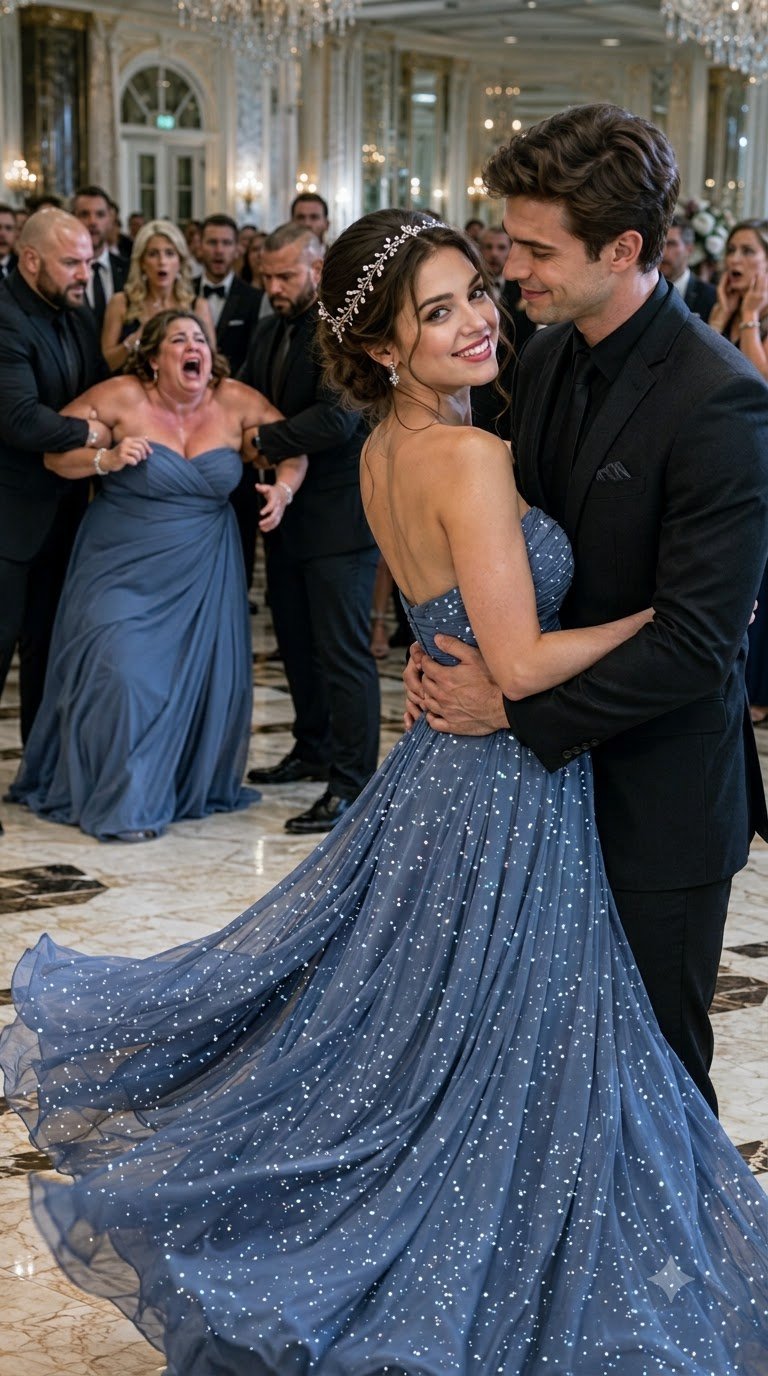
And she was wearing my mother’s dress.
It was a staggering, grotesque distortion. The fabric was too shiny, the cut a little stiff, the handmade flowers replaced by cheap, mass-produced lace appliqués. But from ten feet away, it was an undeniable, aggressive copy of the dress I was currently wearing.
A collective gasp rippled through the student body as they looked from her, up on the stage, down to me in the front row.
“Is she wearing the same dress?”
“Isn’t that her stepmom?”
“Oh my god, what is happening?”
Shirley leaned into the microphone. She thrived on the spectacle.
“Thank you, everyone,” her voice echoed, dripping with synthetic, sickening sweetness. “Tonight is about stepping into the future. But for our family, it is also about healing from a tragic past. As many of you know, we suffered a terrible loss last year with the passing of my dearest friend, Kathy.”
I felt my blood turn to ice. She was weaponizing my mother’s death in front of the entire school.
“To honor Kathy, I had this beautiful dress designed,” Shirley proclaimed, touching the fake flowers on her collar. “It is a symbol that we can rebuild. That a mother’s love—even a stepmother’s love—endures.”
The sheer audacity paralyzed me. She was claiming ownership of the design, painting herself as the benevolent savior of our broken family. But the horror was only just beginning.
She turned to my father, who was staring at the floor. She nudged him sharply.
My father stepped forward, holding a manila folder. His hands were shaking.
“We… we wanted to make a special announcement tonight,” my father stammered into the mic, not daring to look at me. “Because family is so important. Shirley has been the rock of this family. And today… today a judge finalized the paperwork.”
Shirley took the folder from him, pulling out a legal document with a flourish.
“As of this afternoon, I am officially and legally Delilah’s mother,” Shirley announced, her voice rising in triumph. “I have adopted her. And as her legal guardian, I am so proud to announce that I will be overseeing her college trust fund to ensure she has the brightest future possible.”
The gymnasium went dead silent.
It wasn’t just a dress. It was a coup d’état. She hadn’t just forced my father to erase my mother from the house; she had manipulated him into legally erasing her from my paperwork, giving Shirley total, unchecked access to the substantial trust fund my mother had set up for me before she died.
She scanned the crowd and locked eyes with me. Her smile sharpened into a blade. She had cornered me in front of five hundred people.
“Delilah, sweetheart,” she cooed into the microphone. “I see you found a dress that looks just like mine! Why don’t you come up here and give your new mother a hug?”
It was a checkmate move. If I ran away crying, I was the unstable, ungrateful teenager resisting love, and she kept the money. If I screamed, I was a hysterical child.
Gary squeezed my hand. His eyes were dark with fury.
I took a breath that felt like inhaling shattered glass. I didn’t run. I let go of Gary’s hand, picked up the hem of my mother’s true legacy, and began the long walk up the stairs.
I stopped three feet away from Shirley. Close up, the chemical smell of her cheap perfume was overpowering.
“What a lovely sentiment, Shirley,” I said. I didn’t use the microphone, but the acoustics of the silent room carried my voice.
Her eyes twitched, the first sign of a crack in her porcelain mask. “Smile for the cameras, Delilah,” she hissed through her teeth, opening her arms for a hug. “Accept it. I won.”
“But there’s one problem with your story about designing this beautiful tribute,” I continued, loudly, stepping back to avoid her grasp. I turned slightly so the crowd could see my profile.
Before Shirley could react, Mrs. Chen, our senior adviser and another old friend of my mother’s, stepped out from the wings. She walked directly to the AV control board.
“Actually, Shirley,” Mrs. Chen’s voice boomed over the speakers, cold and authoritative. “We have a slight correction to the evening’s program.”
The massive projector screen behind us, which had been displaying a loop of senior photos, suddenly flickered.
Shirley’s smile vanished. “What is this? Thomas, what is going on?”
The screen illuminated. It wasn’t a photo. It was the security video from Mrs. Howard’s Alterations.
The high-definition footage was damning. There was Shirley, towering over Mrs. Howard, slamming her manicured hand on the cutting table.
A murmur of confusion, rapidly turning into shock, swept through the gym.
“Turn that off!” Shirley shrieked, dropping her adoption papers. She lunged toward the AV booth, but the principal stepped in her path, his face a mask of bewildered horror.
Mrs. Chen flipped a switch, and the audio from the security tape was fed directly into the gym’s massive sound system.
The tinny, recorded voice of my stepmother filled the room.
“I don’t care how you do it, just make a replica that fits me. And tell the brat her original is rotting. If she insists on wearing it, well… I’ve already taken care of the lining. Let’s just say she won’t be dancing for long once the chemical burn sets in.”
The words bounced off the gymnasium walls. The shock from the crowd turned into audible gasps. Students were recording on their phones. The parent volunteers on stage backed away from Shirley as if she were radioactive.
Shirley’s face contorted into a mask of pure, unadulterated panic. “It’s a deepfake!” she screamed, her voice cracking. “Delilah put her up to this!”
She turned to the crowd, pointing a shaking finger at me. “Look at her dress! It’s a cheap knockoff! She copied me!”
I didn’t yell. I reached down to the hem of my skirt. With agonizing slowness, in front of five hundred people, I pulled the dusty pink silk taut, exposing the thick inner seam.
Mrs. Chen signaled the AV booth. A camera operator from the school’s broadcast club, prepped by Gary, rushed to the front of the stage, zooming his lens directly onto my hands.
The massive screen behind us shifted to a live, magnified feed of the fabric.
“My mother, Kathy, sewed this dress for me as she was dying,” I said, my voice steady, amplified by the mic Mrs. Chen handed me. “And she left a message for you, Shirley.”
On the screen, the microscopic blue thread became visible. It wasn’t just a letter. It was a perfectly embroidered sentence.
I read it aloud, my voice ringing with absolute authority.
“For Shirley: You can have my cowardly husband. But you will never take my daughter, and you will never take my legacy.”
Shirley looked at the screen, then down at her mass-produced hem. She was trapped in the glare of the spotlight, stripped of all her lies.
“Thomas!” she wailed, a desperate, animalistic cry. She reached out toward my father. “Do something! They are ruining me!”
My father was frozen. He looked at the screen, at the irrefutable proof of his late wife’s genius and his new wife’s depravity.
Before he could speak, the heavy metal doors at the back of the gymnasium burst open.
The flashing red and blue lights of two police cruisers spilled into the darkened room, painting the shocked faces of the student body in harsh, strobing colors.
Four uniformed officers marched down the center aisle, led by a grim-faced Mrs. Howard, who was clutching a thick red-wax-sealed envelope.
The music was completely dead. The only sound in the gymnasium was the heavy thud of the officers’ boots against the polished hardwood floor.
Shirley scrambled backward, tripping over the microphone cord. Her cheap pink dress caught on the edge of a speaker, tearing a jagged hole near the knee.
“Shirley Bennett?” the lead officer asked, stepping onto the stage.
“This is a misunderstanding!” she gasped, her hands trembling violently. “I am a respected member of this community! I just adopted this girl!”
“We have a sworn affidavit, security footage of attempted assault with a chemical agent, and substantial evidence of financial fraud regarding a minor’s trust fund,” the officer stated, his voice devoid of emotion. He unclipped a pair of handcuffs from his belt. “Turn around, please.”
“Thomas!” she screamed, dropping to her knees. “Tell them! Tell them it’s a lie!”
Every eye in the room shifted to my father. He looked like a man who had just woken up from a years-long coma to find his house on fire. He looked at the handcuffs, then at Mrs. Howard, who stood at the base of the stage holding the envelope of his sins.
Finally, he looked at me.
“Delilah…” he whispered, taking a step toward me. His eyes were pleading. He wanted me to save him. He wanted me to tell everyone that this was just a family dispute gone too far.
I looked at the man who had let another woman try to burn my skin and steal my future, all because he was too weak to be alone.
“You chose her,” I said, my voice barely above a whisper, yet it felt like a gunshot. “Now, you get to live with her.”
I turned my back on him.
The officers hauled Shirley to her feet. She fought them, screaming obscenities, the facade completely shattering. Her mass-produced pink dress tore further at the seams as they frog-marched her down the stairs and out the center aisle of the gymnasium.
My father stood alone on the stage, the adoption papers scattered at his feet like dead leaves. He looked around at the hundreds of students and parents staring at him with unvarnished disgust. Without another word, he shrank into himself and hurried out the side exit, fleeing the humiliation he had built with his own two hands.
Mrs. Howard walked up the stairs and handed me the heavy envelope. The red wax seal was still intact.
“Your mother wanted you to open this when the air was clear,” she said gently, her eyes shining with unshed tears. “You did beautifully, Delilah. She would be so proud.”
I took the envelope. It felt heavy with truth.
Gary walked up onto the stage and wrapped his arms around me. I leaned into his chest, the adrenaline finally leaving my system, replaced by a profound, overwhelming sense of victory.
Later that night, sitting on the floor of Gary’s living room, I broke the red seal.
Inside were the bank statements and the investigator’s reports, proving Shirley’s embezzlement and their affair. But beneath all the ugly legalities was a single piece of thick stationery.
My dearest Delilah,
If you are reading this, it means the trap was sprung. It means you stood tall in the dress I made for you, and you refused to be swallowed by the dark.
I knew about Thomas and Shirley. I knew he was too weak to protect you, and I knew she was too greedy to stop at just taking my husband. She wanted my life. But my life is you.
I am leaving the trust fund completely out of your father’s control. The documents Shirley thought she forced him to sign are worthless; I transferred everything to an irrevocable trust with Eleanor Howard as the executor until you turn eighteen.
Do not let them convince you that you are small. You are my masterpiece, my brave girl. Let them have each other. You have the whole world.
Love, Mom.
I held the letter to my chest and cried, mourning the mother I lost, but celebrating the fierce, brilliant protector she had been right up until her last breath.
The fallout was swift and merciless. Shirley was indicted on multiple charges, from fraud to reckless endangerment. My father, implicated in the financial mess and shunned by the entire town, filed for bankruptcy and moved to a neighboring state. I never spoke to him again.
I moved in with Mrs. Howard for the last month of high school. I graduated with honors, my trust fund secure, my future entirely my own.
I never wore the pink dress again. I didn’t need to. It hung in my closet, a beautiful, silent sentinel, a reminder of the night I stopped being a victim of a broken household and became the author of my own vindication. The legacy we leave behind isn’t built on the lies we tell to survive. It’s stitched into the truth of who we are, impossible to replicate, and resilient enough to withstand the most corrosive of betrayals.
If you want more stories like this, or if you’d like to share your thoughts about what you would have done in my situation, I’d love to hear from you. Your perspective helps these stories reach more people, so don’t be shy about commenting or sharing.