PART 2
On the other side of my apartment door stood a man I had only seen in photographs.
Marcus Vale.
Camila Whitmore’s personal bodyguard.
He was built like a wall, dressed in a black coat despite the mild spring night, his shaved head gleaming under the hallway light. In the society magazine photos, he always stood two steps behind Camila, expressionless, one hand near his jacket, like her shadow had learned how to breathe.
Now he was outside my door at 3:07 in the morning.
And he was smiling.
“Elena?” he called softly.
My hand clamped over my mouth.
Behind me, Sophie whimpered from her bedroom.
Marcus tilted his head, as if he could hear the tiny sound through the door.
“Elena Rivera,” he said. “Open up. We need to talk.”
I stepped back, my bare heel pressing against the cold floorboards.
The USB drive burned inside my robe pocket.
He knocked again, slower this time.
Bang.
Bang.
Bang.
“Mrs. Whitmore would like her property returned.”
Her property.
The doll.
My stomach dropped so hard I thought I might be sick.
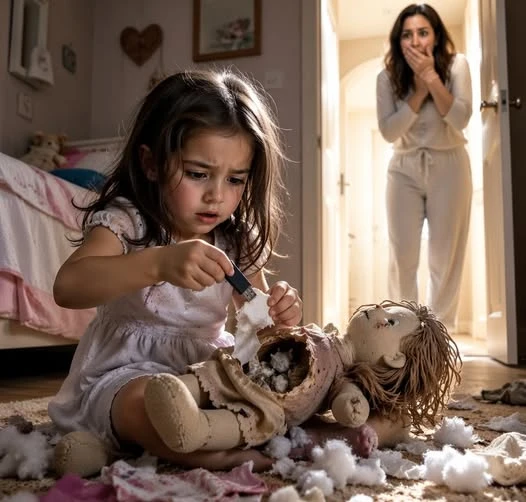
I turned and saw the rag doll lying on the kitchen table where I had dropped it, its stomach seam torn open, yellow stuffing hanging out like old flesh.
I moved fast.
I grabbed it, stuffed it into the cabinet under the sink, then hurried to Sophie’s bedroom. She was sitting up in bed, cheeks wet, her little hands gripping her blanket.
“Mommy,” she whispered, “is it the bad woman?”
I pressed a finger to my lips and scooped her into my arms.
The pounding stopped.
For one second, the apartment went completely silent.
Then my phone buzzed on the nightstand.
A message from an unknown number appeared on the screen.
I know you watched it.
The room seemed to tilt.
Another message came in.
Open the door, Elena. Don’t make this ugly in front of your daughter.
I stared at the phone, ice moving through my veins.
Then I did the only thing my body knew how to do.
I ran.
My apartment had one mercy: a fire escape outside the bedroom window. I had always hated it because the old metal bars made the room look like a cage. That night, it became a ladder out of one.
I pulled the window up as quietly as I could. It groaned anyway.
From the hall came Marcus’s voice.
“Elena.”
Not loud.
Not angry.
Just certain.
Like he already knew there was nowhere for me to go.
I wrapped Sophie in a blanket, climbed out first, then reached back and pulled her against my chest. The iron steps were slick with mist. Three floors below, the alley looked narrow and black.
“Hold on to me,” I whispered.
Sophie buried her face in my neck.
We climbed down as fast as I dared.
Halfway down, the window of my bedroom slid open above us.
Marcus leaned out.
For the first time, his smile disappeared.
“There you are.”
I didn’t think. I jumped the last few steps, pain shooting up my ankle as I landed. Sophie cried out, but I kept running.
The alley smelled of garbage, rainwater, and old brick. My robe snapped around my legs. I was barefoot, carrying my daughter, with a stolen USB drive in my pocket and a monster’s bodyguard behind me.
At the end of the alley, a black SUV screeched to a stop.
Its headlights blinded me.
I froze.
The driver’s door opened.
But it wasn’t Marcus.
A woman stepped out, holding both hands up.
“Elena Rivera?” she said quickly. “I’m not with them. My name is Detective Nora Graves. Alexander sent me.”
I didn’t move.
She looked about forty, with tired eyes, a gray hoodie under a leather jacket, and a scar along her chin. She was not in uniform. She looked like someone who had not slept properly in years.
Behind me, metal rattled.
Marcus was coming down the fire escape.
Detective Graves snapped, “Get in the car. Now, unless you want him taking your little girl next.”
That decided it.
I ran to the SUV.
She opened the back door, shoved us in, then got behind the wheel and peeled away from the curb so fast Sophie and I slammed against the seat.
A second later, Marcus hit the alley mouth behind us. He watched the SUV disappear into the street, his black coat moving in the wind like a torn flag.
Detective Graves did not speak until we had crossed six blocks and taken three sudden turns.
“Is she hurt?” she asked, glancing at Sophie in the rearview mirror.
“No,” I said, though my voice sounded nothing like mine. “Who are you?”
“I told you. Nora Graves.”
“That means nothing to me.”
“It shouldn’t,” she said. “I was investigating Camila before she was Camila.”
My grip tightened around Sophie.
“What does that mean?”
“It means Camila Whitmore is a costume. Lucy Hernandez is another one. She has worn a lot of names.”
I pulled Sophie closer. “Where are you taking us?”
“Somewhere cameras won’t follow.”
“I’m not going anywhere until you tell me what’s happening.”
Detective Graves laughed once, not because anything was funny.
“You’re already in the middle of it, Elena.”
The city rushed past the windows in wet streaks of red and yellow light. Queens at night had never looked so dangerous to me. Every parked car seemed occupied. Every corner seemed to be watching.
Sophie fell asleep against my chest, exhausted by fear.
I kept my hand in my pocket, fingers wrapped around the USB drive.
Detective Graves noticed.
“Good,” she said. “You still have it.”
“You knew about the drive?”
“I knew Alexander was trying to get something out. I didn’t know how.”
“He sent it in a doll.”
“Smart,” she murmured. “Or desperate.”
I looked at her reflection in the mirror.
“Why should I trust you?”
“You shouldn’t.” Her eyes flicked toward me. “Trusting people is how Alexander ended up in that basement.”
The SUV turned into an underground parking garage beneath a closed medical building in Long Island City. Graves parked in a dark corner and killed the engine.
“Stay here,” she said.
“No.”
She turned to face me. “Elena—”
“No. I am done having strangers tell me what to do. My ex-husband vanished for three years. His millionaire wife has a fake identity. A bodyguard broke into my apartment. My child is terrified. You either explain this right now, or I take my daughter and scream until someone calls every cop in New York.”
Graves stared at me.
Then she nodded, slowly.
“Fair enough.”
She got out, opened the back door, and led us through a service entrance into the basement of the medical building. Inside was a disused clinic with plastic-covered chairs, dark exam rooms, and vending machines that had not worked in years.
In one office, a single lamp glowed on a desk.
A man sat there.
At first, I did not recognize him.
He was too thin.
Too pale.
Too still.
Then he lifted his head.
And the world stopped.
“Alexander,” I whispered.
He looked worse than he had in the video. His cheeks were hollow. His beard had grown in patches. His hands trembled on the arms of the chair.
But his eyes filled with tears when he saw Sophie.
“My little star,” he said.
Sophie stirred in my arms.
For a moment, I was angry enough to turn around and leave him there. Every birthday he missed rose inside me. Every unpaid bill. Every night Sophie asked why Daddy did not call. Every time I lied and said he was busy because I did not know how to tell a child she had been abandoned.
Then Sophie opened her eyes.
She saw him.
“Daddy?”
Alexander broke.
He covered his face and made a sound I had never heard from him before, a sound like something inside his chest had finally cracked open.
Sophie wriggled out of my arms and ran to him.
I almost stopped her.
But she reached him first and wrapped her small arms around his neck.
Alexander held her like she was the last warm thing in the world.
“I’m sorry,” he whispered into her hair. “I’m so sorry. I tried to come home.”
I stood in the doorway, fists clenched.
“To us?” I said. “Or to your old life after the rich one became inconvenient?”
His eyes lifted to mine.
“Elena…”
“No.” My voice shook. “You don’t get to say my name like that. Not yet.”
Graves closed the door behind us.
Alexander looked down, shame passing over his face.
“You deserve the truth.”
“I deserve a lot more than that.”
“Yes,” he said. “You do.”
The lamp hummed softly.
Graves leaned against a filing cabinet, arms crossed.
Alexander took a breath that seemed painful.
“I didn’t leave you for Camila,” he said.
I laughed, sharp and ugly.
“Oh? Did the wedding photos lie too?”
“No. I married her. I made that choice. I was selfish, stupid, and weak. I wanted the life she offered me. I told myself Sophie would be better off with money once everything settled. I told myself I’d send support, that I’d visit, that I’d make it right.”
“But you didn’t.”
“No,” he whispered. “Because after the wedding, I realized there was no money.”
I stared at him.
“What?”
“Not the way people think. Camila wasn’t marrying me because she loved me. She needed me.”
Graves said quietly, “Alexander worked in financial compliance before he met her. He knew how to move money cleanly.”
Alexander nodded.
“The Whitmore fortune was already bleeding. Camila’s father had hidden debts, shell companies, offshore accounts, lawsuits waiting to explode. She needed someone to help cover the tracks.”
“And you did it,” I said.
“At first, yes.” He did not defend himself. “Then I found things I wasn’t supposed to find. Missing people tied to trusts. Dead relatives who were still signing documents. Charities that were fronts. Children’s medical foundations that never treated a single child.”
The room seemed to grow colder.
“I confronted her,” he said. “I threatened to go to the FBI.”
Graves looked at me. “He called me instead.”
“You’re not a detective anymore, are you?” I asked.
“No,” Graves said. “I was. Until I got too close to Lucy Hernandez seven years ago.”
“Camila.”
“Lucy,” Graves corrected. “That was her real name once. Maybe.”
Alexander’s hands were shaking harder now.
“She knew about the call. That same night, I collapsed at dinner. When I woke up, I was in a room underground.”
I saw again the video. The darkness. His sunken face. The fear.
“She drugged you,” I said.
“She drugged me, forged a psychiatric history, and told the world I was at a private wellness facility in Switzerland recovering from a breakdown.” His mouth twisted. “Everyone believed her. Why wouldn’t they? She was Camila Whitmore. I was the social-climbing husband who had become unstable.”
I swallowed.
“And the child support?”
His eyes closed.
“She froze every account I had. Everything in my name was either gone or controlled. I tried sending messages. Letters. Money. Nothing got out.”
“Except the doll.”
He nodded. “An old caretaker helped me. Mrs. Alvarez. She cleaned the lower rooms. She had a granddaughter Sophie’s age. I begged her. She smuggled the doll out through a donation box.”
Graves’s jaw tightened.
“Mrs. Alvarez was found dead two days ago,” she said.
My hand flew to my mouth.
Alexander flinched as if struck.
“They told me she had quit,” he whispered.
“No,” Graves said. “They made it look like a fall.”
For a few seconds, no one spoke.
Sophie sat on Alexander’s lap, too young to understand everything, but old enough to feel the horror in the room. She touched his cheek with one tiny hand.
“Daddy, did the bad woman hurt you?”
Alexander kissed her palm.
“Yes,” he said softly. “But you were very brave. You found the treasure.”
Sophie looked at me, proud and frightened.
I wanted to pick her up and carry her somewhere sunlight could reach us.
Instead, I turned to Graves.
“What’s on the USB?”
“Enough to scare Camila,” she said. “Not enough to stop her. Not yet.”
Alexander shook his head. “There’s a second drive.”
“Where?” I asked.
He hesitated.
Then he looked at Sophie.
A terrible understanding moved through me.
“No,” I said.
“Elena—”
“No.”
“It’s not on her,” he said quickly. “I would never put her in danger like that.”
“You already did.”
The words landed hard.
He looked away.
“The second drive is hidden in a place only Sophie would make me think of.”
I waited.
Alexander’s voice dropped.
“The carousel in Flushing Meadows. Behind the blue horse with the chipped ear. We took her there on her second birthday.”
I remembered.
Of course I remembered.
Sophie in a yellow dress. Alexander lifting her onto the painted horse. Me laughing because she kept shouting, “Faster!” even though the carousel barely moved.
That had been before everything.
Before he chose someone else’s money.
Before my daughter learned to miss a man who had vanished.
Graves stood straight.
“We need that drive tonight.”
I looked at her like she was insane.
“It’s almost four in the morning.”
“Exactly. Camila’s people are at your apartment. By sunrise, they’ll search every connection Alexander had. If they figure out the carousel, the drive is gone.”
“How would they figure it out?”
Alexander looked at me.
“Because I talked in my sleep when they drugged me.”
My blood chilled.
Graves pulled a gun from a locked drawer and checked the magazine.
I took a step back.
“I’m not taking my daughter on some midnight treasure hunt while Camila’s bodyguard hunts us.”
“You’re not,” Graves said. “Sophie stays here with Alexander.”
“No,” I said instantly.
Alexander’s face tightened with pain.
“Elena, I understand—”
“You don’t understand anything. You do not get to disappear for three years and then ask me to leave my child in a basement with you.”
His eyes reddened.
“You’re right.”
That stopped me.
He looked at Sophie, then at me.
“You’re right. I lost the right to ask. But Camila won’t stop. Not after tonight. If that second drive has what I think it has, it can end this.”
“What is on it?”
Alexander’s voice became almost inaudible.
“Proof that Camila Whitmore died twenty-two years ago.”
The lamp buzzed.
I heard water dripping somewhere deep in the old building.
“What did you say?”
Graves answered.
“The real Camila Whitmore was eight years old when she disappeared from her family’s summer estate in Maine. Officially, she was found two days later, traumatized but alive. After that, she was sent abroad for treatment. She came back years later, different. Private schools. Boarding houses. New accent. New manners. Everyone called it recovery.”
“But it wasn’t her,” Alexander said. “The girl who came back was Lucy Hernandez.”
My mind struggled to accept the shape of it.
“That’s impossible.”
“No,” Graves said. “It’s money. Enough money makes impossible things administrative.”
I thought of the driver’s license hidden in the doll.
Lucy Hernandez.
Poor rural town.
A name buried under silk and diamonds.
“Then where is the real Camila?” I asked.
Graves looked at Alexander.
He lowered his eyes.
“That’s what the second drive proves.”
A sound came from the hallway.
All three adults froze.
Not a loud sound.
Just the soft click of a door.
Graves raised her gun and motioned for silence.
Sophie clung to Alexander.
The office door had a narrow frosted window. Beyond it, the hallway was dark.
A shadow moved across the glass.
My breath locked in my lungs.
Graves stepped forward.
Then a voice drifted through the door.
“Elena?”
Not Marcus.
Not Camila.
A woman.
Thin. Trembling. Familiar in a way I could not place.
Graves’s face changed.
“Don’t open it,” Alexander whispered.
The voice came again.
“Please. I’m not with her. I followed you.”
Graves mouthed one word.
Back.
I pulled Sophie from Alexander’s lap and moved into the corner.
Graves opened the door an inch, gun ready.
A woman stumbled inside.
She was in her late sixties, with silver hair pinned messily at the back of her head, her face bruised along one cheekbone. She wore a nurse’s uniform under a raincoat.
Alexander gasped.
“Mrs. Alvarez?”
The woman’s eyes filled with tears.
“They said you were dead,” he whispered.
“They thought I was,” she replied.
Then her knees buckled.
Graves caught her before she hit the floor.
We laid her on an exam table in the next room. Her pulse fluttered under the skin of her throat. There was dried blood behind her ear, and her hands were scraped raw.
“They pushed me down the back stairs,” she whispered. “I woke in the laundry truck. God spared me for a reason.”
Alexander gripped her hand.
“I’m so sorry.”
Mrs. Alvarez shook her head weakly.
“No time. She knows about the carousel.”
Graves swore under her breath.
“How?”
“She heard him,” Mrs. Alvarez said, nodding toward Alexander. “He said ‘blue horse’ yesterday when they gave him the new pills.”
Alexander looked sick.
Mrs. Alvarez turned her eyes to me.
“You are Elena.”
“Yes.”
“You must not let that woman near your child.”
“I know.”
“No.” Her grip tightened with surprising strength. “You don’t know. She does not want the drive only.”
My stomach tightened.
“What does she want?”
Mrs. Alvarez looked at Sophie.
Then back at me.
“She wants the girl.”
The room seemed to fall away beneath me.
Alexander rose from his chair so fast he nearly collapsed.
“No.”
Mrs. Alvarez began to cry silently.
“I heard them. She said the documents were almost complete. She said the bloodline needed a clean vessel. She said the little girl was useful because no one watches poor children closely.”
I pulled Sophie behind me.
“What bloodline?” I demanded.
Graves’s face had gone pale.
“Whitmore inheritance law,” she said. “The old family trusts only pass to a biological descendant of Arthur Whitmore.”
I shook my head. “Sophie is not a Whitmore.”
Alexander did not move.
His silence hit me before his words did.
“Elena,” he said.
A roaring filled my ears.
“What did you do?”
He looked broken all over again.
“Before Camila locked me up, she made me take a genetic test. She said it was for a private medical policy. Weeks later, she told me I had Whitmore blood.”
“No.”
“My mother had an affair before she married my father. I never knew. My biological father was James Whitmore. Camila’s uncle.”
“No,” I repeated, but softer this time.
“That means Sophie…”
Graves finished for him.
“Sophie is a living Whitmore heir.”
I backed away from all of them.
My daughter clung to my robe, confused and frightened.
Alexander stepped toward me.
“I didn’t know when she was born. I swear on her life, I didn’t know.”
“Don’t swear on her life,” I snapped. “You don’t get to put anything on her life.”
Mrs. Alvarez coughed, wincing.
“Lucy cannot inherit everything herself,” she said. “Not if the truth about Camila is exposed. But if she controls the child…”
“She controls the fortune,” Graves said.
My knees nearly gave out.
Suddenly every missing child story I had ever ignored on the news came back to me. Every smiling photo on a poster. Every mother pleading into a camera.
And now my daughter’s small fingers were wrapped in mine.
Graves checked her phone.
“We move now.”
“I’m not leaving Sophie.”
“Then bring her,” Graves said. “But understand this: nowhere is safe anymore.”
Alexander tried to stand again, but his legs failed him.
“I’m coming.”
“You can barely walk,” Graves said.
“I’m coming.”
“No,” I said.
He looked at me.
I wanted to hate him cleanly. It would have been easier. But his face was gray with fear, not for himself, but for Sophie.
“I need you alive,” I said. “Not heroic.”
Something passed through his eyes.
Pain.
Gratitude.
Maybe both.
Mrs. Alvarez grabbed my wrist.
“In the doll,” she whispered.
“What?”
“There was more than the drive.”
“No, there was only—”
“The eyes,” she said. “Check the doll’s eyes.”
A cold memory flashed through me: the rag doll’s mismatched button eyes, one brown, one black.
The doll was still under my sink.
Back at my apartment.
Where Marcus Vale was waiting.
Graves heard the thought before I said it.
“We can’t go back.”
Mrs. Alvarez shook her head.
“You must. The black eye has a key inside. Small. Silver. It opens the lockbox under the carousel floor.”
Graves shut her eyes for half a second.
“Of course it does.”
“So we need the doll,” I said.
“And the carousel,” Graves said. “Before dawn.”
Sophie whispered, “Mommy, I can get Dolly.”
“No, baby.”
“But Daddy said Dolly is brave.”
I knelt in front of her and held her face between my hands.
“You are not going anywhere near that apartment.”
She looked past me at Alexander.
“Daddy?”
He swallowed hard.
“Listen to Mommy,” he said. “Always.”
The plan we made was terrible because every plan available to us was terrible.
Graves would go to the carousel and see if Camila’s people were already there. Alexander and Mrs. Alvarez would stay hidden in the clinic. I would return to my building alone, get the doll, retrieve the key, and meet Graves at Flushing Meadows.
I hated it.
Alexander hated it.
But dawn was coming.
And Camila had already turned my life into a locked room.
Graves gave me a burner phone, a small can of pepper spray, and shoes from a supply closet that were half a size too big.
Before I left, Sophie grabbed my hand.
“Don’t let the bad woman take you too,” she whispered.
I kissed her forehead.
“Never.”
Alexander watched us from the chair, his face carved with guilt.
“Elena,” he said. “I know I don’t deserve anything from you. But thank you for keeping her safe.”
I looked at him.
“For three years, I thought you forgot her.”
His eyes filled.
“I remembered her every minute.”
I wanted to say that was not enough.
But I did not.
Because the worst part was, I believed him.
The city was beginning to pale when I reached my block.
My apartment building looked ordinary from the outside. Brick. Fire escapes. A broken buzzer. A trash bag split open near the curb.
Nothing about it suggested that men with money and guns had crossed its threshold.
I entered through the basement laundry room, using the superintendent’s old trick: the side door never latched if you lifted and pushed at the same time.
Inside, the building smelled of detergent and stale heat.
I climbed the back stairs slowly, every creak sounding like a gunshot.
On the third floor, my apartment door stood open.
My heart thudded once, hard.
I slipped inside.
The living room had been destroyed.
Cushions ripped open. Drawers dumped. Sophie’s picture books scattered across the floor. Her little pink cup lay crushed under someone’s shoe print.
Rage steadied me.
They had come into my home.
Into my daughter’s home.
I moved to the kitchen, opened the cabinet under the sink, and reached into the back.
Empty.
The doll was gone.
For one second I could not breathe.
Then a floorboard creaked behind me.
I spun around.
Marcus Vale stood in the kitchen doorway, holding the rag doll by its neck.
“Looking for this?”
I raised the pepper spray.
He smiled.
“Elena. Don’t embarrass yourself.”
I sprayed him directly in the face.
Marcus roared, dropping the doll as his hands flew to his eyes. I grabbed it and ran, but he lunged blindly and caught my ankle.
I hit the floor hard. Pain exploded in my chin.
He dragged me backward.
“You stupid little—”
I kicked him in the face with my borrowed shoe. His head snapped back. I scrambled up, clutching the doll, and bolted through the hall.
He came after me, half-blind and furious.
I did not run toward the stairs.
I ran toward Mrs. Chen’s apartment.
Mrs. Chen was eighty-two, widowed, and owned a baseball bat because she believed New York had declined after 1978.
I pounded on her door.
“Mrs. Chen! Fire!”
That was the magic word.
Three doors opened at once.
Lights came on.
A dog started barking.
Mrs. Chen appeared in a purple robe, bat already in hand.
Marcus stopped at the end of the hall, eyes streaming, face twisted with hatred.
For one second we stared at each other.
Then he smiled again.
Not at me.
At someone behind me.
A woman’s voice said, “Elena, darling. You’ve caused so much trouble.”
Camila Whitmore stood at the top of the stairwell.
She looked perfect.
Even at dawn, even in a dingy Queens apartment building, she looked like she had stepped out of a luxury advertisement. Cream coat. Pearl earrings. Red lips. Hair smooth as dark glass.
Mrs. Chen muttered, “Who is this one?”
Camila’s eyes flicked to the neighbors gathering in the hall.
Her smile warmed instantly.
“I’m so sorry,” she said, voice trembling with practiced concern. “My brother-in-law’s ex-wife has been having an episode. We came to help before she hurt the child.”
I almost laughed.
It was brilliant.
Simple.
Cruel.
Everyone looked at me: barefoot robe replaced by borrowed shoes, bleeding chin, wild hair, clutching a filthy doll.
Then at Camila: calm, wealthy, elegant.
I saw the story arranging itself in their eyes.
Marcus wiped his face with a handkerchief.
“She attacked me,” he said.
Mrs. Chen looked from him to me.
Then she lifted her bat.
“Good.”
Camila’s smile faltered.
Mrs. Chen turned to the neighbors.
“You all saw this big man chase Elena. You all saw.”
A few people murmured.
Mrs. Chen pointed the bat at Camila.
“And you. Rich lady. Get out of my building.”
For the first time, I saw something real pass through Camila’s face.
Not fear.
Hatred.
Pure and cold.
She looked at me.
“You have no idea what you’re holding.”
I hugged the doll tighter.
“I know enough.”
“No,” she said softly. “You really don’t.”
Then police sirens wailed outside.
Camila’s expression changed again, folding back into innocence.
Marcus leaned toward her.
“We need to go.”
She ignored him.
Her eyes stayed on mine.
“Bring me the girl, Elena, and I will let Alexander live.”
My blood turned to ice.
“I don’t have her.”
Camila smiled.
“I know.”
My heart stopped.
She glanced at her phone.
“Not anymore.”
Then she turned and walked down the stairs.
I shoved past Marcus and ran to the window at the end of the hall.
Below, a black car pulled away from the curb.
In the back seat, through the tinted glass, I saw a small hand press against the window.
Sophie.
I screamed so loudly the neighbors fell silent.
By the time I reached the street, the car was gone.
My burner phone rang.
I answered with shaking hands.
Graves’s voice came through, breathless.
“Elena, where is Sophie?”
I could not speak.
“Elena?”
“She took her,” I whispered.
There was a pause.
Then Graves said, “Camila?”
“Yes.”
Another pause.
Shorter.
Darker.
“Elena,” Graves said, “I’m at the carousel.”
I gripped the filthy doll so hard one of its seams tore wider.
“And?”
“The blue horse is gone.”
I closed my eyes.
“What do you mean gone?”
“I mean someone cut it off its pole and removed it. But they left something behind.”
“What?”
Graves’s voice changed.
“Elena, there’s a fresh blood trail under the platform.”
My stomach clenched.
“And there’s a phone ringing inside the floor.”
I looked down at the doll in my arms.
Mrs. Alvarez’s words came back.
The black eye has a key inside.
My fingers dug into the doll’s face. I ripped at the black button eye until the thread snapped. Something tiny and metallic fell into my palm.
A silver key.
On its side, in letters so small I could barely read them, someone had engraved a name.
Not Camila.
Not Lucy.
Sophie.
The burner phone crackled.
Then another voice came on the line.
Sweet.
Calm.
Smiling.
“Hello, Elena.”
Camila.
Behind her, faintly, I heard my daughter crying.
“Mommy?”
I could not breathe.
Camila laughed softly.
“Now that you have the key, let’s talk about what your daughter is really worth.”
…If you want to know what happened next, please type “YES” and like for more.