The crisp, unmistakable scent of bleach and stale cafeteria coffee hit me the moment the sliding glass doors of St. Catherine Medical Center parted. It was a smell I had come to know better than the scent of my own home in Sacramento. For ten grueling months, this sterile purgatory had been my second residence, my son Colton’s fluctuating health the grim metronome by which I lived my life.
I paused by the directory, my reflection caught in the polished chrome of the elevator doors. The woman staring back at me looked older than her sixty-two years. My shoulders were stooped under the invisible weight of compounding interest, maxed-out credit cards, and the suffocating terror of losing my only child. I had emptied my savings account. I had sold my late husband’s vintage pickup truck. I had taken out two predatory personal loans that kept me awake, sweating, at three in the morning. I had even sold the heavy, cast-iron professional sewing machine my mother had left me—the exact machine I had used for twenty-five years to painstakingly alter wedding dresses, prom gowns, and school uniforms to keep a roof over our heads.
Every time Colton, with his pale face and apologetic eyes, told me he didn’t want to be a burden, I found another piece of my life to carve away and sell.
But today was different.
Inside the worn leather of my handbag, tucked safely behind a stack of final-notice utility bills, was a slip of paper. It was a California SuperLotto Plus ticket. And it was worth twelve million dollars.
Twelve million dollars.
The numbers were burned into my retinas. I had checked them in the dim light of my kitchen at midnight, again at three in the morning, and once more in the hospital parking garage, my hands trembling violently against the steering wheel of my twelve-year-old sedan.
I was walking to Room 412 not as a desperate, debt-ridden widow, but as a savior. I could picture the exact sequence of events: I would walk in, hold his hand, and tell him the war was over. No more choosing between his experimental medications and my groceries. He could close down his failing commercial printing business without shame. He could focus entirely on healing. I expected tears. I expected profound, soul-shaking relief.
The elevator chimed, depositing me on the fourth floor. I navigated the familiar, muted corridors, my heart hammering a frantic, joyous rhythm against my ribs.
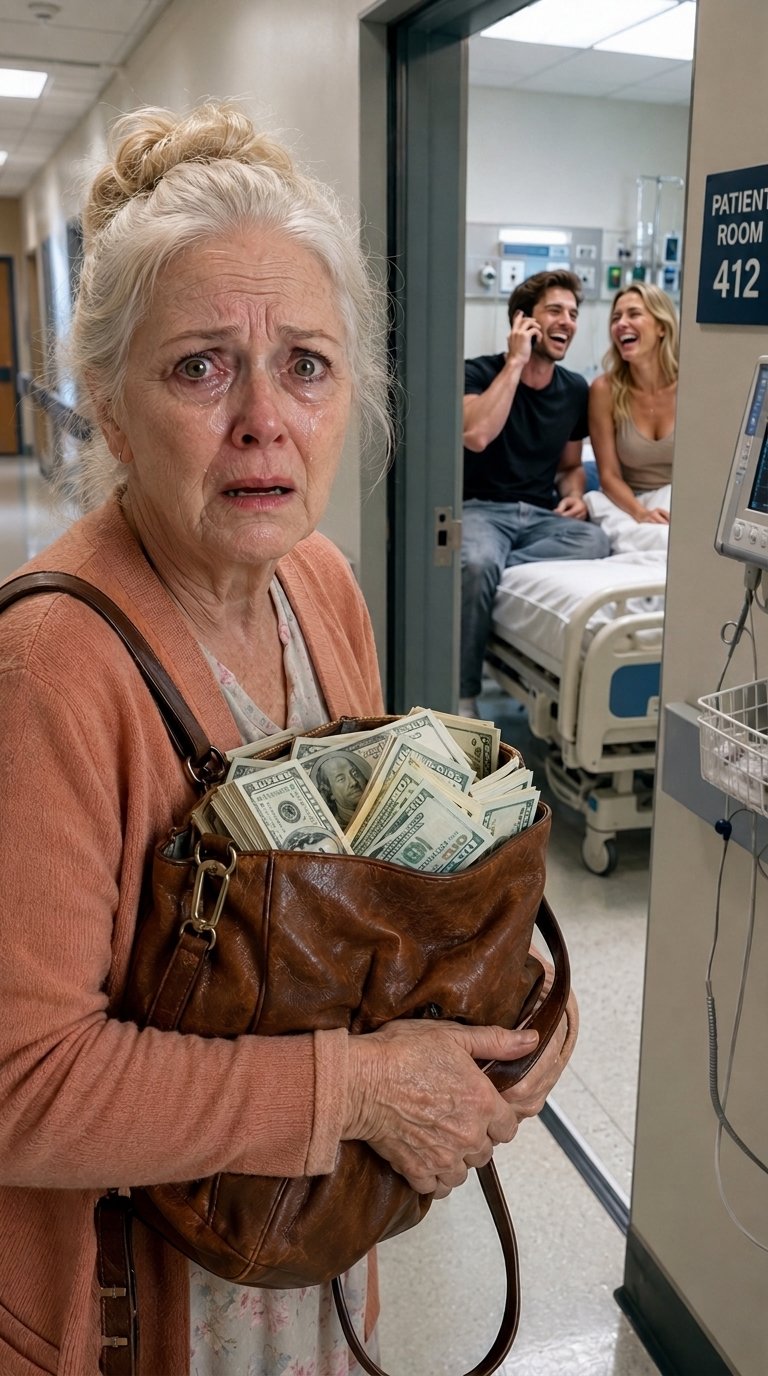
I approached Room 412, my hand reaching for the heavy wooden door. It was cracked open just an inch, a sliver of fluorescent light spilling out onto the linoleum tiles. I was about to push it wide when a voice stopped me dead in my tracks.
It wasn’t the weak, exhausted rasp Colton usually reserved for my visits. It was a sharp, masculine chuckle.
“You’re telling me she actually sold the antique sewing machine?” a deep, unfamiliar voice asked. “The one she never shut up about?”
“Got three grand for it,” Colton replied. His voice was vibrant, laced with a cruel amusement I had never heard before. “I told her the insurance denied the latest MRI scan, and she had it listed on Craigslist within the hour. My mother lives to rescue me, Marcus. It’s her entire identity. I feed her a little panic, and she bleeds cash.”
I froze. My hand hovered inches from the door handle. The air in my lungs turned to ice.
“Well, you need to accelerate the timeline, man,” the man named Marcus said. I peered through the narrow crack. Marcus was a man in a sharp, cheap suit, leaning against the window sill, examining his cuticles. “The printing business is drowning. The creditors are circling. We need that house in Arden-Arcade liquidated.”
“I’m working on it,” Colton sighed, stretching his arms over his head in the hospital bed, looking healthier than he had in a year. “But if I push too hard, she might ask questions. We need her to sign the Power of Attorney first.”
“Just tell her the doctors found another problem,” Marcus sneered. “Tell her you might not make it through the year. Stress the old bat out. The more frantic she is, the closer she gets to a stroke, or at least a diagnosis of cognitive decline. Once she’s declared incompetent, or once she just drops dead from the stress, you get the house, the life insurance, everything. We flip the property, clear the business debts, and you’re golden.”
“Just be ready with the paperwork,” my son said, his tone casual, as if discussing the weather. “Give it a few more months. I’ll break her down. She’s already hanging by a thread.”
My vision blurred. A cold, heavy dread coiled in my gut, pulling me down into a dark abyss. I stumbled back from the door, my hand flying to my mouth to stifle the sob clawing at my throat. My own son. My flesh and blood. He wasn’t just manipulating my love for money. He was actively hoping for my demise. He was waiting for my mind to shatter or my heart to give out so he could harvest the remains of my life.
I didn’t burst in. I didn’t scream. A sudden, terrifying clarity washed over me, colder than the hospital air conditioning. I turned on my heel and walked silently away, my footsteps swallowed by the long, sterile corridor, the twelve-million-dollar ticket burning like a coal in my purse.
My son wanted to play a game with my life. He had no idea the rules had just changed.
I drove home in a state of clinical detachment. The Sacramento heat shimmered in waves off the asphalt, but inside my car, I was freezing. The woman who had driven to the hospital an hour ago was dead, killed by a few sentences spoken in Room 412.
I pulled into the driveway of my small, single-story home in Arden-Arcade. The paint was peeling around the window frames, and the lawn was scorched yellow from neglect. This was the house Colton wanted to liquidate. This was the roof over my head he was willing to sell out from under me.
I unlocked the front door and walked straight to the kitchen table. It was scarred from years of my sewing pins and scissors, but recently, it had served a darker purpose. It was the command center where I sorted medical bills, final notices, and overdraft warnings.
I pulled the lottery ticket from my bag and set it flat on the table. It was just a piece of thermal paper, but it was a weapon.
I pulled out a yellow legal pad and a pen. My hand, which had trembled with joy earlier, was now steady, guided by a cold, righteous fury. I wrote three questions in sharp, jagged letters:
How long has he been faking?
How much has he stolen?
Who is Marcus?
Before I could underline the final question, my cell phone vibrated violently against the wood. The screen illuminated, displaying a text message from an unknown number.
I stared at it for a long moment before tapping the screen.
Mrs. Hayes, please do not tell Colton about the lottery ticket. He already knows you bought one from the corner store, and he is watching your reactions. There are financial documents carrying your name that you never approved. He is trying to frame me, and he is coming for everything you own. We need to talk. – Paige Holloway.
The name sparked a vague memory. Paige Holloway. Colton had mentioned her a few times—his mousy, quiet bookkeeper at the printing company.
I typed back a single, definitive sentence: Where and when?
We agreed to meet the following morning at a small, independent coffee shop near McKinley Park, a place far from the hospital and far from Colton’s usual haunts.
I didn’t sleep that night. I sat at the kitchen table, staring at the ticket, tracing the numbers over and over. I thought of the nights I had slept in uncomfortable vinyl hospital chairs, listening to his breathing, praying to a God I wasn’t sure was listening to spare my boy. I thought of the meals I had skipped so I could afford his parking garage fees. I mourned the son I thought I had, and I began to strategize against the monster who had taken his place.
Dawn broke, painting the sky in bruises of purple and orange. I showered, dressed in my sharpest, most professional blouse—one I had tailored myself—and drove to McKinley Park.
The café was quiet, smelling of roasted beans and damp earth from the nearby park. I spotted Paige immediately. She was sitting in a dark corner booth, nursing a mug with both hands. She looked terrified. Dark circles bruised the skin under her eyes, and she was compulsively looking over her shoulder every time the café door chimed.
I slid into the booth across from her. I didn’t offer a polite greeting.
“Tell me everything,” I commanded.
Paige jumped, her eyes darting to my face. She reached into an oversized canvas tote bag and pulled out a thick navy-blue folder and a silver flash drive. She pushed them across the table toward me, her hands shaking so badly the folder tapped against the wood.
“I handled the bookkeeping for Colton’s printing company,” she began, her voice a breathless whisper. “I swear to you, Mrs. Hayes, at first, I didn’t know. I thought you were just a very generous mother keeping his dream afloat. He told me you were an angel. But then… the numbers stopped making sense.”
I opened the navy folder. Inside were stacks of credit agreements, high-interest equipment leases for commercial printers that didn’t exist, and short-term business loans.
I scanned the bottom of the first page. There, on the guarantor line, was my name. Loretta Hayes.
“I didn’t sign this,” I said, my voice dangerously quiet.
“I know,” Paige swallowed hard. “He photographed your driver’s license, your utility bills, your old tax returns when you weren’t looking. He practiced your signature for weeks. The curves are just slightly wrong, but to a predatory lender, it looks perfect. Whenever a bank got suspicious about the company’s revenue, he played the sick card. He told them his wealthy mother was covering everything because she would never let her dying son fail.”
I flipped through the pages, doing the mental math. It was staggering.
“How much?” I asked.
“Ninety thousand dollars,” Paige whispered, a tear slipping down her cheek. “And climbing. But that’s not why I contacted you.”
I looked up, meeting her terrified gaze. “Why did you?”
“Because he knows the company is going under. The lenders are demanding audits. And he’s planning to throw me to the wolves,” she said, her voice cracking. “I found emails between him and that lawyer friend of his, Marcus. They’re manufacturing evidence to make it look like I was the one embezzling the funds and forging your name. If the police get involved, I go to prison, and he plays the victim of a rogue employee.”
She leaned in closer, the scent of fear radiating off her. “But it gets worse, Mrs. Hayes. Word got around the neighborhood that the winning ticket was sold at your corner store. The clerk remembered you always play those numbers. Colton got wind of it yesterday. He isn’t waiting anymore. He’s filed emergency paperwork to have you declared financially and medically incompetent. He’s going to strike before you can even claim the prize.”
I closed the folder, the heavy thud sounding like a gavel in the quiet café. My own son had built a guillotine, and he was positioning my neck squarely on the block.
“I need you to testify,” I said. “I need you to give me everything on that flash drive.”
“I will,” Paige said frantically. “But Mrs. Hayes… you need to look at the last section of the folder. The medical bills.”
I frowned, flipping to the back. It was a stack of pharmacy logs, blood test results, and discharge summaries that I had paid for but never truly understood.
“What am I looking at, Paige?”
She took a deep, shuddering breath. “I cross-referenced his pharmacy receipts with his actual bloodwork from the hospital portal. The doctors couldn’t figure out why his kidneys kept failing, why his blood pressure would randomly crash.”
Paige pointed a trembling finger at a specific line of lab results.
“He isn’t failing to get better, Mrs. Hayes,” she whispered, the horrifying truth hanging in the air between us. “He’s not taking his medication. And when he needs a crisis to get you to sign over more money… he’s taking things he shouldn’t. He is actively poisoning himself to stay sick.”
The revelation hit me with the force of a physical blow. The air in the café vanished. My vision tunneled until all I could see was the line of medical jargon on the paper.
He is poisoning himself.
The countless nights I had cried by his bedside, watching him writhe in agony. The times the monitors had screamed, bringing nurses rushing in while I prayed for a miracle. It was all a performance. A grotesque, self-inflicted torture designed to manipulate the deepest, most primal instinct a mother possesses: the need to protect her child. He was willing to destroy his own body if it meant he could control my wallet.
“Are you absolutely sure?” I asked, my voice devoid of any emotion. I had moved past grief. I was entering a state of absolute, chilling resolve.
“I’m sure,” Paige said, wiping her eyes. “He left a burner phone at the office. I hacked the passcode. He’s been ordering heavy metal supplements online and taking them just before his blood tests to throw off his liver and kidney enzymes. It’s calculated. It’s evil.”
I slipped the folder and the flash drive into my handbag, right next to the lottery ticket. They were no longer just documents; they were ammunition.
“Thank you, Paige,” I said, standing up. “You just saved your own life. Do not contact him. Do not go back to the office. Lay low. When the time comes, my lawyer will contact you.”
I left her trembling in the booth and walked out into the glaring sunlight. I had one stop to make before I went back to the hospital.
By noon, I was sitting in the sleek, glass-paneled office of Helena Cross. Helena was a shark in a tailored Chanel suit, a high-powered attorney who specialized in elder law, financial exploitation, and brutal family property disputes. I had found her name in an article about a landmark case where she tore apart a family trying to swindle their matriarch.
I didn’t waste time on pleasantries. I dropped the navy folder on her mahogany desk, placed the flash drive on top of it, and finally, gently laid down the twelve-million-dollar lottery ticket.
Helena’s eyebrows arched a fraction of an inch as she looked from the ticket to my face. “Mrs. Hayes. That is quite an opening statement. How can I help you?”
For the next two hours, I outlined the entire, sickening saga. I told her about the forged loans, the impending frame-job on Paige, the overheard conversation with the slimy lawyer Marcus, and the horrifying realization of Colton’s medical self-sabotage.
Helena listened in absolute silence, her sharp eyes scanning the forged documents and the medical logs. When I finished, she steepled her fingers, her expression dangerous.
“Your son is not just a fraud, Loretta. He is a sociopath,” Helena said flatly. “And he has vastly underestimated his mother.”
“I want to protect the prize money,” I said, my voice steady. “But more than that, I want to stop him. If I just cut him off, he’ll find another victim, or he might actually kill himself trying to fake another crisis. He needs medical care—psychiatric care—but he can never be allowed to touch a single cent of my money again. And he needs to take responsibility for the ninety thousand dollars he stole.”
Helena smiled, a predatory, brilliant expression. “We can do all of that. Before you claim the prize, we will establish a blind trust to protect your identity and your assets. But regarding your son… we have a timeline issue.”
She tapped Marcus’s name on a printed email from the flash drive. “If he and this bottom-feeding lawyer have already filed for emergency medical conservatorship, they are moving fast. They want to corner you while they think you’re vulnerable and exhausted. They want a judge to declare you incompetent based on ‘severe distress’.”
“So what do we do?” I asked.
“We give them exactly what they want,” Helena said, her eyes gleaming. “We set a trap. And you, Loretta, are going to be the bait.”
Helena laid out the plan. It was audacious, incredibly risky, and required a performance of a lifetime. I had to go back into that hospital room and give Colton the very thing he was waiting for: a mother on the brink of total collapse.
“He needs to think he’s won,” Helena instructed, leaning across the desk. “He needs to think you are so confused, so broken by his ‘failing health,’ that you will sign anything he puts in front of you. He will try to bypass the court system by getting you to sign a durable Power of Attorney right there in the hospital bed. When he brings that paper into the room, we snap the trap shut.”
I nodded slowly, the gravity of the plan settling over me. I was going to look into the eyes of the boy I raised and play him exactly the way he had played me.
“Are you ready for this, Loretta?” Helena asked softly. “Once we do this, there is no going back. The relationship, whatever is left of it, will be ashes.”
I looked at the lottery ticket, then at the forged signatures. I thought of the sewing machine.
“Burn it to the ground,” I said.
The performance began the next morning.
I arrived at St. Catherine’s wearing a wrinkled sweater, my hair purposefully unkempt. I hadn’t worn makeup, allowing the dark circles under my eyes to show their full depth. I shuffled my feet as I walked down the fourth-floor corridor, dragging my purse as if it weighed a hundred pounds.
I pushed open the door to Room 412. Colton was sitting up, watching television. He quickly arranged his face into a mask of brave suffering as I entered.
“Mom?” he rasped, reaching out a pale hand. “You look exhausted. You shouldn’t have come.”
“Oh, sweetie,” I murmured, letting a tremor enter my voice. I sat heavily in the visitor’s chair, intentionally knocking my purse onto the floor. My keys and a few loose coins scattered across the linoleum. I stared at them blankly for a long moment before slowly leaning down to pick them up, my hands shaking.
“Mom? Are you okay?” Colton asked, his tone laced with a sudden, sharp interest.
“I’m… I’m just so tired, Colly,” I used his childhood nickname, rubbing my temples. “I couldn’t remember where I parked the car today. I walked around Level 3 for twenty minutes. And the bank… someone from the bank called, but the numbers didn’t make sense. I couldn’t understand what they were saying about the house.”
I saw a flash of predatory triumph in his eyes before he masked it with deep concern.
“The bank? What did they say, Mom? Are they foreclosing?” he asked, pushing.
“I don’t know,” I whimpered, letting a single tear fall. It wasn’t entirely fake; I was mourning the death of my love for him. “My head is just so foggy. I can’t keep track of the bills anymore. I tried to do the math this morning, but the numbers just swim on the page. If something happens to me, Colton… I don’t know what will happen to you.”
“Hey, hey, look at me,” Colton said softly, playing the comforting son to perfection. “You don’t need to worry about the bills. You just need to rest. Maybe you shouldn’t be making financial decisions right now. The stress is literally killing you, Mom.”
“But who will handle it?” I asked, staring at him with wide, vacant eyes. “I’m so lost.”
“I can,” Colton said smoothly. “Even from in here, I can make some calls. I have a friend, Marcus. He’s a lawyer. He can draft up some temporary paperwork, just a basic Power of Attorney, so I can handle the bank for you. Just until you feel better.”
I hesitated, portraying perfect, fragile uncertainty. “A lawyer? That sounds expensive, sweetie. And… complicated. I don’t want to sign my life away.”
“You’re not, Mom,” he soothed, his voice dripping with venomous honey. “It’s just to protect the house. To protect us. I’ll have Marcus bring the papers by today. You just sign them, and you won’t have to worry about a single bill ever again.”
“Okay,” I whispered, slumping back in the chair, closing my eyes. “Okay, Colly. Whatever you think is best. My mind just isn’t working right.”
I listened, my eyes closed, as he scrambled for his phone. I heard the faint tapping of keys as he fired off a text message. He was eager. He was greedy. And he was walking right into the snare.
I stayed for another hour, acting confused, repeating stories from his childhood, and “forgetting” the names of his nurses. By the time I stood up to leave, Colton looked positively giddy.
“Marcus will be here at 3:00 PM, Mom,” he said. “Can you come back then?”
“I’ll be here,” I promised, shuffling toward the door.
I walked out of the hospital, the facade dropping the moment the automatic doors closed behind me. I pulled out my phone and dialed Helena’s number.
“He took the bait,” I said, my voice hard and clear. “3:00 PM. Room 412.”
“Excellent,” Helena replied, the sound of a briefcase snapping shut echoing through the line. “I have the finalized Medical Trust documents. I’m bringing security, and I’m bringing Paige. See you at 2:55, Loretta.”
I sat in my car in the parking garage, the heat oppressive, waiting for the clock to tick down. At 2:45 PM, I saw a black Mercedes pull into the visitor lot. A man in a cheap suit carrying a leather briefcase got out. Marcus.
The players were taking their positions. The final act was about to begin.
I walked into Room 412 at precisely 3:00 PM.
Colton was sitting upright, the illusion of the dying man momentarily forgotten. Marcus, the sleazy lawyer I had spied on, was standing at the foot of the bed, arranging thick stacks of legal documents on the overbed table.
“Mom, you made it,” Colton said, his smile tight. He gestured to Marcus. “This is my friend, Marcus. He drew up the papers we talked about. To help you with the bank.”
“Hello, Mrs. Hayes,” Marcus said, his voice slick with false sympathy. He didn’t look me in the eye. “Colton has told me how overwhelmed you’ve been feeling. Cognitive fatigue is very common under this kind of stress. We’re just going to make this very easy for you. Just a few signatures, and Colton will assume full fiduciary control of your estate, the house, and your bank accounts.”
He slid the stack of papers toward me and offered me a heavy, gold-plated pen.
“Just sign on the sticky notes, Mom,” Colton urged softly. “Then you can go home and sleep.”
I walked over to the bed. I looked down at the documents. It was a comprehensive Durable Power of Attorney. If I signed this, I would legally become a ghost, and Colton would own every asset I possessed, including the twelve million dollars waiting to be claimed.
I picked up the gold pen. It felt heavy in my hand.
I looked at Colton. His eyes were locked onto the tip of the pen, his pupils dilated with greed. He wasn’t looking at his mother; he was looking at his payday.
I pressed the tip of the pen to the first line.
Then, I stopped.
I straightened my spine. The stoop in my shoulders vanished. I dropped the gold pen onto the floor; it hit the linoleum with a sharp clatter.
“Actually, Colton,” I said, my voice ringing out clear, sharp, and entirely devoid of confusion. “I don’t think I’ll be signing anything of yours today.”
Colton frowned, his brow furrowing. “Mom? What are you doing? You said your head was foggy. Just sign the—”
“My mind is perfectly clear,” I cut him off, my gaze locking onto his and pinning him to the mattress. “Clearer than it has been in ten months.”
Before Marcus or Colton could react to the sudden shift in my demeanor, the door to Room 412 swung wide open.
Helena Cross marched in, flanked by two large, imposing private security contractors in dark suits. And right behind them, trembling but standing tall, was Paige Holloway.
Colton’s face drained of all color. He looked from Paige to the security guards, his jaw dropping. “Paige? What the hell are you doing here?”
Marcus took a step back, clutching his briefcase against his chest like a shield. “Who are you people? This is a private medical room!”
“I am Helena Cross, legal counsel for Mrs. Loretta Hayes,” Helena announced, her voice echoing with absolute authority. She stepped forward and slammed the thick navy folder onto the overbed table, right on top of Marcus’s fraudulent Power of Attorney documents.
“And this,” Helena continued, tapping the folder, “is ninety thousand dollars’ worth of forged loan documents, fraudulent equipment leases, and evidence of wire fraud, all bearing my client’s forged signature. Signatures, I might add, that Ms. Holloway is fully prepared to testify were executed by you, Colton.”
Colton scrambled backward against the headboard, his eyes darting frantically around the room. The mask of the sick, loving son was gone, replaced by the cornered panic of a rat in a trap.
“Mom… Mom, she’s lying!” Colton stammered, pointing a shaking finger at Paige. “She’s the bookkeeper! She embezzled the money! I was trying to protect you!”
“Stop it, Colton,” I said. My voice was quiet, but it commanded the room. “I know everything. I know about the loans. I know you were planning to frame Paige. I stood outside that door two days ago and listened to you and Marcus laugh about how I was going to lose my mind or drop dead so you could take my house.”
Marcus turned ghostly pale. He looked at Colton, then at Helena, and realized he was standing in the middle of a massive federal crime. He slowly backed toward the door.
“I… I was just retained to draft standard paperwork,” Marcus stammered, raising his hands. “I have no knowledge of any fraud.”
“Leave,” Helena barked without looking at him. “Before I have my team hold you for the authorities.”
Marcus practically ran out of the room.
It was just us now. Colton, stripped of his allies, his lies exposed under the harsh fluorescent lights.
“Mom… please,” he begged, a pathetic whine entering his voice. “I’m sick. Look at me. My kidneys—”
“Are failing because you are actively poisoning yourself,” I finished for him, the words tasting like ash in my mouth.
Colton choked on his next breath. Total silence fell over the room.
“Paige pulled the pharmacy logs, Colton,” I said, stepping closer to the bed, looking down at the stranger I had given birth to. “You’ve been taking heavy metals to skew your blood tests. You tortured yourself, and you tortured me, just to keep the money flowing. You used my love as a weapon against me.”
He had nothing left. No lies, no excuses. He looked away, his jaw tight, a sullen, hateful glare settling over his features.
“So what now?” he spat, his true nature finally bared. “You’re going to send your own dying son to prison? You’re going to let me rot in here?”
“No,” I said calmly.
Helena pulled a single, crisp document from her briefcase and laid it on the table.
“This is a legally binding Irrevocable Medical Trust,” I explained. “I have funded it with exactly enough money to cover your legitimate hospital bills, your doctors, and a mandatory psychiatric evaluation. The hospital will be paid directly. The pharmacy will be paid directly.”
I leaned in, my face inches from his, forcing him to look at me.
“But you will never see a single penny of cash,” I whispered, the finality of the statement echoing between us. “You will not get my house. You will not get another loan in my name. You are entirely on your own for the ninety thousand dollars you owe those creditors. And if you ever try to contact me, or Paige, for money again, Helena will hand that blue folder over to the District Attorney, and you will go to federal prison.”
Colton stared at me, his chest heaving. The realization was crashing over him like a tidal wave. He had overplayed his hand. He had tried to steal everything, and in doing so, he had lost his only lifeline.
“You can’t do this to me,” he hissed, tears of genuine rage finally pooling in his eyes. “I have nothing! The business is gone! I’m bankrupt!”
“Then you will have to learn how to survive on your own,” I said, turning my back on him. “Because the mother who lived to rescue you died the moment she heard you laughing about her grave.”
I walked toward the door.
“Mom!” he screamed, his voice raw and desperate. “Mom, you can’t just walk away! Mom!”
I didn’t turn back. I walked out of Room 412, the heavy wooden door swinging shut behind me, severing the cord between us forever.
Six months have passed since that day in the hospital.
True to my word, I never spoke to Colton again. Helena manages the Medical Trust. She informs me, via brief monthly emails, that his health stabilized rapidly once he stopped poisoning himself. He was discharged to a psychiatric facility and later released. Without my credit to prop him up, his printing business collapsed spectacularly. He filed for bankruptcy and is currently working off his debts, terrified of the blue folder Helena holds like a sword over his head.
Paige Holloway found a new job at a reputable accounting firm. I anonymously paid off her remaining student loans as a silent thank you for her bravery.
And me?
Three weeks after the confrontation, accompanied by Helena and a team of wealth managers, I walked into the California Lottery headquarters and claimed the twelve-million-dollar prize through a blind LLC.
I didn’t buy a mansion. I didn’t buy a yacht.
I stayed in Sacramento, but I bought a beautiful, secure condo in a quiet, gated community. I travel when I want to. I sleep eight hours a night without the phantom weight of debt crushing my chest.
But the first thing I bought with my winnings—the very first check I wrote—was to the antique dealer who had purchased my mother’s cast-iron sewing machine. I bought it back for triple what he paid me.
It sits in the corner of my sunlit living room now. I don’t need to alter dresses to survive anymore. But sometimes, in the quiet afternoons, I sit at the machine and run a piece of fabric through the needle. I listen to the steady, rhythmic hum of the gears. It sounds like survival. It sounds like freedom. It sounds like peace.
If you want more stories like this, or if you’d like to share your thoughts about what you would have done in my situation, I’d love to hear from you. Your perspective helps these stories reach more people, so don’t be shy about commenting or sharing.