Part One
Aunt Beatrice’s fork hit her plate hard enough that everyone at the table looked up.
“You are humiliating this family,” she said.
You are humiliating this family.
Letters covered my grandmother’s breakfast table. My mother, Pauline, sat frozen beside my father, Russell. Wes’s hand rested near mine, but he didn’t reach for it.
He was waiting to see what I would do.
Twelve hours earlier, I’d thought the worst thing my family had ever done was quietly judge the man I loved.
Then my new husband opened an old metal box and showed me their cruelty had actually started years before I’d even met him.
The first time I brought Wes home, my parents had decided who he was before dinner even reached the table.
My mother noticed the faint grease still under his fingernails. My father noticed his work boots by the door. Neither of them noticed him carrying in four bags of groceries for me while they watched, unmoving, from the kitchen window.
“So, Wes,” Mom said, pouring the wine a little too carefully. “Did you ever think about college?”
Wes glanced at me, then smiled easily. “I thought about a lot of things.”
Dad chuckled. “That usually means no.”
That usually means no.
“Dad.”
“I’m only asking.” He leaned back in his chair. “A man needs direction. A career that can actually grow.”
“Wes has a career.”
“We know he works hard, Alina,” Mom said gently. “We’re talking about long-term security.”
Wes didn’t argue with any of it. He just glanced toward the driveway instead.
“Does your car grind when you brake, sir?”
Dad blinked. “How did you know that?”
“Heard it when you pulled in. You’ll want the rotors checked before they do real damage.”
How did you know that?
Within thirty seconds, Dad was asking what a repair like that would cost. Wes answered plainly, without ever pointing out that my father had doubted his future and trusted his judgment inside the same two minutes.
That was Wes. He gave people room to hear themselves.
Aunt Beatrice arrived halfway through dinner. She spotted Wes and paused for exactly half a second before recovering her smile.
“You must be the mechanic.”
“His name is Wes,” I said.
“Of course, darling. Relax.” She studied his face a moment too long. “You look familiar.”
You look familiar.
“My mother used to do work for families around here,” Wes said simply.
Something shifted in my aunt’s expression — gone almost as fast as it arrived. She turned to me instead. “Your mother tells me the wedding’s still happening this summer.”
“It is.”
“Isn’t that a little rushed?”
“We’ve been together three years, Aunt Beatrice.”
Wes’s phone rang. He checked the screen. “Sorry — I need to take this,” and stepped into the kitchen.
The second the door swung shut, my whole family leaned toward me at once.
Mom said love didn’t pay bills. Dad said a good man could still be the wrong man for my future. Aunt Beatrice said people from different backgrounds usually ended up embarrassed by each other, sooner or later.
People from different backgrounds usually ended up embarrassed by each other.
I looked through the glass kitchen door. Wes caught my eye and gave me the smallest smile — he knew exactly what was happening at that table without having to hear a word of it.
He knew I’d spent years keeping the peace in that family, and he loved me enough not to make the evening any harder than it already was.
That was one of a hundred reasons I’d fallen for him.
On the drive home, I asked, “Have you met her before? Aunt Beatrice?”
Wes kept his eyes on the road. “No.”
“She looked like she knew you.”
“Maybe I just remind her of someone.”
Maybe I just remind her of someone.
The answer came a half-second too fast, but I let it go, the way you let a lot of small things go when you’re twenty-six and in love and tired of arguing with people who’ve already made up their minds.
A few weeks later, I stopped by his garage near closing time. He was leaning under the raised hood of an old sedan while an older woman stood beside him, twisting her keys anxiously between two fingers.
“I can’t afford a whole new engine,” she said.
“You don’t need one.”
“You said it sounded bad.”
“It does. Bad doesn’t always mean hopeless.” He separated what was urgent from what could wait a few more months, then quoted her barely enough to cover the parts.
She frowned. “I don’t want charity, son.”
“It isn’t charity, Miss Odell. You taught half this neighborhood how to read.”
You taught half this neighborhood how to read.
“That was my job.”
“And this is mine.”
After she drove off, I crossed my arms. “You’re losing money on that repair.”
“Not much.”
“That’s not really a defense.”
Wes wiped his hands on a rag. “She needs that car for her appointments, Lin. The rest doesn’t matter much to me.”
My family saw only a mechanic. I saw a man who could help someone without ever making her feel small for needing it.
As the wedding got closer, my parents pushed harder, not softer.
One afternoon, Mom took me shopping and spent twenty full minutes circling the actual reason she’d invited me.
“Marriage changes people,” she finally said, over a bolt of pale blue fabric.
“I know.”
“Love isn’t quite the same thing as building a life.”
“Wes and I are building one together, Mom.”
She set the fabric down. “You may spend years making up for what he lacks.”
You may spend years making up for what he lacks.
“What exactly does he lack?”
“Alina.”
“No. Say it.”
She lowered her voice like the fabric shop had ears. “Education. Social confidence. Ambition.”
“Wes runs a busy garage, supports himself entirely, and treats people with more respect than half the men you’ve always admired at your dinner parties.”
“That’s not what I meant.”
“It’s exactly what you meant.”
She sighed. “One day you might feel embarrassed, when he can’t keep up.”
“You keep talking about the life Wes can give me,” I said. “You’ve never once asked what kind of life we give each other.”
I left without buying anything. It was the first time in my life I’d walked away from my mother before she’d approved of me.
When Wes proposed, my father asked, straight-faced, “Are you really going to throw your future away on a man who’s spent his whole life under other people’s cars?”
“I’m marrying a man who actually knows what things are worth,” I told him. “Ask him sometime how he measures people. It isn’t by their diploma.”
Part Two
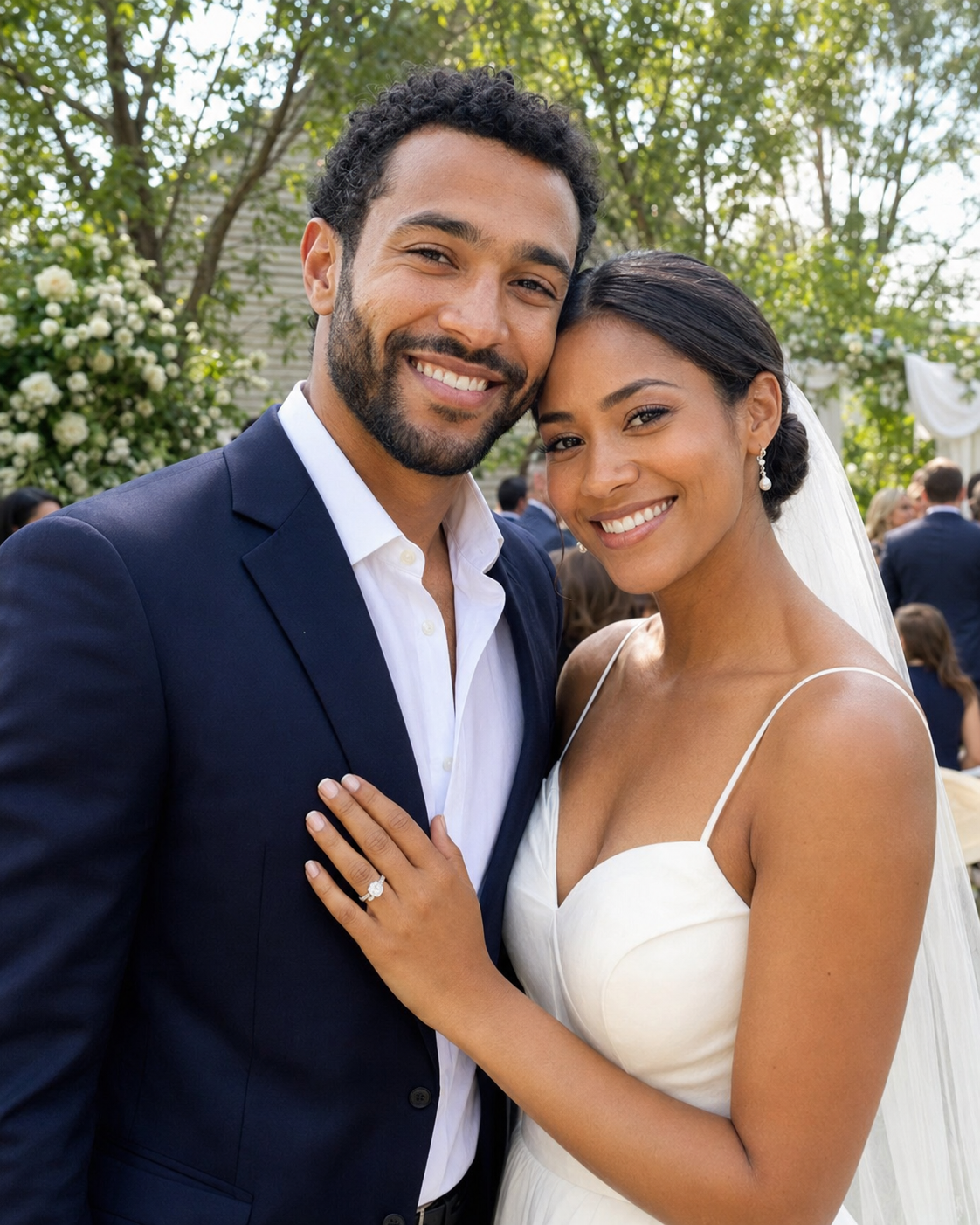
Our wedding was small and simple. Wes’s friends moved chairs before the ceremony without being asked twice. His customers brought extra food nobody had requested. Two of his mechanics argued cheerfully over which of them had actually taught him more.
My family smiled beautifully for every photograph.
My family smiled beautifully for every photograph.
Their faces changed the second the cameras looked away.
Near the cake table, Aunt Beatrice adjusted a flower that hadn’t needed touching. “You may find all this charming today,” she said.
“I do.”
“Give it five years.”
“What happens then?”
“You’ll remember exactly how you were raised.”
I looked at her. “That’s precisely what I’m afraid of.”
Before she could answer, a young server nearby dropped his tray. Glasses shattered across the floor. He froze completely.
Wes crouched instantly. “Don’t touch the small pieces,” he told him gently. “You’ll cut your hand open.”
Aunt Beatrice watched the two of them. “Some people simply aren’t trained for anything better.”
“Keep your voice down, Beatrice,” Mom murmured, glancing around.
“Why?” Beatrice said, not lowering it at all. “His mother knew how to make herself useful around a house, at least. Good the son learned an actual trade.”
His mother knew how to make herself useful around a house.
Wes went completely still.
I stepped toward her. “What did you just say?”
She lifted her chin. “I made an observation.”
“You brought up his mother.”
“She worked for people we knew, once.”
Wes rose slowly, and I saw an expression on his face I had genuinely never seen there before. It wasn’t surprise.
It was recognition.
“Wes?” I asked.
He looked at me. “Not here.”
“And your place tonight,” I said to my aunt, “is insulting my husband at his own wedding?”
“Alina,” Mom warned.
“No, Mom.”
Wes touched my arm. “Please.” That single word stopped me cold — it was his wedding too. I nodded, though something inside me had already quietly shifted and wouldn’t shift back.
Wes smiled his way through the rest of the reception, but he’d gone noticeably quiet underneath it.
When we finally got home, I expected us to laugh about the cake leaning to one side, to collapse together on the couch still half-dressed for the day. Instead, Wes took off his jacket and walked straight toward the garage.
“Where are you going?”
“I need to show you something.”
He came back carrying an old metal box, scratched and rusted soft at every corner. He set it on our kitchen table and rested both hands flat on the lid for a long moment before opening it.
“After what Beatrice said tonight, I couldn’t carry this into our marriage without you knowing, Alina.”
I pulled out a chair. “Open it.”
Inside: letters, photographs, several returned envelopes, and something flat wrapped carefully in a piece of soft fabric.
Wes handed me the first photograph. A young woman stood in a driveway I somehow recognized. She had his exact eyes.
“That’s your mother.”
He nodded. “She worked for your grandmother, years before I was born.”
She worked for your grandmother, years before I was born.
“Why didn’t you ever tell me?”
“I didn’t want what happened to her to be the first thing you saw whenever you looked at me.”
“What happened?”
He nodded toward the wrapped fabric. Inside was a photograph of a shattered porcelain vase — one I recognized instantly from old family photos on Grandma’s mantel.
“My aunt broke this,” I said slowly.
Wes’s jaw tightened. “She took it down from a locked cabinet. My mother watched her drop it.”
“And when Grandma found out?”
“Your aunt blamed my mother for it.”
The first letter, in careful, aging handwriting, denied ever touching the vase and begged my grandmother to reconsider. It warned that losing this job would mean losing every future reference she’d need.
“They fired her,” I said.
Wes nodded. “Your grandmother warned several other families around Hollowell that my mother couldn’t be trusted with anything breakable in their homes. After that, the work simply dried up. All of it, everywhere.”
My stomach turned over. “But Beatrice knew the truth.”
“She stayed quiet and let it happen.”
I found several unopened envelopes, still sealed, all from my grandmother. “What are these?”
“Years later, your grandmother wrote that Beatrice had finally confessed to her privately. She sent apologies. She sent checks.”
“Your mother returned them?”
“A private check,” Wes said quietly, “couldn’t undo a public lie that had already cost her everything.”
I wiped my face with the back of my hand. “Did my parents know any of this?”
“I don’t know,” he said. “I only know my mother died two years ago still believing your whole family had called her a liar and meant it.”
I reached for my phone. Wes covered my hand with his.
“Not tonight.”
“Beatrice insulted your mother at our own wedding, Wes.”
“I know.”
“I’m calling them right now.”
“This isn’t only your fight to have, Lin.”
“I know that.”
“Do you?”
The question actually stopped me. I’d wanted, in that exact moment, to storm straight into my family’s house and punish every one of them before they had a chance to explain themselves.
But his mother’s memory wasn’t a weapon for me to swing on her behalf.
I set the phone back down. “What do you need from me, Wes?”
“For you to hear all of it before you decide what happens next. All of it, together.”
“Then we read through everything together, tonight.”
By dawn, we’d sorted every letter by date, spread across our kitchen table like evidence in a case that had waited three decades to be reopened. One letter confirmed his mother, Delia, had died two years earlier. Another, in Grandma’s own hand, listed every family she’d personally warned against hiring her.
“Family breakfast is in an hour,” I said.
Wes closed the lid slowly. “I don’t know if I can sit across from them, Alina.”
“Then I’ll go alone. I’ll ask the questions. I won’t show anyone a single page of this without your say-so first.”
He studied me for a long moment. “No,” he said finally. “We go together.”
Part Three
At Grandma’s table, I set copies of the letters down beside the coffee cups, one by one.
“Did Wes’s mother work for you, Grandma?”
Her hand shook around her cup.
Aunt Beatrice leaned forward. “Alina, not today.”
“I asked Grandma. Not you.”
“Yes,” Grandma finally whispered.
“Was she blamed for breaking the vase?”
“Yes.”
“Did she actually break it?”
Grandma began to cry quietly. “No.”
Mom stared at her own mother. “Then who did?”
Aunt Beatrice’s whole face went tight and still.
I turned to face her directly. “You did.”
“The vase slipped out of my hands,” Beatrice said.
“And you let Wes’s mother lose her job for it.”
“I was frightened.”
“For how long, exactly?”
Dad reached for the letters like he could make them disappear. “We can handle this privately, later.”
I moved the pages out of his reach. “Private is exactly how the lie survived for thirty years.”
Grandma wiped her face with a napkin. “I sent money, eventually.”
Wes finally spoke, his voice level and quiet. “You mailed checks to her house. You never once corrected the families who’d stopped offering her work because of what you’d told them.”
“I was ashamed,” Grandma said.
“So was my mother,” Wes said. “She died still believing this entire family had called her a thief and meant every word of it.”
Aunt Beatrice struck the table with her palm. “You’re humiliating us.”
“No,” I said. “I’m ending what you started thirty years ago.”
Mom looked at me, eyes wet. “Are you really going to risk this whole family over something that happened before you were even born?”
“I’m deciding whether this family deserves a future with me in it at all.”
Dad turned to face Wes directly. “I misjudged you. I judged you by your boots and your education, and I was completely wrong to do it.”
Wes held his gaze steadily. “Your apology belongs to me, sir. The truth belongs to my mother’s memory. Those aren’t quite the same thing.”
Mom studied him. “Did you know who Alina was, when the two of you first met?”
Wes’s jaw tightened briefly. “No. Her car broke down on Miller Road during a storm. I fixed it. She brought me genuinely terrible coffee as a thank-you, and we just kept talking after that.” Despite everything, I nearly smiled at that, even sitting in the middle of my own family’s unraveling. “I learned your mother’s maiden name months later,” he told Mom. “By then I already loved her completely.”
That mattered more than I could say out loud. Whatever this marriage had become in that kitchen overnight, it hadn’t started as anyone’s revenge. The past had simply found the two of us on its own.
Grandma turned slowly to face her other daughter. “You’ll no longer manage this family’s charitable giving, Beatrice.”
Beatrice stood so fast her chair nearly went over. “That work is my entire life.”
“You liked being seen as generous,” I said quietly. “You were never actually generous when nobody was watching you do it.”
She grabbed her bag. “You’re choosing him over your own family.”
“I’m choosing the truth,” I said. “Whether you remain part of my family depends entirely on what you do with it from here.”
She left alone, and nobody at that table moved to stop her.
Grandma looked at Wes. “What can I actually do, now?”
I wanted to answer for him. Instead I just asked, “What would honor your mother, Wes?”
“A written statement clearing her name completely,” he said. “Sent to every single family who ever heard the lie. And a training fund — for adults who had to put off school for reasons that were never their fault.”
Aunt Beatrice stepped away from the family’s charitable board the following week, though she blamed nearly everyone at that table except herself, right up until the day she finally stopped attending family gatherings altogether.
Seven months later, Grandma read Delia’s cleared statement aloud before the very first training award was given out in her name. Mom and Dad stood quietly near the back of the room. Seven months, it turned out, had taught them that an apology was only ever a beginning, never an ending on its own.
Beatrice stayed away.
That evening, I placed a single photograph from the award ceremony inside the old metal box, and Wes closed the lid gently over it.
He had opened that box once to show me exactly who my family had been.
What I did after that showed him, finally, exactly who I’d chosen to become instead.
— END —