A week after visiting Minka in her new home, I was sitting on the bed in my small room with the foster family, my knees drawn up, staring at the wall as if there were some kind of answer.
There was a knock.
Not that short, annoyed knock that tells you the food is ready. But carefully. Almost friendly.
„Jonas?“, Mrs. Krüger asked through the door. „There’s a visit for you downstairs.“
For a moment I thought I had misheard.
I didn’t get any visitors otherwise.
I went downstairs and saw her immediately: Mrs. Schneider was standing in the hallway, in her dark coat, with a scarf that sat crooked, as if she had tied it around as she walked. Next to her stood a man with gentle eyes and a woman with red hands, as if she had been carrying something outside shortly before.
They both smiled as if they didn’t want to scare me.
„Hello, Jonas“, said Mrs. Schneider quietly. „These are Mr. and Mrs. Lehmann.“
I stopped on the lowest step.
I didn’t know what people would say in a moment like that. So I said nothing at all.
Mr. Lehmann briefly raised his hand. „We just wanted to get to know you“, he said. „Only if that’s okay with you.“
Just getting to know each other.
He said it as if I were someone you don’t just pick up from somewhere, but someone you ask.
That was new to me.
We sat down in the kitchen. Mrs. Krüger placed cups on the table even though nobody really wanted to drink coffee. I got cocoa because adults always believe that cocoa makes everything easier.
Sometimes that’s even a little bit true.
Mrs. Lehmann pushed a small container across the table for me.
„I hope that’s okay“, she said. „Cheesecake. Ms. Schneider said that you like him.“
I looked at the container first, then at her.
I couldn’t remember the last time someone had thought of something that was just for me.
„Thank you“, I said. And my voice sounded smaller than I wanted.
Mrs. Schneider smiled at me briefly. It was as if she had noticed what was scurrying past in my face.
Then the adults talked for a while about things I didn’t really understand. Responsibilities. Discussions. Time. Possibilities. Everything sounded cautious, as if nobody wanted to say the wrong word.
I only listened halfway.
I kept looking at Mrs. Lehmann’s hands. They were red and dry, with small cracks in the ankles. Working hands. No hands from any catalogs. When she realized I was looking, she didn’t pull them away.
She just said: „I bake too often. My husband says I always feed worries butter and sugar.“
Mr. Lehmann nodded seriously. „Unfortunately, that’s true.“
And that’s when I had to grin for the first time.
It was only short.
But it was there.
Before they left, Mrs. Schneider asked me if I wanted to go to Minka with her again on Saturday.
„And if you like“, she said, „the Lehmanns can join too. Completely without pressure. Just a visit.“
Completely without pressure.
She said that especially for me.
I nodded.
It rained on Saturday. Such a cold, even rain that isn’t dramatic enough to stay home, but just annoying enough that everything looks grey.
Mrs. Schneider’s car smelled of peppermint candies and wet fabric. I sat in the back and kept my hands clamped between my knees.
„You don’t have to like anyone just because they’re nice“, said Mrs. Schneider suddenly, without looking at me. „And you don’t have to decide immediately what you feel.“
I looked out the window.
„I know“, I said.
But in truth, I knew nothing at all.
All I knew was that good things always seemed to me a bit like steps where it’s easy to slip.
When we arrived at the home of the elderly couple who had taken in Minka, Mr. Bender opened the door for us. He wore slippers with a checkered pattern and a sweater with a thread hanging from the sleeve.
„Well, there’s her boy“, he said, as if that were completely self-evident.
Her boy.
Not the boy. Not the child. Not this case.
Her boy.
It was warm in the apartment. Not stuffy. More like how it used to be warm at my grandma’s house. After tea, washing powder, and anything baked in the oven.
Minka was actually lying by the window again.
When she saw me, she did not raise her head in fright, but slowly. Dignified, almost offended, as if she had long since decided that hectic movements were beneath her dignity.
Then she stood up and came towards me.
Old, yes.
Thin, yes.
But with that little firm look she always had when she decided something was important now.
I knelt down, and she poked her nose against my chin.
I laughed and cried at the same time, which would have been terribly embarrassing if Mrs. Bender hadn’t immediately pretended she urgently needed to stir something in the kitchen.
The Lehmanns arrived ten minutes later.
They stood somewhat uncertainly in the hallway, both wearing damp jackets from the rain. Mrs. Lehmann had a bouquet of flowers for the Benders, and Mr. Lehmann carried a bag of cat treats, which Minka later ignored because old cats have their own opinions.
Nobody pushed themselves.
Nobody sat down too close.
Mr. Lehmann first asked Mr. Bender about the broken window handle, which he could look at. Mrs. Lehmann helped with setting the table in the kitchen. Ms. Schneider spoke to me normally about school, as if my life hadn’t been completely out of control just a week ago.
It was a quiet afternoon.
And that’s exactly why he stayed in my head.
No big promises. No sentences like something out of a movie. Only people who treated each other carefully because they knew there was something fragile in the room.
During the cake, Mrs. Lehmann asked me if I had always liked animals so much.
I shrugged.
„Actually, Minka only liked my grandma at first“, I said. „I was rather tolerated.“
Mr. Bender laughed loudly.
„Then you’re in good company now“, he said. „She usually just tolerates us.“
Even Mrs. Bender had to laugh.
And I realized that for the first time in a long time, I was sitting at a table where nobody sounded like they were just waiting for me to leave.
As we were leaving, Mr. Lehmann asked casually outside at the front door: „Would you like to see our workshop? I repair old furniture. Nothing special. But sometimes it’s nice when someone looks at it and says if a chair is still crooked.“
I looked at him.
I didn’t know why this particular sentence stuck in my head: whether a chair was still crooked.
Perhaps because it was a task where I didn’t have to be anything big. Just someone with eyes.
„Maybe“, I said.
He nodded as if that were a perfectly adequate answer.
The following week I often thought about the Lehmanns.
Not all the time. But whenever something went wrong. When someone at school laughed because I stopped reading aloud. When I wanted to automatically set aside a piece of bread again in the evening. When I woke up at night and didn’t know where I was at first.
Then I thought of the warm windows at the Benders’ house. To Mrs. Lehmann’s cracked hands. To Mr. Lehmann’s calm voice.
To people who didn’t look at me as if I were a problem with shoes.
Two Saturdays later, I set off again with Mrs. Schneider.
This time to the Lehmanns.
Not forever, I told myself.
Just look.
Her house stood on a quiet side street. Not a big house. Not perfect. There were rubber boots in front of the door, and in the front garden there was an overturned bucket next to a half-buried spade. A curtain hung in the kitchen window, which had a small hole at the bottom.
I liked it more than I would have liked right away.
Inside, it smelled of wood and soup.
Mr. Lehmann actually showed me the workshop behind the house. Everywhere there were chairs, small tables, drawers, handles in cans, sandpaper, screws in old jam jars.
It wasn’t neat in the strict sense.
But everything had its place.
„Some things come out broken“, said Mr. Lehmann, stroking the back of an old kitchen chair. „Some things are just casual. Some things look worse than they are.“
I didn’t know if he was talking about furniture or something else.
Perhaps he didn’t know that himself.
He gave me a piece of sandpaper and showed me how to work with the grain, not against it. I was too hasty at first. Then too careful. Then it slowly got better.
„See?“, he said. „You don’t have to hit it hard. Sometimes patience is enough.“
I sanded a single chair back that afternoon.
And when I got home later, my hand hurt, but in a good way.
It was as if I had done something that made a little sense.
After that, the visits became more regular.
Not every day.
Not that someone immediately used big words.
Only Saturdays for now. Then a Sunday lunch too. Then an afternoon during the week, because Mrs. Krüger had an appointment and Mrs. Schneider had asked if the Lehmanns could take me for a few hours.
With the Lehmanns, I didn’t have to constantly pay attention to whether I was taking up too much space.
When I was silent, they let me be silent.
When I spoke, they listened without wanting to know everything better.
And if I had had bad dreams at night and was correspondingly biting in the morning, Mrs. Lehmann would simply make me a cheese sandwich and say: „Today is probably a difficult day.“
No: Don’t pretend.
No: Others have it worse.
Just: a difficult day.
It’s strange how much a sentence like that can save you.
Click the button below to read the next part of the story.
I saw Minka continuing to play for the Benders.
Not every day, but often enough that she didn’t forget me. Ms. Bender sometimes sent small messages via Ms. Schneider: Today she snored again on the windowsill. Or: She has occupied Mr. Bender’s slipper and is defending him like a queen.
Once I painted Minka in my school notebook, even though I’m bad at drawing.
Mrs. Lehmann later found the leaf in my jacket pocket when she hung it up to dry. She said nothing about it, but placed it framed on my bed in the evening when I went upstairs after eating.
Not expensively framed.
An old, slightly scratched wooden frame from the workshop.
It was perhaps the most beautiful gift I had ever received.
At some point, the day came when Mrs. Schneider went for a walk with me and didn’t talk about Minka or about school, but about the future.
I hated that word immediately.
The future always sounded like you had to know something I didn’t.
„The Lehmanns can imagine you moving in with them“, she said cautiously. „Only if you want that too. And of course, there would be time. Nobody will pull you in anywhere.“
I stopped on the sidewalk.
In front of us ran a man with a dachshund who refused to go any further. A bicycle drove past behind us. The world continued as normal, although my heart suddenly beat so loudly that I thought it had to be heard.
„And what if they change their minds?“, I asked.
Ms. Schneider did not reply immediately.
„Then that would be bad“, she said honestly. „But Jonas, do you know what I’ve learned in the last few weeks? People who are so careful with the hearts of others don’t think of such things lightly.“
I looked at my shoes.
„I’m not easy“, I said.
„No“, she said. „You are not.“
Then she smiled a little.
„But you know what? They’re not easy either. Sometimes that’s not the worst thing at all.“
A few days later, I was sitting at the Lehmanns’ kitchen table, and nobody used big, shiny words.
Mr. Lehmann stirred in his tea, even though there was nowhere left to stir.
Mrs. Lehmann had her hands clasped together as if she had to stop herself from becoming too hectic.
„We can’t promise you a fairy tale“, she finally said. „It’s sometimes loud here. Sometimes chaotic. And we’re not rich either.“
„The hallway is always too cold in winter“, added Mr. Lehmann. „And I swear while screwing.“
„You swear even without screws“, she said.
For the first time that evening, we all had a brief laugh.
Then Mrs. Lehmann became serious again.
„But if you want to come to us“, she said, „then not as someone on probation. But as one of us. Slowly, with everything you bring. Even with the difficult part.“
I stared at the table.
There was a small patch of water next to my glass in the shape of a crescent moon.
I thought of my grandma.
To her crooked fingers.
To Minka on the brown cardigan.
On Saturday morning with the box.
To the path where I thought I would only lose something.
And I realized that I was suddenly terrified.
Not before being alone again.
But rather from no longer being alone and still believing it.
„May I still go to Minka’s?“, I asked, my throat burning.
Mrs. Lehmann’s face changed immediately. Not injured. It was more as if she understood that this was the most important question of all.
„Of course“, she said. „As often as possible.“
Mr. Lehmann nodded. „Families don’t get smaller just because more people join.“
That’s when I started to cry.
Not nice. Not still. Absolutely.
With raised shoulders and that embarrassing breath that you can’t control.
Mrs. Lehmann did not get up to hug me. She simply stayed seated and just pushed a cloth napkin over to me because she might have suspected that this was exactly what I could endure at that moment and nothing more.
I will love her for the rest of her life.
I moved in with the Lehmanns in late autumn.
With two garbage bags, a backpack and the scratched frame with my crookedly painted Minka.
This time nobody left me anywhere.
Mr. Lehmann took the heavier bag without making a big deal out of it. Mrs. Lehmann had freshly made up my bed, with dark blue bedding, because Mrs. Schneider had once told her that I preferred blue to green.
An old stuffed dog from the workshop lay on the pillow. Sewn from scraps. Something’s wrong. One ear larger than the other.
„I was never good at sewing“, said Mrs. Lehmann apologetically.
I sat down on the bed and held the crooked stuffed animal in my hands as if it were something fragile.
„I think he’s good“, I said.
And that was true.
Things weren’t easy in the first few weeks.
Of course not.
I still get startled by noises at night. I secretly stored food in a desk drawer, even though nobody took anything from me. Once I lied and said I didn’t need a signature at school because I was so afraid of doing anything wrong.
Mr. Lehmann did find the note later.
I was waiting for trouble.
To that cold, tired adult face that says: You see, that’s exactly why.
Instead, he just sat down next to me at the kitchen table and said: „With us, you don’t have to lie to be allowed to stay.“
It took me a long time to believe that statement.
But I started it.
When winter came, I was allowed to visit Minka with Mrs. Schneider and the Lehmanns on the Sundays of Advent.
With the Benders, she now had a firm place on the sofa backrest and an even firmer place in their hearts. Mr. Bender always claimed that he had nothing to do with cats.
But Minka slept conspicuously often on his legs.
On one of those Sundays, Mrs. Bender placed my grandmother’s brown cardigan in my arms.
„I think“, she said cautiously, „Minka doesn’t need her as urgently as she did at the beginning.“
I pressed the jacket against me.
She hardly smelled like she used to.
More like apartment, warmth, and a little bit like cat.
But that was enough.
On Christmas Eve, we all sat together at the Lehmanns’ table.
Not just the three of us. Mrs. Schneider also came by later. And the Benders for an hour. Even Minka was brought along for the early evening in her transport bag, outraged as always, but healthy and sealed, and clearly believing that she was the most important person in the room.
Perhaps she was.
Mr. Lehmann was cutting bread. Mrs. Lehmann cursed about the sauce. Mr. Bender told a story for the third time. Mrs. Schneider was already laughing before the punchline came. And Minka slept as if she had never belonged anywhere other than right there, right among all these people.
I sat there and looked around.
And suddenly I understood something that I, as a twelve-year-old, couldn’t yet put into words:
A home isn’t always where it all started.
Sometimes it’s the place where someone decides you can stay.
Really stay.
Later that evening, when the plates were empty and the voices had become quieter, Mrs. Lehmann briefly placed her hand on the back of my head.
Only very slightly.
„Glad you’re here“, she said.
It was a simple sentence.
But some simple sentences go deeper than anything great.
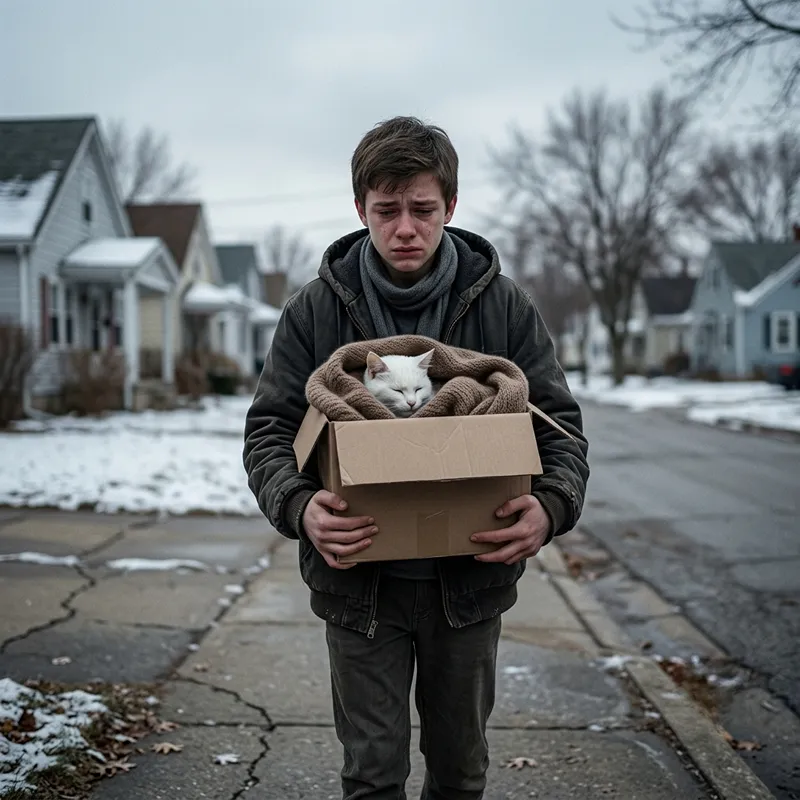
Today, when I think of the boy with the cardboard box who was walking through the city and thought he was going to lose the last thing he had left, sometimes I want to hold him in my arms.
I want to tell him that love doesn’t always look the way you first think.
That a promise doesn’t always fail because you have to let go of something.
And that there are people who catch you even though they didn’t know you before.
I didn’t betray Minka when I took her to the animal shelter.
I saved her.
And perhaps, in her old grumpy way, she did the same for me.
Because without this cardboard box, without this long journey, without this note with shaky writing, Mrs. Schneider would never have found me.
The Benders would never have included Minka.
And the Lehmanns would never have known that somewhere in their town lived a boy who loved an old cat so much that he preferred to stay hungry himself so that she would not be alone.
Minka lived to be two beautiful years old.
With sun in their fur, soft blankets under their paws, and people who treated them with the patience that old hearts need.
When she finally died, she was not alone.
Me neither.
And sometimes, to this day, I think my grandmother somehow knew that.
That perhaps at the exact moment I lifted the box on Saturday morning and started running, she already suspected that Minka wasn’t the only one who would arrive somewhere.
But both of us.