A doctor showed me an X-ray of my daughter’s face and quietly explained that her jaw had been shattered in six places.
Hours earlier, she had been a normal college student, worrying about midterm exams and weekend plans. Now she lay in a hospital bed, tethered to a chorus of weeping machinery, unable to speak, unable to explain what had happened in the dark. I had survived war zones, covert operations, and the kind of battlefield chaos that permanently rewires a man’s soul, but absolutely nothing could prepare me for the night I learned someone had nearly beaten my little girl to death.
My name is Daniel Mercer.
For most people, I am just a retired military veteran living a quiet, aggressively unassuming life in a sleepy Illinois suburb. I spend my days fixing things around the house that aren’t really broken, drinking entirely too much bitter black coffee, and calling my nineteen-year-old daughter, Lily, more often than she thinks is strictly necessary. She is a sophomore at Bradley University. She is the brightest, most untainted thing in my life—the only anchor keeping me from drifting back into the dark waters of my past.
And on a rainy Thursday night, the fragile, glass-walled peace I had built was brutally smashed to pieces.
The call came at exactly 11:47 p.m. I remember the digital clock glowing a harsh red in the dark living room because I had just switched off the television, listening to the rain assault the roof. The phone buzzed aggressively against the oak coffee table, rattling like a trapped insect.
Unknown number.
Normally, I would have ignored it, letting it fall into the digital abyss of voicemails. But a cold, familiar prickle at the base of my neck—an instinct honed over a decade in military intelligence—screamed at me to answer.
“Hello?” I said, my voice thick with sleep.
The voice on the other end was clinical, detached, and entirely devoid of empathy. “Is this Daniel Mercer?”
“Yes.”
“This is Mercy General Hospital. Your daughter, Lily Mercer, has been admitted to the emergency department.”
The oxygen vanished from the room. My stomach seized, twisting into a hard, cold knot. “What happened?”
A terrible, heavy pause stretched across the line. “Sir, you need to come immediately.”
My pulse hammered against my eardrums, loud and frantic. “What happened to my daughter?”
“She was attacked.”
The drive to the hospital was a waking nightmare painted in sweeping windshield wipers and blinding, distorted headlights. Rain hammered the glass like physical blows. My hands gripped the steering wheel with such immense force my knuckles ached, the leather groaning under the pressure. Every terrible possibility raced through my mind, each scenario darker and more violent than the last. By the time the automatic doors of the emergency room slid open, I could barely draw breath.
The smell of antiseptic, bleached linen, and floor wax hit me instantly. It is a scent that always drags me back to field hospitals and the metallic tang of loss. Nurses rushed through brightly lit hallways, their rubber-soled shoes squeaking against the linoleum. Machines beeped in a steady, uncaring rhythm. Life continued normally for everyone else. Mine had just crashed into a concrete wall at a hundred miles an hour.
“Lily Mercer,” I demanded at the front desk, my voice carrying a gravelly edge I hadn’t used in almost a decade.
The triage nurse looked up, her professional mask slipping into an expression of profound, devastating pity. “Room 214.”
I didn’t walk; I sprinted. When I reached the threshold of her room, my legs gave out for a fraction of a second. I froze, my hands gripping the doorframe to keep myself upright.
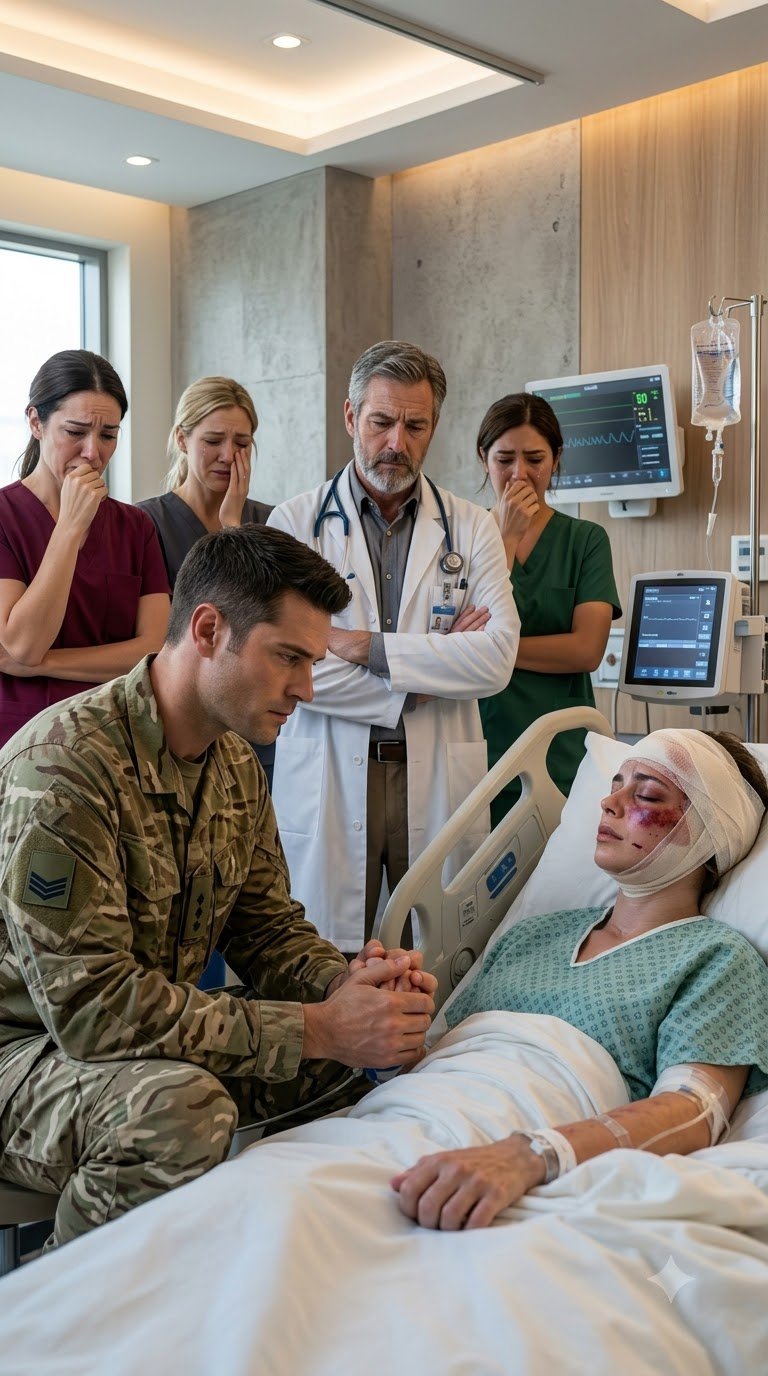
My daughter lay motionless beneath thin, unforgiving white hospital blankets. Bandages wrapped tightly around her head and jaw, making her look incredibly small. One eye was swollen completely shut, the surrounding skin a horrific tapestry of deep purple and mottled black. The other barely fluttered open. A complex web of IV tubes ran into her bruised arms, feeding her a cocktail of painkillers and fluids. On a nearby plastic chair sat a clear evidence bag containing her favorite blue hoodie, soaked in mud and rust-colored stains that I knew instantly were blood.
The sight fractured something deep, ancient, and violent inside my chest. I stepped closer, my boots feeling like lead weights.
“Lily?” I whispered, my voice breaking over the syllables.
Her fingers twitched slightly against the white sheets. That was all. I sank into the hard plastic chair beside her bed and carefully, gently, took her cold hand in mine. “Sweetheart, I’m here. Dad is here.”
A single tear slipped from her good eye, tracking down her bruised cheek and pooling in the white gauze of her bandages.
Moments later, the attending surgeon entered, carrying a manila folder of X-rays. His exhausted, deeply lined face told me everything before he even opened his mouth. He placed the images on the glowing light board, snapping them into place with a sharp click.
“How bad is it?” I asked, my eyes fixed on the stark, skeletal image of my daughter’s skull.
Fractures ran across her jawline like jagged lightning strikes through a pane of glass.
“Six separate breaks,” the surgeon said quietly, adjusting his glasses. “One near the hinge. Multiple compound fractures along the lower mandible. Significant, targeted trauma. Whoever did this didn’t just hit her, Mr. Mercer. They struck her with extreme, calculated force. They used something heavy.”
He didn’t need to elaborate. I knew exactly what targeted force looked like. This wasn’t a mugging gone wrong. This wasn’t a drunken campus brawl or a crime of opportunity. Someone had dismantled her with absolute, chilling precision.
“Who did this?” I asked, turning to him, the grief in my chest rapidly hardening into something cold and sharp.
“We don’t know. Campus security found her unconscious near the science building.”
I stood up slowly. A university campus full of students, security cameras, and ambient lighting, and nobody saw anything? No. That wasn’t just unlikely; it was a statistical impossibility.
I looked down at Lily. Her right hand, the one I wasn’t holding, was still tightly clenched, the knuckles white, as if she were desperately holding onto a lifeline. A young nurse stepped in with a warm basin of water. “I need to clean her hands, Mr. Mercer,” she said softly.
“Let me,” I said, taking the warm cloth.
I gently touched Lily’s clenched fist. “It’s okay, baby. Let go. You’re safe now.”
Slowly, painfully, her fingers uncurled, the muscles trembling with the effort.
The nurse gasped, stepping back so quickly she nearly knocked over the basin. I didn’t breathe. My heart completely stopped.
Resting in the center of my daughter’s bruised palm, caked in dried mud and blood, was a heavy, blackened piece of metal. It wasn’t a necklace or a piece of cheap campus jewelry. It was a military unit insignia. A jagged silver sword crossing a desert scorpion.
It was the insignia of my old Special Forces covert unit. The one that was supposedly wiped out in Kandahar sixteen years ago.
The past hadn’t just caught up with me. It had reached out from the grave and tried to kill my daughter.
And as I stared at the blood-stained metal, a horrifying realization washed over me: whoever dropped this wasn’t leaving a clue. They were sending an invitation.
The insignia burned a hole in my pocket. I hadn’t shown it to the police. You don’t hand over a ghost to local law enforcement; they wouldn’t know what to do with it, and worse, they might accidentally alert the very people who left it. I needed to move in the shadows, just as they did.
By 3:00 a.m., a detective named Mara Hayes finally met me in the deserted hospital cafeteria. She looked overworked, her blazer wrinkled, nursing a styrofoam cup of black coffee like it was the only thing keeping her upright.
“Mr. Mercer, I’m deeply sorry about your daughter,” she began, flipping open a worn leather notepad. “We are currently reviewing the campus security footage.”
“What did you find?” I asked, keeping my voice dangerously flat. I didn’t want to show her the monster that was currently waking up inside me.
She hesitated, tapping her pen against the rim of her cup. “Your daughter was found at 10:58 p.m. Her phone is missing, but her wallet, cash, and laptop were left behind in her backpack. As for the cameras… there is a gap. Nine minutes. From 10:43 to 10:52, all cameras covering the east walkway went offline.”
“A technical glitch?” I challenged, leaning forward.
“That’s what the university IT department is claiming. A brief server disruption due to the storm.”
“Detective, cameras on an isolated closed-circuit network don’t just ‘glitch’ in a synchronized nine-minute window exactly when a violent, targeted assault occurs. That’s not a glitch. That’s a blackout.”
She sighed heavily, rubbing her temples. “I know how it looks. But I need proof, not paranoia. Stay with your daughter, Mr. Mercer. Let me do my job.”
I left the hospital an hour later. The rain had slowed to a miserable, freezing drizzle, coating the streets of Peoria in a slick sheen. I drove my beat-up Ford truck to Bradley University, parking a few blocks away from Hartwell Science Hall. The campus was a ghost town, illuminated by the sickly yellow glow of sodium street lamps. I pulled up the collar of my jacket and bypassed the yellow police tape near the service walkway where Lily had been found.
I stood exactly where she had fallen. The dark stain of her blood was still visible on the wet concrete, a silent scream in the night. I looked up, calculating angles and sightlines. Three cameras pointed directly at this chokepoint. It was the only unlit spot on the path.
I pulled out a high-powered tactical flashlight and shined it at the camera lens above the door, then down at the puddles on the ground. I walked over to the university’s security outpost window nearby. A monitor inside showed the live feed of the walkway. I watched it for three solid minutes.
It wasn’t a blackout.
On the monitor, a small puddle in the corner of the frame reflected a flashing neon sign from a distant street. But the reflection in the puddle blinked three times, skipped a beat, and repeated the exact same pattern. Over and over.
It was a video loop.
Someone had sliced into the university’s network, bypassed their firewalls, and fed it a pre-recorded loop to mask the attack. That required military-grade hacking protocols. Local thugs couldn’t pull that off.
“You’re not supposed to be here,” a nervous voice stammered behind me.
I turned slowly. A young campus security guard stood ten feet away. His name tag read Collins. He looked terrified, his hand trembling as it hovered near his radio. He couldn’t have been older than twenty-one.
“You found her?” I asked, taking a slow, measured step closer.
“No, that was… that was Officer Vance. He’s off shift tonight.” Collins took a step back, his eyes darting toward the shadows.
“You know something, Collins. You know what really happened here. What did you see?”
“Nothing! I swear. I have to go.” He turned and practically ran toward the staff parking lot, his boots splashing loudly in the puddles.
I followed him, keeping to the shadows, my footsteps completely silent. He led me to a dimly lit, empty parking lot behind the administration building. But he didn’t go to his own car. He walked toward a large, unmarked black SUV idling in the darkest corner of the lot.
I hung back, pressing my back against a cold concrete pillar. Collins approached the driver’s side. The tinted window rolled down just an inch. I couldn’t hear the words, but Collins was gesturing frantically, his voice high and panicked.
Suddenly, the SUV’s engine roared to life. But it didn’t drive away. The driver threw it into gear and swerved violently, the massive vehicle accelerating straight toward the pillar I was hiding behind. The high beams snapped on, blinding me in a wash of harsh white light.
I dove to the right just as the reinforced steel bumper of the SUV smashed into the concrete, sending chunks of debris flying like shrapnel. I hit the wet pavement, executing a shoulder roll to absorb the impact, and sprang to my feet, my muscles coiling with adrenaline.
The front doors of the SUV kicked open. Two men stepped out into the rain. They wore unmarked black tactical gear, their faces completely obscured by neoprene masks. They didn’t shout. They didn’t hesitate. They moved with the terrifying, silent synchronization of highly trained operators.
One rushed me from the left, throwing a brutal, perfectly executed hook aimed at my jaw. I slipped under it, driving my elbow hard into his floating ribs. It felt like hitting solid oak. He didn’t even flinch. The second man stepped in and swept my legs. I went down hard, tasting copper as I bit my tongue.
They were trying to subdue me, not kill me—using CQC (Close Quarters Combat) techniques I had learned at Fort Bragg. I grabbed a handful of loose gravel from the asphalt and threw it directly into the second man’s eyes, using the momentary distraction to kick his knee backward with the heel of my boot. It popped with a sickening crunch. He grunted, dropping to one knee.
I spun to face the first attacker, raising my fists, but a sudden, sharp sound echoed through the parking lot.
Pfft.
A suppressed gunshot. Quiet. Deadly.
I dropped flat behind a parked sedan, my heart hammering against my ribs. I looked over toward the SUV. Collins, the young security guard, was lying flat on his back on the asphalt, a dark red pool spreading rapidly beneath his chest, mixing with the rain.
The two attackers didn’t bother checking on him. They immediately dragged their injured comrade into the back of the SUV, threw it in reverse, and tore out of the parking lot, their tires screaming in the wet night, leaving me alone in the freezing rain with a dead kid.
They had used me to flush out their loose end. And they had eliminated him without a single second of hesitation.
As I stared at Collins’ lifeless eyes, I realized this wasn’t an investigation anymore. This was a war. And I was already losing.
I anonymously called in the shooting from a burner phone I kept in my glove compartment and vanished into the night long before the first sirens wailed in the distance. By dawn, the storm had broken, leaving the sky a bruised, cynical gray. I was back in Lily’s hospital room, my knuckles bruised and raw, my clothes smelling faintly of rain, asphalt, and blood.
A young woman with dark, heavy curls and deeply red-rimmed eyes was sitting in the vinyl chair next to Lily’s bed. She jumped, startled, when I walked in.
“I’m Maya,” she whispered, clutching a paper coffee cup like a lifeline. “I’m Lily’s roommate.”
She reached down and handed me a brown paper grocery bag containing Lily’s personal items. “I’m so sorry, Mr. Mercer. She… she was looking into something. She was scared. It was a group on campus called The Crown.”
“What kind of group?” I asked, taking the bag and wiping my bloody knuckles with a coarse paper towel.
“Rich kids. Frat guys with legacy money. But Lily found something deeper. A digital folder hidden on their servers. She called it ‘The Rook’.”
The Rook. A chess piece. The insignia in my pocket felt like a burning coal.
“Where is her laptop, Maya?” I demanded, my voice tight.
Maya looked down at her lap, her hands trembling. “Last night, right after the attack, a campus cop came to our dorm room. He said he needed it for evidence. He was very aggressive. His name tag said Vance.”
The cop who supposedly found Lily. The cop who wasn’t on shift tonight. The cop who was systematically burying the evidence.
“Maya,” I said, forcing my voice to soften, trying not to terrify the girl further. “Did Lily leave anything else? Anything at all?”
Maya hesitated, then reached deep into the pocket of her oversized cardigan and pulled out a small, scuffed silver USB drive. “She told me if anything ever happened to her, I should hide this, and give it only to you. No one else.”
I took the drive, its cold metal surface sending a shiver down my spine. “You did good, Maya. You did perfectly. Stay with her. Lock this door and don’t let anyone in unless they have a badge you can verify.”
I left the hospital and went straight to my truck, locking the doors. I plugged the USB into my heavily encrypted field laptop. There was only one file on the drive. An MP4 video.
I hit play.
The footage was shaky, shot from a hidden angle—likely a phone propped up inside a bag—inside a dimly lit, wood-paneled basement. A group of college students in expensive clothes stood around a heavy oak table, counting stacks of cash and examining printed documents. But my eyes bypassed them instantly, locking onto the older man standing in the corner shadows.
He wore a tailored dark wool coat. His posture was rigid, demanding absolute, terrifying authority.
“The Mercer girl copied part of the archive,” one of the students said, his voice trembling with genuine fear.
The older man turned his head slowly. The dim, flickering basement light caught the jagged, pale scar running along his jawline.
My heart completely stopped. The air evaporated from my lungs. A cold sweat broke out across my forehead.
It was Colonel Adrian Vale.
My former commanding officer. The man who had sold out our unit’s coordinates in Kandahar for millions in untraceable bearer bonds. The man I had personally watched die in a massive roadside IED explosion sixteen years ago. I had attended his closed-casket funeral.
He was alive.
On the video, Vale looked directly into the hidden camera lens, his eyes cold and dead. It was as if he could pierce through the screen, through time and space, to look right at me. He smiled—a thin, reptilian stretching of his lips.
“Then Daniel Mercer finally has a reason to remember,” Vale’s voice rasped through the laptop speakers, echoing in the quiet cab of my truck.
I slammed the laptop shut. The rage that exploded inside me was blinding, white-hot, and absolute. Vale hadn’t just survived; he had orchestrated a ghost network, funding it through these rich college brats, and now he had ordered the hit on my daughter simply to draw me out.
I needed Vance. He was the weak link. He was the thread I was going to pull until Vale’s entire sweater unraveled.
Using old military contacts and a few favors I hadn’t cashed in a decade, it took me exactly three hours to track Officer Vance’s private residence to a rundown, brutalist apartment complex on the industrial edge of Peoria. I waited in the narrow, trash-strewn alley behind his building, blending into the shadows.
At 2:00 p.m., Vance practically burst out the back door. He was carrying a heavy canvas duffel bag, his eyes wide and paranoid, sweating profusely despite the chill in the air. He was running.
I stepped out of the shadows, entirely blocking his path. Vance froze, dropping the bag with a heavy thud. His hand darted toward his service weapon in its holster, but I was vastly faster. I lunged, grabbing him by the tactical vest and slamming him brutally against the rough brick wall. I pressed my forearm against his throat, cutting off his airway just enough to induce panic.
“Where is the laptop, Vance?” I hissed, my face inches from his.
He gasped for air, his eyes wide with stark terror. “Man, you don’t understand! You’re dead! We’re all dead! They’ll kill me! They…”
“I will kill you right now,” I lied, applying more pressure to his windpipe, letting him feel the uncompromising strength in my arm. “Where is Vale?”
“He’s… he’s at the…”
Vance’s eyes suddenly widened impossibly far. But he wasn’t looking at me in fear. He was staring in sheer, unadulterated terror at something over my left shoulder.
Before I could turn, a brilliant, ruby-red laser dot danced across Vance’s sweating forehead, settling perfectly between his eyes.
Thwack.
The supersonic crack of a high-caliber sniper rifle echoed through the alley like a thunderclap. Vance’s head snapped backward violently, his body going completely limp in my grip. A fine, warm mist painted the brick wall behind him.
I dropped his lifeless body and dove frantically behind a rusted green dumpster just as a second bullet shattered the concrete where I had been standing a millisecond prior, spraying rock dust into my eyes.
I was pinned. And the ghost I was hunting had just proven he could reach out and touch me anytime he wanted.
I stayed pinned behind that rusted, foul-smelling dumpster for twenty agonizing minutes, my breathing shallow, listening to the wail of approaching police sirens. When I was certain the sniper had displaced, I crawled through a broken chain-link fence, hopped a retaining wall, and vanished into the city’s labyrinth of backstreets.
Vale’s network was vast, well-funded, and they possessed high-ground overwatch. They had just brazenly assassinated a police officer in broad daylight in an American city simply to protect a secret.
I navigated back to my truck, parked three blocks away. My hands were shaking—not from fear, but from the massive, toxic adrenaline dump flooding my system. I locked the doors and opened my laptop again. I needed to finish watching the video on the USB drive. I needed to see if there was anything else, any clue to where Vale was operating from.
I skipped past the basement scene, scrubbing the timeline forward. The screen went black for a few seconds.
Then, a new video file started.
It wasn’t a basement. It was a kitchen.
My kitchen.
The camera angle was high, positioned somewhere near the top molding of my living room bookshelf. The footage was crisp, high-definition, and agonizingly clear. The timestamp in the bottom right corner indicated it was recorded exactly three weeks ago.
I watched myself on the screen. I was wearing my faded gray sweatpants, pouring coffee into a chipped ceramic mug, completely oblivious to the violation of my sanctuary. I watched as I picked up my phone on the counter, smiled softly, and made a call. I remembered that specific morning perfectly. I had been calling Lily to wish her luck on her history midterms.
The realization hit me like a physical blow to the sternum. Vale hadn’t just found me. He had been completely inside my house. He had bypassed my alarm system, planted cameras, and watched me sleep, eat, and live. He had let me believe I was safe, a predator patiently observing its prey in a glass cage.
Suddenly, the harsh ringing of a cell phone shattered the silence in the truck.
Not the burner. My personal phone.
Unknown number.
I stared at the glowing screen for three rings. I answered it, hitting the speakerphone button.
“Hello, Daniel,” the gravelly, sophisticated voice whispered through the digital connection.
“Vale.” I practically spat the name, gripping the steering wheel until the leather creaked.
A low, dry chuckle vibrated through the speaker. “I see you found my little home movies. I must say, your choice of interior decor is rather depressing. You live like a monk, Daniel. Still mourning the past?”
“You touched my child, Adrian. I don’t care how many men you have. I am going to tear you apart piece by piece.”
“I merely delivered a message,” Vale replied smoothly, entirely unbothered by my threat. “You have something that belongs to me. The Kandahar Ledger. The real one. The one your lovely, tragic late wife supposedly destroyed before she passed away.”
My blood ran like ice water through my veins. The Ledger. The physical black book that detailed every bribe, every treasonous act, every bloody dollar Vale had accepted to let my men die. “Sarah had nothing to do with this. She’s been dead for eight years. You leave her out of it.”
“Sarah was a very, very clever woman,” Vale mused, his tone shifting to something darker. “But we are out of time playing these games. I want the Ledger, Daniel. The physical book.”
“I don’t have it. It burned in the fire.”
“Liar,” Vale snapped, his veneer of civility finally cracking, revealing the monster underneath. “Bring it to me. Or your daughter’s broken jaw will seem like a papercut compared to what I do to her next.”
“Where are you?” I demanded, scanning the trees and rooftops around my truck, suddenly hyper-aware of every shadow.
“I’m close, Daniel. In fact, I love watching you scramble. It’s quite entertaining. Do you hear that?”
Over the phone line, I heard a sharp, high-pitched electronic beep.
“What did you do?” I asked, a cold dread coiling in my gut.
“I just wanted to see how fast you can run when you have proper motivation.”
The line clicked dead.
Simultaneously, a news alert flashed across my phone screen, accompanied by an emergency siren tone.
BREAKING: MASSIVE POWER GRID FAILURE AT MERCY GENERAL HOSPITAL. BACKUP GENERATORS SABOTAGED. CRITICAL CODE BLUE INITIATED.
My heart stopped.
Lily was on life support monitors. And she was completely in the dark.
I broke every conceivable traffic law in the state of Illinois getting back to Mercy General. I jumped curbs, ran red lights, and nearly side-swiped a transit bus. The hospital loomed ahead, a towering silhouette against the night sky, completely dark save for the pulsing, demonic red emergency strobes flashing weakly in the stairwells.
Inside, absolute chaos reigned. Sirens wailed in the distance outside. Doctors and nurses were shouting frantically, manually ventilating critical patients in the hallways, their panicked faces illuminated by the harsh, erratic beams of handheld flashlights. The elevators were dead metal boxes.
I hit the eastern stairwell, taking the concrete steps three at a time. My lungs burned with the exertion, but my military training completely took over, filtering out the screaming, the crying, the sheer, paralyzing panic of the civilians around me. My singular, laser-focused objective was Room 214 on the second floor.
I kicked the heavy fire door open. The second-floor hallway was a madhouse of long shadows and flashing red strobe lights.
I reached around to the small of my back and drew the concealed 9mm Glock I had retrieved from my lockbox. I kept it pressed flat against my thigh, hidden from the panicked medical staff but ready to be raised in a fraction of a second.
I reached Room 214. The heavy wooden door was slightly ajar.
I pushed it open with the toe of my boot, sweeping the room with the barrel of my weapon, piercing the gloom.
“Lily!”
The room was bathed in the eerie, blood-red emergency glow. Maya was slumped over the visitor’s chair, breathing heavily, completely unconscious.
Lily was thrashing weakly in her bed, her heart monitor emitting a flat, continuous, terrifying tone because the power feed had been completely severed.
I rushed to the bed, holstering my weapon quickly. “Lily! I’m here. I’ve got you.”
She was hyperventilating, her good eye wide with absolute, primal terror. But she wasn’t looking at me. She was looking frantically at Maya.
I turned to the sleeping girl. I shook her shoulder hard. “Maya. Wake up.”
Maya groaned, her head rolling back. She rubbed her eyes, confused. “Mr. Mercer? What… what happened? The lights…”
“Are you hurt?” I asked, rapidly checking her for injuries.
“No, I… I just felt so dizzy. I fell asleep.” She had been drugged. A mild sedative slipped into her coffee.
As she sat up, something heavy fell out of the pocket of her cardigan and hit the linoleum floor with a dense, metallic thud.
I froze. I knelt down and picked it up.
It was a chess piece. A Rook.
It was forged from heavy, military-grade tungsten, identical to the one in Lily’s hand earlier. Etched into the bottom were the exact GPS coordinates of the valley in Kandahar where my men died. Wrapped tightly around the base was a small, crisp slip of paper.
I unfolded it. The handwriting was elegant, sharp, and terrifyingly familiar. Vale’s handwriting.
Next time, this pawn is removed from the board entirely. Bring the Ledger.
Vale had been in this room. While I was out hunting his pawn in the alley, his operatives had walked right into this hospital, drugged a nineteen-year-old girl, slipped a death threat into her pocket, and walked out like ghosts.
A choked, desperate sob pulled my attention back to the hospital bed.
Lily was violently reaching for the small dry-erase board the nurses had left on her bedside table. Her hand was shaking so badly she knocked over a plastic water cup. I lunged forward and held the board steady for her, pressing the marker into her trembling fingers.
“It’s okay, sweetheart,” I lied, my voice shaking with the effort to contain my fury. “I’m going to get us out of here. I’m going to end this.”
She shook her head frantically, rejecting my comfort. She pressed the marker to the board.
I expected her to write a description of the men who attacked her. I expected her to give me a clue about Vale.
Instead, she wrote three words that caused the entire world to tilt violently on its axis. Three words that shattered sixteen years of carefully constructed grief, lies, and mourning.
THEY WANT MOM.
I stared at the whiteboard, my brain completely misfiring. “Lily… Mom passed away eight years ago. The cancer… we buried her.”
Lily squeezed her eyes shut, a fresh wave of tears streaming down her battered face. She violently wiped the board with her sleeve and wrote again, pressing the marker so hard the plastic tip snapped in half.
MOM IS ALIVE.
The room spun. The red emergency lights pulsed like a dying heartbeat.
My wife. Sarah. A brilliant former cryptographer for the NSA. She hadn’t died of illness eight years ago. She had faked her death. She had taken the real Kandahar Ledger—the only actual evidence of Vale’s treason, the key to bringing down his entire empire—and she had vanished into the wind to protect me and Lily.
And Lily had found out. While digging into The Crown, she hadn’t just found Vale; she had found a digital trail leading to her own mother. That was what The Crown was really hiding. That was why Vale had to silence her with such extreme prejudice, and why he was using her to lure me in.
Vale wasn’t just hunting the Ledger. He was hunting Sarah.
We were all hunting a ghost.
And as the emergency lights flickered, hissed, and completely died, plunging the hospital room into absolute, suffocating pitch-black darkness, I heard the unmistakable, chilling metallic click of an assault rifle bolt chambering a round just outside our door.
The hunt had arrived.
If you want more stories like this, or if you’d like to share your thoughts about what you would have done in my situation, I’d love to hear from you. Your perspective helps these stories reach more people, so don’t be shy about commenting or sharing.