My mother-in-law offered to take my son to his appointment.
At 4:00 p.m., the hospital called and said, “He never checked in.”
By the time my six-year-old slipped through the back door just before 4 a.m., alone, wearing clothes I had never seen before, his hair cut almost to the scalp, his entire body shaking, I already knew something terrible had happened.
That morning had started like an ordinary Thursday.
Eggs hissed in butter on the stove.
A vanilla candle burned beside the sink because my wife, Sarah, said the kitchen felt calmer when it smelled like something sweet.
Gray daylight pressed against the cold window over the sink, and the refrigerator hummed in the corner with the same low sound it made every morning.
Ethan sat at the table in his dinosaur hoodie, kicking his feet against the chair legs.
He was six years old.
He had a scab on one knee, a loose tooth he refused to let anyone touch, and the serious face of a child who believed his backpack was his responsibility even though he still needed help zipping it.
The appointment was supposed to be simple.
Orthopedics.
One follow-up.
Nothing scary.
Three weeks earlier, Ethan had fallen off his bike at the end of our driveway.
He had cried harder from embarrassment than from pain, because the neighbor’s yellow school bus had just rolled by and two older kids had seen him go down.
The pediatrician had checked him, then sent us for imaging, then told us he was healing fine but wanted one last look before clearing him for recess.
The reminder was still stuck to our fridge with a small American flag magnet.
2:00 p.m. Hospital Orthopedics Desk. Ethan Richardson.
I remember tapping the magnet twice with my knuckle that morning.
I remember saying the time out loud.
“Two o’clock. Hospital orthopedics.”
Ethan nodded like I had given him a mission.
Then Sarah came into the kitchen holding a paper coffee cup and said, “Actually, Mom is going to take him.”
I stopped with the spatula in my hand.
“Why?” I asked.
“She offered.”
That was how Gertrude moved through our lives.
She offered.
She offered to pick up groceries, then reorganized the pantry and told Sarah I bought the wrong cereal.
She offered to watch Ethan for an hour, then came home with new shoes for him and said mine made him look neglected.
She offered to help with birthdays, holidays, school forms, doctor visits, and anything else that gave her a reason to stand in the middle of our marriage and call it care.
Control learns the language of concern before it shows its teeth.
That was something I had learned slowly.
Sarah had learned not to notice.
Her mother had raised her on favors with strings so tight they felt like love.
Gertrude could make a demand sound like mercy.
She could make a boundary sound like an insult.
And if I objected, I became the problem.
I told Sarah I did not like it.
I told her Ethan’s appointment was at a hospital, not a school pickup line or a grocery run.
I told her Gertrude had a way of turning every favor into ownership.
Sarah sighed like I had put something heavy on her morning.
“You have that meeting,” she said. “Mom knows how to handle appointments. Please don’t make this a whole thing.”
That sentence had become a wall between us.
Please don’t make this a whole thing.
It meant stop noticing.
It meant stop naming patterns.
It meant let my mother do what she wants so I do not have to feel guilty for letting her.
At 10:00 a.m., Gertrude pulled into our driveway in her silver Mercedes.
The car was spotless, polished enough to reflect the bare branches over our roof.
She stepped out in a cream coat, sunglasses pushed into her hair, and looked past me like I was a piece of furniture someone had placed badly.
Then she saw Ethan.
Her whole face changed.
“Ready, sweetheart?” she asked.
Her voice went soft and sugary.
Ethan looked at me first.
I have replayed that glance more times than I can count.
Not because he was scared yet.
He was not.
He trusted adults.
He trusted Grandma because Sarah trusted Grandma.
He trusted me because I had always come when he called.
That glance was just a child checking the shore before stepping into water.
I zipped his backpack and handed it to him.
“Straight to the appointment, okay?” I said. “Call me when you get there.”
Gertrude smiled without showing her teeth.
“We know,” she said.
Ethan climbed into her car.
The door closed.
The Mercedes backed out of the driveway, rolled past the mailbox, and turned onto the street.
I stood on the porch longer than I needed to.
Then I went back inside and tried to work.
By 2:15 p.m., I had read the same paragraph in my work notes four times.
I told myself I was only checking because I was between meetings.
I told myself good fathers were allowed to be annoying.
I called the clinic.
The receptionist put me on hold.
The waiting music was so soft it almost sounded like breathing through a wall.
When she came back, her voice had changed.
“Sir, we don’t show Ethan Richardson as checked in today. Are you sure the appointment wasn’t rescheduled?”
My hand went cold around the phone.
I opened the patient portal.
The appointment was still there.
2:00 p.m.
Same department.
Same confirmation number.
I called Gertrude.
Voicemail.
I called again.
Voicemail.
I called Sarah.
No answer.
At 2:41 p.m., I called Gertrude again.
Voicemail.
At 3:06 p.m., I called the hospital main desk and asked if there was any chance he had been checked in under Sarah’s information.
They transferred me twice.
At 3:39 p.m., I left Gertrude a message that was much calmer than I felt.
“Gertrude, this is Michael. Call me immediately. The hospital says Ethan was never checked in.”
At 4:00 p.m., the hospital scheduling office confirmed the sentence that made my living room feel too small around me.
“He never checked in.”
After that, I started documenting everything.
Screenshots of the call log.
The appointment reminder.
The patient portal page.
Each voicemail timestamp.
2:17.
2:41.
3:06.
3:39.
Not because I wanted to build a case.
Because some part of me already knew I might need proof just to be believed.
There are moments in a marriage when you realize truth is not enough.
You need timestamps.
You need screenshots.
You need the world outside your house to confirm what everyone inside it keeps calling your imagination.
Sarah came home a little after 5:00 p.m. with grocery bags hooked over both wrists.
One paper bag sagged in the middle where something cold had started to sweat through.
She found me pacing between the kitchen island and the back door.
“Where is Ethan?” I asked.
She blinked at me like I had interrupted her before she could put away the milk.
“Mom probably took him for ice cream.”
“He missed his hospital appointment.”
That made her pause.
Only for a second.
“Maybe she went to the wrong entrance.”
“The hospital said he never checked in.”
Sarah set the bags down too hard.
A box of crackers tipped sideways onto the counter.
“You always do this,” she said. “You turn everything involving my mother into a crisis.”
Paranoid.
Dramatic.
Overreacting.
Those words had lived in our house for years, always waiting near Gertrude’s name.
I called Gertrude again while Sarah stood there with her arms folded.
Voicemail.
I showed Sarah the portal.
I showed her the call log.
I showed her the appointment confirmation.
She stared at the screen, then looked away.
“Mom will explain,” she said.
That was the sentence that made me understand how deep the damage went.
Not Ethan will be home soon.
Not I’m scared too.
Mom will explain.
Even with our son missing, Sarah was still waiting for Gertrude to make reality acceptable.
I called local non-emergency and asked what I should do when a child had been taken to an appointment by a family member and never arrived.
The dispatcher asked for details.
Name.
Age.
Last known clothing.
Vehicle.
Relationship.
I answered each one with my voice held together by force.
Six years old.
Dinosaur hoodie.
Blue backpack.
Silver Mercedes.
Maternal grandmother.
Sarah stood near the sink, pale and silent, her hand wrapped around the edge of the counter.
When the dispatcher told me an officer would call back for a report, Sarah whispered, “You called the police on my mother?”
I looked at her.
“Our son is missing.”
She had no answer for that.
The evening stretched into something unreal.
I checked the driveway every few minutes.
I called every hospital number I could find.
I called Gertrude until her voicemail stopped ringing and went straight to the message.
At 8:12 p.m., I took another screenshot.
At 9:30 p.m., Sarah finally called her mother and left a message with a voice that cracked at the edges.
“Mom, this isn’t funny. Call me.”
It was the first time all day she sounded afraid.
By midnight, the house had become a waiting room.
The kitchen lights stayed off.
The microwave clock glowed blue.
Outside, the driveway sat empty under the porch light.
Every time a car passed the mailbox, my whole body lifted before I realized it was not stopping.
Sarah sat on the stairs with her phone in both hands.
She kept checking it like the screen owed her mercy.
At 1:18 a.m., an officer called me back and asked if there had been any custody dispute.
“No,” I said.
“Any family conflict?”
I looked at Sarah.
“Yes,” I said.
Sarah closed her eyes.
The officer took the information and told me to keep my phone close.
He used words like report, welfare concern, family contact, known vehicle.
They were calm words.
They were paper words.
They did not fit inside my chest.
At 3:47 a.m., the back door creaked open.
I heard it before I understood it.
A scrape of the hinge.
A small push of cold air.
Then footsteps crossed the tile.
Slow.
Uneven.
Barely steady.
Ethan stood in the kitchen wearing sweatpants I had never bought and a faded T-shirt that hung crooked off one shoulder.
His dinosaur hoodie was gone.
His backpack was gone.
His shoes were gone.
His hair was gone too, shaved so close I could see pale skin under the kitchen light.
His lips were cracked.
His hands trembled like he had been cold for hours.
He looked at me as if he was scared I might disappear too.
“Daddy…”
I dropped to my knees so fast my shoulder hit the cabinet.
He smelled like someone else’s laundry detergent, cold air, and fear.
“Buddy,” I said carefully, keeping my voice low even though everything inside me was breaking, “where were you?”
His eyes filled.
“Grandma told me I’m not allowed to say where we went.”
I did not yell.
I did not grab him.
I did not run upstairs and drag Sarah into the kitchen by the truth she had refused to see.
For one ugly second, I pictured Gertrude standing in our driveway with that polished smile.
I pressed both hands flat on the floor to keep myself steady.
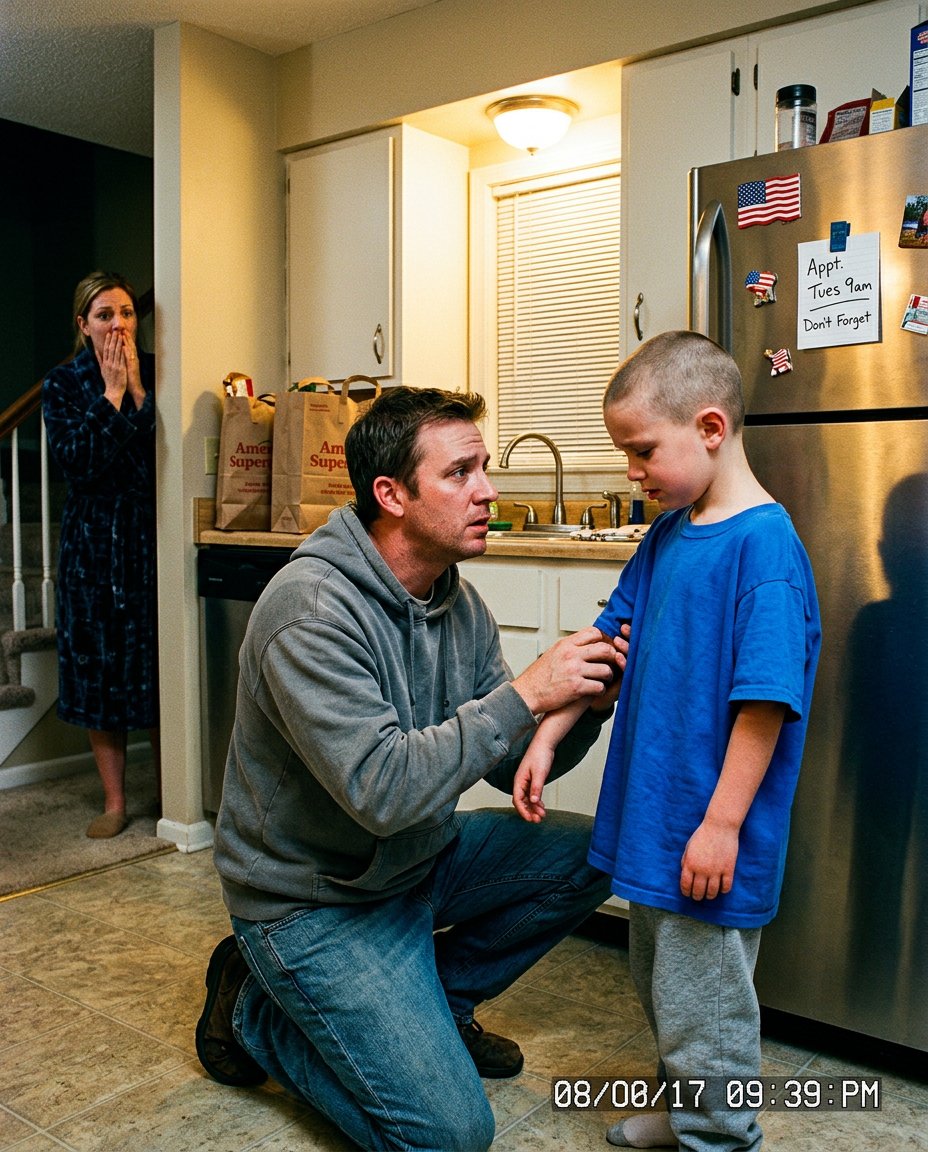
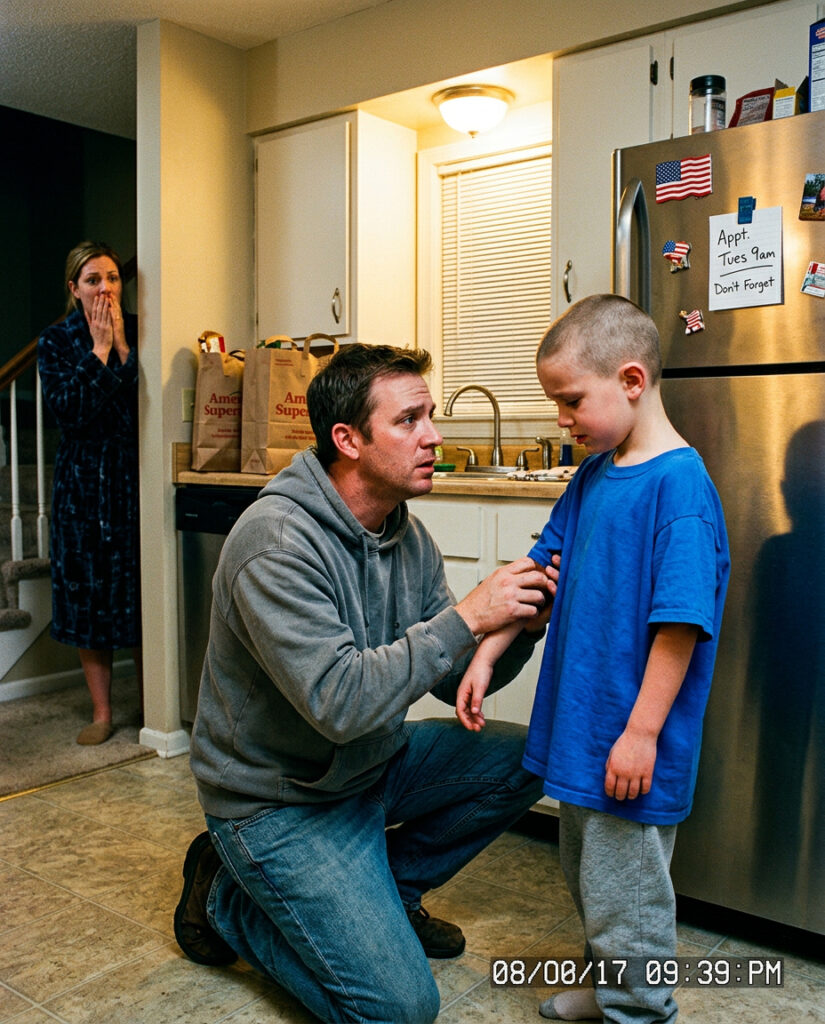
Then Ethan tugged his sleeve down.
It was such a small movement.
A child protecting a place on his body before anyone even asked.
That tiny motion told me more than any sentence could.
I reached for his arm as gently as I could.
“Can I look?” I asked.
He nodded without looking at me.
When I lifted the sleeve, Sarah made a sound from the stairs.
I had not even heard her come down.
There was a mark on his forearm.
Not something I could explain away as playground roughness.
Not something that belonged to a child who had simply gone for ice cream.
I looked at Ethan’s shaved head, the unfamiliar clothes, the missing backpack, and the hospital appointment still pinned to the fridge under the little flag magnet.
Gertrude had been hiding far more than a missed appointment.
Then my phone lit up on the tile.
Gertrude.
I let it ring twice.
Ethan pressed himself into my chest.
On the third ring, I answered and put it on speaker.
Gertrude’s voice came through calm, smooth, almost bored.
“Before you start acting hysterical, Michael, you need to understand I did what your wife was too weak to do.”
Sarah covered her mouth.
I felt Ethan shaking.
“What did you do?” I asked.
Gertrude exhaled like I was wasting her time.
“I corrected him,” she said.
The room went silent.
Even the refrigerator seemed louder.
Sarah whispered, “Mom?”
Gertrude’s tone sharpened.
“Don’t you start. You let that child run wild. You let Michael fill his head with nonsense. I took him somewhere safe.”
“Where?” I asked.
She did not answer.
“Where did you take my son?”
Gertrude laughed once.
Small.
Cold.
“You should be thanking me.”
That was when I looked down and realized Ethan’s backpack was still missing because it had something in it she did not want us to see.
I asked Ethan softly, “Buddy, did Grandma take your backpack?”
He nodded once.
Sarah’s face emptied.
Not softened.
Emptied.
Like some part of her had finally opened the door to the room I had been shouting about for years.
Gertrude was still talking.
She said words like discipline and family standards and embarrassing.
She said my son’s name as if he belonged to her.
I picked up my phone from the floor and saw the call timer running.
00:43.
00:44.
00:45.
I was recording.
Not because I had planned it.
Because when the phone rang, my thumb had done what my brain could not yet form into strategy.
It had hit record.
Sarah saw the screen.
Her knees seemed to weaken.
She sat down on the bottom stair, one hand still over her mouth.
“Mom,” she said again, and this time it sounded like a daughter losing the last safe version of her childhood.
Gertrude kept going.
“You always let him make me the villain,” she said. “But when that boy is older, he’ll understand who loved him enough to make hard choices.”
Ethan whimpered against me.
That sound changed Sarah.
Not all at once.
Not dramatically.
But something in her eyes came into focus.
She stood up.
Her voice was small when she spoke, but it was steady.
“Mom, where is his backpack?”
Gertrude went quiet.
That silence told us everything.
At 4:06 a.m., the officer called back because I had left a message saying Ethan had returned.
I put Gertrude on hold and answered.
I gave him the update.
Returned alone.
Clothes changed.
Hair shaved.
Visible mark.
Missing backpack.
Recorded phone call.
The officer told us not to delete anything.
He told us to photograph the clothing.
He told us to write down Ethan’s words exactly as he said them.
He told us to preserve the call log and the hospital confirmation.
For the first time that night, procedure felt like oxygen.
Sarah brought a blanket from the couch and wrapped it around Ethan.
Her hands shook as she tucked it over his shoulders.
“I’m sorry,” she whispered to him.
Ethan did not answer.
That was the hardest part for her.
Not anger.
Not blame.
His silence.

A child can forgive many things adults should never ask them to carry, but his body had already learned what her denial had cost.
I took photos of the unfamiliar clothes.
I photographed the hospital appointment reminder.
I saved the patient portal screen.
I exported the call recording and sent it to myself twice.
I wrote down Ethan’s sentence exactly.
Grandma told me I’m not allowed to say where we went.
At 5:22 a.m., an officer arrived.
The porch light was still on.
The small flag magnet still held the useless appointment reminder to the fridge.
The grocery bags were still on the counter.
One carton of milk had gone warm.
The officer spoke gently to Ethan and asked only a few questions.
Ethan answered some of them.
Not all.
When asked where he had been, he looked at Sarah first.
That destroyed her.
She turned away and pressed both hands to her face.
The officer took notes.
He used careful words.
He did not promise anything.
But he believed what was in front of him.
Sometimes belief is not comfort.
Sometimes it is just the first locked door opening.
Later that morning, Sarah called Gertrude again with the officer present.
Gertrude did not answer.
By then, her confidence had begun to drain.
Not because she felt sorry.
Because people like Gertrude are not afraid of harm.
They are afraid of records.
They are afraid of timestamps.
They are afraid of their own voice played back in a room where they cannot control the story.
The hospital rescheduled Ethan’s appointment.
This time, I took him myself.
Sarah came with us.
She sat in the hospital waiting room with Ethan’s blue backpack in her lap after it was returned days later, emptied of half the things he had packed himself.
No dinosaur water bottle.
No crayon folder.
No little plastic triceratops he kept in the front pocket for luck.
Sarah held the backpack like it weighed more than our whole marriage.
The orthopedics desk cleared him physically for recess.
That sentence should have felt like relief.
It did not.
Because the real injury had never been his bike fall.
It had been the adults who thought love meant access without accountability.
Gertrude tried to explain herself through messages.
Then through Sarah’s aunt.
Then through a long voicemail where she cried only when she talked about being misunderstood.
She never once asked how Ethan was sleeping.
She never once asked if he was afraid.
She never once apologized to him.
Sarah listened to that voicemail in the laundry room with the dryer running behind her.
When it ended, she stared at the phone for a long time.
Then she deleted it.
Not the saved copy.
Just the one on her screen.
“I don’t want her voice in my hand anymore,” she said.
It was not a perfect ending.
Real families do not heal on command.
Ethan had nightmares for weeks.
He wore hats even inside the house.
He asked before every appointment who was driving.
Every time a silver car slowed near our mailbox, he moved closer to me.
Sarah started therapy.
So did Ethan.
So did I, though I resisted at first because fathers are good at confusing staying functional with being fine.
We changed emergency pickup permissions at school.
We updated every medical form.
We added notes to the pediatric portal.
We saved every document in a folder on my laptop labeled ETHAN – SAFETY.
That name still makes my stomach tighten.
Gertrude lost the one thing she had mistaken for love.
Access.
She could still send cards.
She could still leave voicemails.
She could still tell relatives I had poisoned her daughter against her.
But she could not take my son anywhere.
She could not sign him out.
She could not stand in our driveway and smile her way past what she had done.
Months later, Ethan’s hair grew back soft and uneven.
One morning before school, he stood in front of the bathroom mirror and asked if it looked weird.
Sarah was in the hallway, frozen with a laundry basket against her hip.
I said, “It looks like yours.”
He touched the top of his head.
Then he smiled a little.
Not all the way.
But enough.
That night, Sarah found the little American flag magnet on the side of the fridge and moved it lower, where Ethan could reach it.
He used it to hang up a drawing of our house.
There were three people in the picture.
Me.
Sarah.
Him.
The porch light was yellow.
The driveway was empty.
And beside the mailbox, in crooked blue crayon, he had drawn himself holding my hand.
I stood there looking at it for a long time.
Because that small glance he gave me before leaving with Gertrude was still the part I replayed.
Children look back at the person they trust before stepping away.
Now, every time Ethan looks back, I make sure I am there.