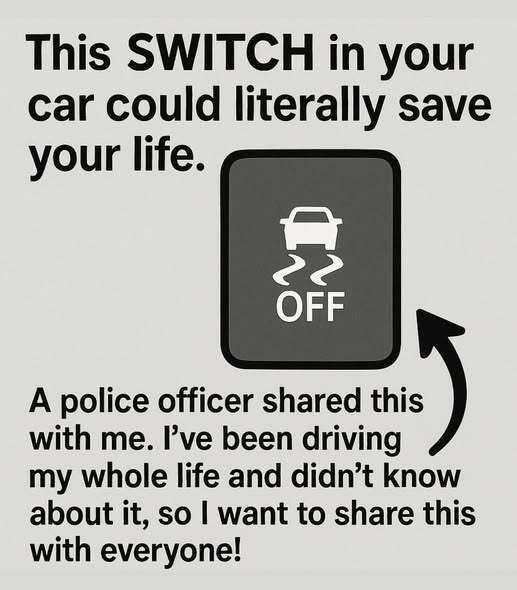
Every driver develops a relationship with their vehicle, learning its quirks and features. Yet, there is one feature common to nearly every modern car that often goes completely unrecognized. It’s the button or indicator for the Electronic Stability Control (ESC) or Traction Control System (TCS), symbolized by a car with a pair of wavy lines underneath. While features like backup cameras and blind-spot monitors get a lot of attention, this older, more fundamental technology works tirelessly to prevent accidents before they happen. Its low profile is precisely why so many are unaware of its function, making it the most important feature on your dashboard that you might not know you have.
This system’s operation is a marvel of real-time computing. As you drive, sensors monitor your steering input, the rotation of each wheel, and the car’s overall direction. If the car begins to slide or a wheel starts to spin uselessly—a common occurrence on ice, wet leaves, or during aggressive acceleration—the system springs into action. It can apply the brake to a single spinning wheel to transfer power to one with grip, or it can gently reduce engine torque to stop the skid before it starts. During a sudden lane change, it can brake individual wheels to help keep the car’s body stable and prevent a dangerous oversteer or understeer situation.
The safety impact of this technology is monumental. It is particularly effective at preventing the types of accidents that occur when a driver is surprised by road conditions or makes a sudden input. By helping to maintain the driver’s intended path, it reduces the risk of running off the road or colliding with another object. It is an always-on guardian for everyday hazards like unexpected puddles, gravel on a paved road, or a too-sharp turn taken at slightly too high a speed. For all practical purposes, for every drive to the store or across the country, this system should remain activated, silently ensuring a safer journey.
Of course, the system includes an “off” switch, leading to confusion. This option exists for specific, infrequent scenarios. The most common legitimate use is to escape being stuck. When a car is dug into deep snow or mud, controlled wheel spin is necessary to find traction. The stability system, interpreting this spin as a loss of control, will persistently cut power, leaving you stranded. Disabling it allows the wheels to turn with enough force to potentially climb out. It’s a tool for a specific problem, not for daily driving. After the situation is resolved, reactivating the system is a critical safety step.
Taking the time to learn about this feature is an act of responsible driving. It connects you to the sophisticated safety engineering built into your vehicle and empowers you with knowledge. The next time you start your car, look for the indicator light that shows the system is active—it usually illuminates briefly when you turn the key, then goes out. That brief glow is a signal that your electronic co-pilot is on duty. By understanding and appreciating this hidden guardian, you move from being just an operator of a machine to an informed partner in a sophisticated safety system, making the roads safer for everyone.