Our marriage was a quiet monument to time. Charles and I had shared a home, a family, and fifty years of sunrises. Our love, I thought, was a settled fact, like the furniture in our living room—present, useful, but no longer examined. In the wide-open space of retirement, however, a strange emptiness echoed. I began to feel like a guest in my own life, tending to the mechanisms of our partnership but disconnected from its heart. I nursed a quiet grievance, believing Charles’s steady, practical love was a gentle form of neglect, that his routines were walls keeping me from a world of vibrant feeling. I decided I needed to leave to find myself.
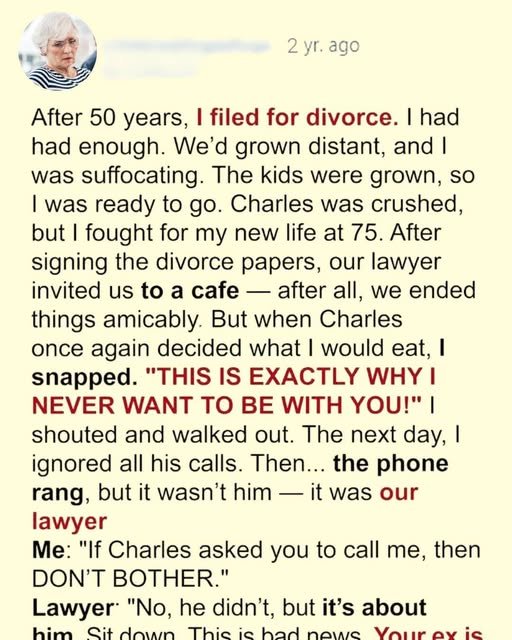
When I told him I wanted a divorce, I expected a reaction that would validate my feelings—anger, hurt, a fight to keep me. His response was a quiet, “Alright.” He said he would never stand in the way of my peace. His calm felt like indifference, cementing my belief that our love had dried up long ago. We signed the papers in a sterile office, the act feeling both monumental and meaningless. Agreeing to one last dinner felt like drawing a final, polite line under our history.
That dinner is where I committed my great sin of misinterpretation. The restaurant lamp was too bright. Without a word, Charles reached and turned it down, just as he had done in countless homes and restaurants over a lifetime. In that moment, I didn’t see care; I saw a metaphor for everything I wanted to escape—a life where my comfort was decided for me. I voiced my bitterness and walked out, leaving him in the dim, gentle light he had created for me. I silenced my phone, resolved not to be drawn back by his predictable, placid presence.
The universe delivered its correction at dawn. A call informed me Charles was in the hospital after a heart attack. Stumbling back into our empty home to gather his things, I found his letter on the table. It was his voice on paper, written after I’d left him at the restaurant. He wrote not to change my mind, but to explain his heart. He described a love that expressed itself not in poetry, but in practicality—in guarding my peace, in shouldering burdens silently, in creating a haven of predictability because he knew the world often felt chaotic to me. Every act I’d seen as controlling was his sacred vocabulary of devotion. Reading it, I felt the foundation of my world crack and shift. I had spent years yearning for a dramatic love story, while living inside a profound one written in daily, selfless acts.
At the hospital, I clung to his hand, pouring out a lifetime of missed gratitude. He survived. The divorce papers are now ash. The journey I began to find myself led me right back to him, but with new eyes. I was not trapped by his love; I had been blinded by it. The freedom I craved was never about geography; it was about perception. I am free now because I finally see the man who, for fifty years, chose me in a thousand quiet ways. I will spend whatever time remains choosing him back, with intention, with clarity, and with the deep, humbling knowledge that I almost left the greatest love I will ever know.