“I’m digging a ditch for what happens after rain.”
That was Eli’s way. He was not much for speeches, but he had a sentence for every foolish assumption, and those sentences stayed with people.

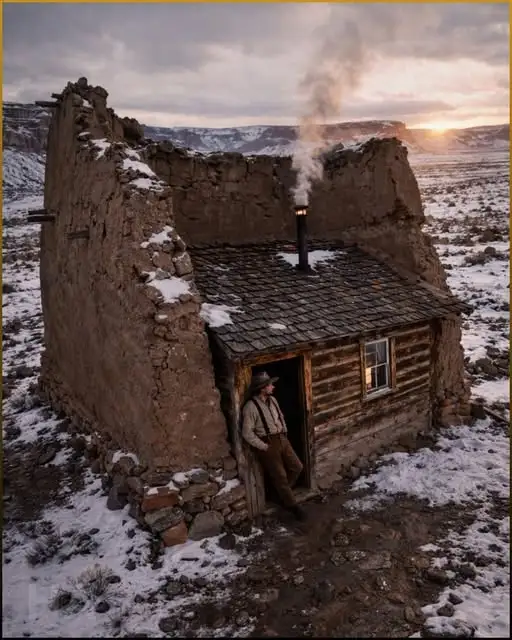
His cabin frame went up slower than anyone thought necessary. Two-by-fours at twenty-four inches on center instead of sixteen. Wider spacing meant fewer studs bridging cold straight through the wall. The floor sat on seasoned juniper sills he had cut from dead-standing timber two years earlier, because green wood had a habit of betraying a man after the job was done. The roof pitched five in twelve, enough to shed weather without wasting material. The leeward eave stretched longer to protect the wall from driven moisture.
And then came the feature that turned him from object of curiosity into public entertainment.

The vestibule.
It was only three feet by five feet, a tiny chamber framed onto the east side of the cabin like an afterthought. Except it was not an afterthought at all. It had an outer door facing the approach and an inner door opening into the living space, arranged so the two were never meant to stand open together.
Silas Pike stood with both thumbs hooked in his suspenders and laughed so hard he coughed.
“What is that?” he asked. “A closet for your courage?”

Eli was planing a board and did not look up. “A place to stop winter from walking through my front door.”
“It’s a shack, Halvorsen, not a courthouse.”
“No,” Eli said. “That’s why it has to work.”
The storekeeper repeated that line for a week, each time to fresh laughter. By the third retelling, Eli’s vestibule had become a full joke on the mesa. Men called it the preacher’s penance box. Women called it the baby room. Children dared each other to run in and out of it before Eli came back from the timber pile.
Only Clara Whitcomb, the territorial schoolteacher, looked at the little chamber and asked a serious question.
“What happens if you don’t build one?”

Eli rested the plane on the sill. “Every time you open a single door in January, all the warm air in your room tries to become outside air. Fast.”
Clara considered that. “And this stops it?”
“This slows it down enough to matter.”
She wrote something in the little notebook she carried everywhere. Clara wrote down weather, attendance, soil conditions, Bible quotations she disliked, and interesting statements from men who did not know they were interesting. She was twenty-six, with sensible boots and a face that always looked as if it were halfway between patience and disapproval.
Silas Pike said she had come west to marry badly and was using school as an excuse.
Clara ignored him so thoroughly it seemed an art.
The one man who did not laugh at Eli was Patrick Rourke, the blacksmith. Rourke had the useful kind of mind, the kind that respected any solution once he understood the mechanism. When Eli explained why wind pressure forced cold through every seam in an exposed shack and why wide nail spacing let boards work loose during storms, Rourke grunted and said, “So most of these men aren’t heating houses. They’re heating the outdoors through cracks.”

“That’s one way to put it.”
“It’s an expensive one.”
The work went on through late September and into October. While other families were already burning their first evening fires and congratulating themselves on finishing early, Eli was still mixing mud-lime chinking, still packing it carefully between boards and frame, still applying clay-and-fiber plaster inside the walls.
Children came to watch because the mixture fascinated them.
“Is that really dung?” one girl asked, nose wrinkled.
“It is,” Eli said.
“That’s disgusting.”
“It is also warm.”
That answer traveled from child to child until half the mesa was saying Eli Halvorsen had plastered his whole cabin with manure, which gave Owen Breck fresh material.

“First he marries a ruin,” Breck announced at Pike’s store, “now he smears his walls with cow leavings. By Christmas he’ll be eating dirt to keep the theme consistent.”
Even Hannah Halvorsen laughed at that one when Eli repeated it at supper.
She was less interested in the settlement’s ridicule than in whether her husband had finally chosen a house that would not freeze their children. Hannah had followed Eli across enough hard country to know the difference between a bold plan and a vanity project. She watched him work, asked questions when she had them, and by the second week of plastering, her skepticism had changed into something warmer.
“Tell me plainly,” she said one evening while smoothing the finish coat with her trowel. “Are you building a cabin, or are you building an argument with every man on this mesa?”
Eli smiled without looking up. “Both, likely.”
“And if your argument loses?”
“Then at least we lose inside a tighter wall.”
Hannah leaned back on her heels and studied the room. The little cabin did not look impressive. That was part of the problem. Men trusted size, newness, show. Eli’s place looked almost humble to the point of insult. One small south-facing window. No glass on the north wall at all. Interior walls whitewashed to bounce what little light they had. A cookstove tight to the best flue location. A bed built into one end. Shelves efficient enough to suggest a ship’s cabin. Nothing wasteful. Nothing pretty except the proportions, which were good in the quiet way practical things sometimes become beautiful without asking permission.
“It won’t impress anybody,” Hannah said.
“Good,” Eli answered. “Maybe they’ll stop looking at it and start feeling it.”
They did not.
By November, Coyote Mesa had settled into the kind of early winter routine that tricked people into believing they understood the season because it had not yet punished them.
Mornings came sharp and bright. The grass silvered white, then thawed by noon. Smoke climbed easy from stove pipes. Men split wood. Women mended. Children trudged to Clara’s schoolroom with slates under their arms. In the store, talk stayed half on politics, half on weather, as if either could be controlled by argument.
Silas Pike continued to take pleasure in Eli’s reputation.
“If the ghosts keep him warm,” he said, ringing up coffee for Owen Breck, “I may rent the ruin next winter.”
But mockery grew thinner once people began noticing smaller things.
They noticed that Eli’s stovepipe drew steady even in wind. They noticed he bought less fuel than most. They noticed that when his children came to school on cold mornings, their hands were warm enough to hold chalk without first breathing on their fingers.
Clara noticed more than anyone.
She kept daily temperature records because the county superintendent required it, though she suspected no superintendent had ever truly read them. She kept attendance as well, and when the first real cold spell passed over the mesa in December, she wrote a note beside the Halvorsen children’s names: Present, alert, no sign of cold strain.
Beside two other families’ names, she wrote: absent, weather-related.
She said nothing aloud at first. Teachers, she had learned, were heard more when they did not speak too quickly.
The real change came in January.
The fifteenth began with lying sunshine.
By noon, the air on the mesa felt almost generous. The thermometer nailed outside Eli’s cabin read forty-two degrees in the shade. The old Pueblo wall beside his house had warmed under the low winter sun until its surface carried a surprising softness when touched, as if the stone remembered August.
Eli noticed the barometer falling before most others did. He noticed the odd white filaments of cirrus sliding in from the northwest. He noticed the horses turning their backs to the open land earlier than usual.
At school, Clara noted the pressure drop in her log and frowned at the horizon.
At the blacksmith’s, Patrick Rourke said, “Storm coming mean.”
At Pike’s store, Silas waved the warning off.
“It’s January,” he said. “Every cloud gets treated like Revelation out here.”
By four o’clock, the light changed.
Old-timers in hard country always spoke of certain weather as if it possessed a face. This one did. The western sky took on a bleached, watchful look. The air went strangely still for a few minutes, and then the first gust came knifing across the mesa hard enough to rattle loose tin and lift a sheet from Owen Breck’s woodpile.
Inside the Halvorsen cabin, Hannah was ladling stew when Eli came in from the yard with his arms full of the last wood he wanted indoors before dark.
“Get the children settled,” he said.
“How bad?”
“Bad enough.”
He set the stove for a clean, steady burn, not too hot, not too wasteful. He checked the damper. He checked the latches on both vestibule doors. He pulled the shutter bar where it could be reached quickly if the storm turned ugly enough to threaten the window. Then he stood a moment with his hand on the inner door and listened to the wind strike the ruined wall.
Not a blow.
A breaking.
The old masonry took the force and changed its shape.
That mattered.
Across the mesa, in the Pike house, the front door had already begun to chatter against its frame.
By seven, the outdoor temperature had dropped to twelve degrees. By eight, wind-driven cold was finding every seam in every thin-walled cabin built for speed rather than endurance. Stove pipes moaned. Loose boards clicked. Smoke spilled back down one flue near the Breck place. A child somewhere cried with the sharp, exhausted rhythm of one who had been cold for too long.
Inside Eli’s cabin, the temperature hovered in the low fifties.
The children had already stopped listening to the wind and gone back to a card game by the lamp. Hannah kneaded biscuit dough with her sleeves rolled up. Eli fed the stove wrist-thick billets of seasoned piñon and watched the room hold its heat instead of surrendering it.
When he opened the inner vestibule door, stepped into the little chamber, closed it behind him, then opened the outer door to bring in more wood, the temperature dip inside the main room was barely noticeable.
That mattered too.
Outside, the storm deepened into its true character.
Blue northers were not merely cold fronts. They were violent reorganizations of the world. The kind of weather that reminded every settler, no matter how ambitious, that the land had not accepted him simply because he had hammered boards together and called it a home.
By ten o’clock, Clara Whitcomb was in bed at the schoolhouse with heated bricks wrapped in towels near her feet and a blanket folded over the crack under the door. She got up twice to record the temperature and once because the wind changed pitch so abruptly she feared the roof had lifted.
At Pike’s house, Silas was on his knees with lampblack on his fingers, shoving wool scraps into wall gaps that still hissed cold after he packed them. His wife, Martha, kept one child in her lap and one wrapped in a shawl near the stove, though “near” no longer meant warm. The room could not keep what the fire produced. Heat leaked out as fast as fear.
“More wood,” Martha said.
“We’re burning too fast already.”
“Silas, the baby’s lips are blue.”
He lurched to the box and fed the stove again.
At Owen Breck’s place, a nail pop opened the siding enough for a ribbon of air so sharp it blew out a lamp on the table.
At the widow Mae Sutton’s shack, her younger daughter woke crying because the water in the washbasin had skinned over with ice.
And all through that savage, unrolling night, the calm yellow square in Eli Halvorsen’s south window stayed steady.
Just after midnight came the knock.
Not on Eli’s outer door. On the vestibule itself. Three blows, then a pause, then two more, as if even urgency had to fight through frozen hands.
Eli looked up from the stove.
Hannah was already on her feet. “Who in God’s name?”
He crossed into the vestibule, shut the inner door behind him, and opened the outer.
Silas Pike stumbled in with his collar white from blown frost and his face gone gray around the mouth.
“It’s Ben,” he said.
For one strange instant Eli thought Silas meant the boy was dead.
Then Silas swallowed and tried again. “He can’t get warm. Martha says his fingers are white. I know we laughed, all right, I know it, but the doctor’s a day off and Rourke said if anyone on this mesa has heat enough to spare, it’s you.”
Pride can survive hunger longer than cold. Cold takes it quickly.
Eli opened the inner door. “Bring him.”
Silas ran back into the dark.
When he returned, he was carrying his youngest son wrapped in blankets, the boy’s face pinched and waxy. Martha followed close behind with the older children huddled under quilts. The vestibule filled with harsh breathing and storm noise and the smell of wool and woodsmoke. Eli worked them through one by one, never both doors open, not even now.
Inside, Hannah cleared space by the stove. Clara, who had seen the movement of lanterns from the schoolhouse and come over against all sense, arrived in the middle of it and took the older Pike girl’s hands between her own.
“What happened?” she asked.
“Not enough house,” Martha said, and then she began to cry.
That sentence stayed with Clara nearly as long as any she ever heard.
Ben Pike was not dying. That was the false terror of the night. But he had the beginning of frostnip in two fingertips and toes gone numb from sleeping in a room too cold for a child’s body to fight it. Eli warmed him slowly, exactly as Rourke later said was wise, and made Silas sit still long enough to learn something from the room around him.
The cabin was not hot.
That was the revelation.
It was not lavishly warm, not tropical, not miracle-touched. It was simply livable. Mid-forties to high-forties through the worst hours. Warm enough that breathing did not hurt. Warm enough that water did not ice in the bucket. Warm enough that a child could recover instead of decline.
Silas sat on the bench under the south window and looked around as if he had been tricked.
“You’re not burning half the wood we are,” he said.
“No.”
“I can feel that.”
“Yes.”
Silas stared at the old wall just beyond the plastered boards. “It’s because of that thing?”
Eli fed the stove another billet. “Not only because of that thing.”
It would have been satisfying, perhaps, to say more. To preach. To force the admission and enjoy it. But winter was still outside, and Eli was not a vain man.
By dawn, the wind had begun to ease, though the cold held on with hard blue teeth. The schoolteacher’s thermometer recorded eight below zero. Smoke rose from the mesa in ragged columns. Men stepped out into the morning looking hollow-eyed, as if they had spent the night arguing with something larger than themselves and lost.
The evidence was everywhere.
Inside the Pike house, the water bucket had frozen at the rim. A crust of interior frost furred the wall near the bed. Half a cord of wood had disappeared in a single night that still left the family shivering.
Inside Eli’s cabin, ash in the stove, a modest woodpile reduced by a sensible amount, no frost inside, no ice on the window, and children who had slept.
That first day after the storm should have been enough.
It was not.
The cold stayed for a week.
That was what turned surprise into certainty and certainty into humiliation.
A single strange night can be blamed on luck, accident, the angle of the wind, a better batch of wood. Seven days of sustained cold becomes arithmetic. It becomes school attendance, coughs, missing fingertips of comfort, fuel stacks shrinking too fast to lie about.
Clara documented everything, because once she realized what she was seeing, she understood the story was larger than weather.
The Halvorsen children attended every day that week.
The Pike children missed four.
Mae Sutton’s girls came twice, both mornings with raw noses and stiff hands until Eli showed Mae how to heat stones safely and place blankets to create a warmer sleeping pocket. Patrick Rourke spent two afternoons moving through the settlement, checking stove draft, hammering loose siding, and muttering things about “houses built like sieves.”
Silas Pike, faced with numbers he could not bully, began to calculate. At the rate his shack was burning fuel, his winter stack would be gone weeks before spring. That was not an inconvenience. That was a threat to his claim, his family, and the illusion of competence on which his authority in the settlement had long rested.
On the eighth day, when the sky finally softened and the worst of the cold relaxed, Silas walked to Eli’s cabin without invitation.
He stood by the old wall a moment before knocking, as if proximity to it still embarrassed him.
Eli opened the outer door and stepped into the vestibule.
Silas held his hat in both hands.
“I came to ask you something,” he said.
“All right.”
“I came to ask you to teach me.”
There are moments when a man changes rank without anyone voting on it. Not in title, not in wealth, not in land, but in the moral geometry of a place. That morning, on Coyote Mesa, Silas Pike’s question moved Eli Halvorsen from object of ridicule to keeper of something everyone suddenly needed.
Eli could have kept that power close and enjoyed it.
Instead he said, “Come back this afternoon. Bring anyone else who wants the lesson.”
Word spread faster than vanity could stop it.
By the time the sun had warmed the south face of the old Pueblo wall enough to wake a little heat from its surface, seven families had gathered near Eli’s cabin. Clara came with her notebook. Rourke came with his tool bag and a look of professional appetite. Mae Sutton brought both girls. Even Owen Breck came, though he muttered to anyone who would listen that he was there “for curiosity, not conversion.”
Eli had prepared simple things.
Two wooden boxes the same size. One with deliberate gaps between boards. One tight and sealed. A candle. An adobe brick he had set in the sun. A handful of mud-lime mix in a bucket.
No grand display. No frontier sermon.
He held up the gapped box first. “This is most of your cabins,” he said.
He lit the candle inside and closed the lid. The flame jittered and leaned with every stray breeze slipping through the cracks.
“This is your heat,” Eli said. “And this is the air you paid to warm escaping because your walls are helping the weather.”
A few people smiled at that in spite of themselves.
Then he put the candle in the sealed box. The flame steadied. The heat gathered.
“You can burn twice the fuel in the first box and still feel poorer,” he said. “Because the problem is not only how much heat you make. It’s how much you let the wind steal.”
Rourke nodded. “That tracks.”
Eli took up the sun-warmed adobe brick and passed it around. People looked surprised at how much heat it still held.
“This wall,” he said, nodding toward the ruin, “stores what the day gives it and lets go of it slowly at night. That is what mass does. These old builders understood that. They also knew where the wind would come from, and they did not insult it by pretending a thin wall in the open was equal to a thick one in shelter.”
Silas said quietly, “We did.”
“Yes,” Eli answered. “You did.”
No cruelty in it. Just fact.
He explained the two-inch air gap between old and new construction. The swale. The rubble trench. The reason for the south window and the absence of north glass. The logic of tighter chinking and interior plaster. The vestibule that prevented every entrance and exit from becoming a surrender.
The lesson stretched past an hour because people did not merely want the theory. They wanted translation. What could be done now, with what they already had, before another storm came?
That was where Eli became most useful.
To Mae Sutton he said, “Build a freestanding stone half-wall along your south-southeast side, leave a gap, and seal your interior cracks. It won’t make your shack a fortress, but it will make it less of a punishment.”
To Silas he said, “Tighten every board you can. Add nails closer on the edges. Chink from the inside with mud-lime. Build a vestibule. That will buy you more than another cord of wood.”
To Owen Breck, who asked what to do about smoke blowback, Eli said, “Raise the stack and stop pretending the roofline is only for appearance.”
That got a laugh, even from Owen.
Clara wrote quickly, then stopped and looked up from the notebook.
“What do I call this?” she asked.
Eli frowned. “What do you mean?”
“In my notes. What do I call the principle?”
He glanced at the ruin wall, then at the gathered families, then at the children who had listened harder than the adults because children always understand survival faster when it is explained plainly.
“Call it paying attention,” he said.
Clara did write that down.
Spring did not arrive all at once, but it arrived eventually, the way truth often does in hard country: not as revelation, but as accumulation.
By March, the modified cabins on Coyote Mesa were telling a different story from the ones that had entered winter unchanged. New little vestibules appeared like practical barnacles on eastern doors. Fresh chinking showed pale in wall seams. Three families had built low stone masses beside their houses, maintaining gaps just as Eli instructed. Rourke started selling extra nails with unusual enthusiasm. Silas Pike, a man who once laughed at mud-lime plaster, began recommending it over the counter to customers buying flour and lamp oil.
Nobody called Eli a ruin squatter anymore.
That name had died in the cold.
The more interesting change, however, came from Clara.
She sent a packet east in April with weather records, attendance notes, and a long letter attached. She addressed it first to the county superintendent because protocol demanded it, then sent a copy farther still to a territorial paper that occasionally printed observations from remote districts when they were clever enough to fill empty space.
Her letter did not speak of miracles.
It spoke of building performance.
It spoke of one family maintaining interior temperatures fifteen to twenty degrees warmer than neighboring cabins during a weeklong freeze while using significantly less fuel. It spoke of air infiltration, thermal mass, and wind pressure in clear, teachable terms. It spoke of practical methods learned from local building traditions too often dismissed by newcomers as primitive. And in a paragraph Eli did not see until much later, she wrote:
The strongest wall on this mesa was not the newest. It was the oldest. The settlers who survived best this winter were not the ones who believed themselves most advanced, but the ones humble enough to learn from work that had endured longer than their opinions.
When that letter was printed months later, folded into a broader piece on frontier shelter in high country, men on Coyote Mesa pretended surprise and women pretended they had expected nothing less. Silas Pike ordered three extra copies and kept one under the till, though he never admitted why.
By then, even he understood the twist in the story people wanted to tell.
They wanted to say Eli Halvorsen had discovered a secret.
He had not.
The secret had been standing there for generations in stone and adobe, taking sun, breaking wind, and waiting for somebody to stop mocking what they did not understand.
Eli’s real gift was smaller and rarer.
He knew how to recognize wisdom when it was not dressed in his own language.
One evening in late spring, after the snowmelt had run down the draw and left the mesa smelling of damp soil and piñon, Eli sat beside the old wall while his children chased each other in the yard. The ruin cast a long, broken shadow. Hannah came out with two cups of coffee and settled beside him on the bench he had made from leftover planks.
“You realize,” she said, “you’ve become respectable.”
“That sounds unpleasant.”
She laughed. “Silas Pike told Martha you’d saved half the mesa from freezing.”
“I showed them how to save themselves.”
“Same difference in a place like this.”
Eli looked at the wall.
Close up, it still carried marks of age and weather. Clay softened in old seams. Stones set by careful hands long gone. Evidence everywhere of labor, intention, and a kind of intelligence the frontier liked to rename only after it had been rescued by it.
“I didn’t save them,” he said after a while. “Those people did.”
Hannah followed his gaze. “The ones who built it.”
“Yes.”
“They’re not here to hear that.”
“No,” Eli said. “But maybe that’s why it ought to be said anyway.”
A week later, Clara came by with her notebook again. She had a way of appearing when a thought had ripened enough to require witness.
“I’m putting together a more formal account,” she said. “For the school records, if nothing else. I want the children to learn something from this place besides arithmetic and state capitals.”
Eli smiled. “That’s ambitious.”
“It is,” she agreed. Then her expression softened. “Tell me one thing honestly. The first time they laughed at you, did you ever doubt yourself?”
He considered it longer than she expected.
“Not the design,” he said. “Only the cost.”
“Money?”
He shook his head. “No. The cost of knowing you might be right and still having to let winter prove it.”
Clara closed the notebook without writing for once. “That,” she said quietly, “is the line I needed.”
She did write it later.
Years afterward, when newer houses rose on better foundations and men who had once mocked old methods explained those same principles as if they had invented them, the story of Eli Halvorsen’s cabin stayed on Coyote Mesa like a splinter people could not quite work free.
Some told it as a story about engineering.
Some told it as a story about humility.
Some told it badly, adding ghosts and curses and nonsense because too many people cannot bear a plain truth unless it wears a costume.
But those who had lived through that January remembered it accurately.
They remembered the shriek of wind through bad walls.
They remembered children sleeping in gloves.
They remembered the golden square of light in a little south-facing window while every other house on the mesa shook and leaked and begged for more wood.
And most of all, they remembered the cruel little joke winter played on their pride.
The man they had called backward had been the only one building forward.
The structure they had dismissed as a heap of old mud had behaved like a teacher.
The “excessive preparation” they sneered at turned out to be the narrow margin between surviving the season and being ruled by it.
By the following autumn, nobody on Coyote Mesa set a front door without first asking which way the wind truly came.
Nobody cut a north window for vanity.
Nobody laughed at vestibules.
And when a new family arrived from Kansas and asked why so many cabins now had stone half-walls standing a few inches off their southern sides, Silas Pike himself answered before anyone else could.
“Because,” he said, with the gravity of a man repeating a lesson paid for in fear, “around here, the oldest wall on the land may know more than the newest man.”
The newcomer looked across the mesa to the Halvorsen place, where the timber cabin sat modest and sure beside the ancient Pueblo ruin, not attached to it, not stealing from it, only sheltering in the wisdom it offered.
“Whose idea was that?” he asked.
Silas glanced toward Eli, who was stacking wood with the same patient movements he had carried from the first day.
Silas smiled a little, though the smile had humility in it now.
“Depends how honest you want the answer,” he said. “If you want the short one, it was Halvorsen’s. If you want the true one, it belonged to people this country had already tested long before we arrived.”
Then he added, because life on the frontier had a taste for the dramatic after all:
“And if you’re smart, you’ll learn from both.”
That winter, and the winter after that, Coyote Mesa still froze hard enough to punish laziness. Stoves still needed wood. Snow still drifted mean around corners. Men still lost arguments to weather. But the settlement was no longer building as if land were blank and history irrelevant.
Children grew up seeing the old wall not as a superstition, not as dead architecture, but as evidence.
Evidence that survival was rarely won by pride.
Evidence that comfort was not softness, but design.
Evidence that the line between suffering and stability might be nothing more glamorous than a tighter seam, a second door, a correctly placed window, and the humility to admit that somebody forgotten had solved your problem before you were born.
That was the real twist, though few stories tell it that way because revenge is louder than respect and miracles are easier to sell than method.
The neighbors had expected the ruins to collapse on Eli Halvorsen.
Instead the ruins held up a mirror.
And what they showed the whole mesa was not ancient magic, not lucky superstition, not a mad Scandinavian’s private trick.
They showed a hard American truth.
The land does not reward noise.
It rewards attention.
THE END