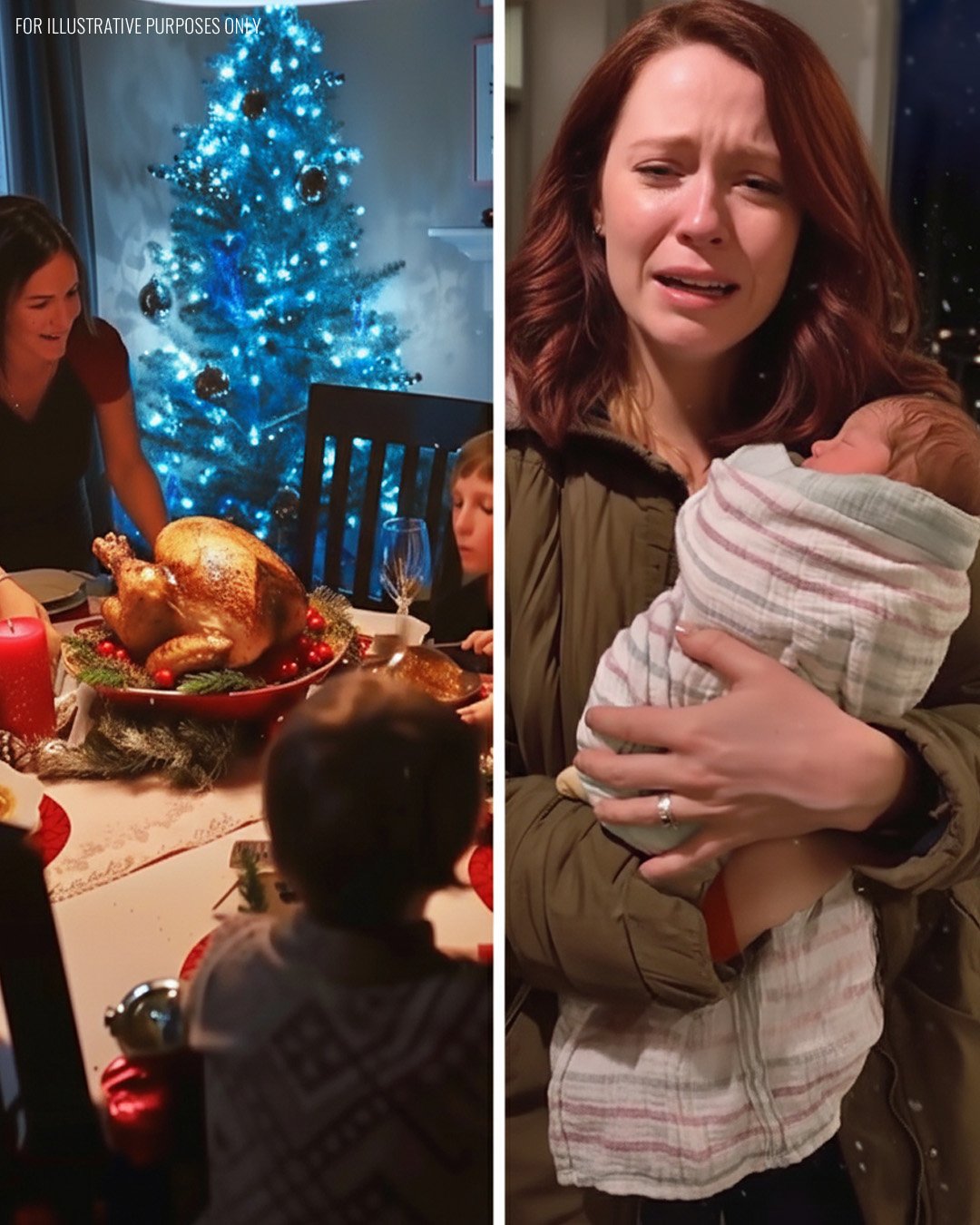
Sometimes the past doesn’t gently knock—it pounds. For Jacob’s family, twelve Christmases had passed since his brother Noah disappeared. Each year held a quiet space for him, a candle in the window, a ghost at the feast. This year, they had decided to stop waiting. The dinner table was set for three, the atmosphere light with the ordinary magic of roast chicken and his son’s laughter. The peace was so complete that the violent knocking at the door felt like an assault. On the porch stood a young woman, Crystal, trembling in the snow, holding a newborn. She was looking for Noah. With those words, the carefully maintained calm of a decade evaporated, replaced by a storm of betrayal, suspicion, and a shocking new connection.
Laura, Jacob’s wife, reacted with a fury born of long-held pain. Noah’s original disappearance had broken the family financially and emotionally. To her, this woman and child represented the resumption of that chaos, a toxic ripple from a stone thrown long ago. Her immediate fear was infidelity, a suspicion that Jacob had secretly been involved in this mess. The baby, Sam, was a living question mark that threatened the foundation of their marriage. For their son Louis, it was a bewildering lesson in the adult secrets that had always swirled beneath the surface of his childhood.
Jacob, however, was anchored by a different emotion: a desperate need to understand. The baby was proof. Noah had been alive, had loved, had fathered a child, and had run away again. This wasn’t a ghost story anymore; it was a story of continued, selfish absence. Jacob couldn’t turn his back on this tangible piece of his brother, this nephew who had done nothing wrong. When Laura, in her hurt, asked him to leave, he did—not to choose Crystal over his wife, but to finally chase down the truth that had haunted him for twelve years.
His journey led him to Crystal’s bleak reality in a rundown duplex. She wasn’t a villain; she was a scared young mother who believed she was giving her child a chance at a better life by seeking out his father’s family. Holding baby Sam, Jacob saw his brother’s eyes and felt the weight of a shared responsibility. He realized this wasn’t about fixing Noah’s mistakes, but about preventing their cycle from continuing. He returned home, not with a solution, but with a child and a choice for his family: to let old wounds define them, or to let a new, vulnerable life redefine what they were capable of.
The final scene on the porch was a mirror of the first, but everything had changed. Jacob stood with his nephew, offering his wife not an apology for the past, but a proposal for the future. Laura’s decision to open the door and say “Please stay” was a quiet act of tremendous courage. It meant choosing a complicated, expanded love over a safe, smaller one. Their Christmas story became one where healing didn’t mean forgetting the past, but making room within the present for its most fragile, unexpected legacy.