Snow muffled the forest of the Ardennes until the morning of December 16, 1944. Just before dawn, the stillness shattered. German artillery unleashed one of the heaviest bombardments of the war. Trees splintered and collapsed. The earth shook as though struck by giant fists. Soldiers of the 106th Infantry Division were thrown awake, scrambling for cover. What had been considered a quiet sector erupted into chaos in seconds. Hitler had begun his last great offensive.
Private Andy Harper hugged the bottom of his foxhole near St. Vith. Each explosion felt closer than the last. His sergeant shouted that they were under full-scale attack, but Andy barely heard him. Snow mixed with dirt rained down as another shell slammed nearby. Andy realized the Germans were trying to break through the lines with overwhelming force. Fear and disbelief washed over him, but the attack was too fierce for anything but survival.
Three days later, Eisenhower studied the map of the front. His fingers traced the deep wedge the Germans had carved into Allied positions. Officers in the room argued about how to respond, but none had a plan strong enough to counter the speed of the German advance. When Eisenhower looked up and asked Patton how fast he could move his army north, everyone fell silent.
Patton answered instantly: forty-eight hours. The officers around the table reacted with disbelief. Patton stood firm and explained that he had already prepared contingency plans. Eisenhower hesitated only briefly before agreeing. Patton saluted sharply and left the room, already thinking several steps ahead.
At Third Army Headquarters, Patton announced that the army was turning north immediately. Officers protested, pointing out the exhausted troops, the frozen roads, and the lack of time. Patton silenced them with a look and reminded them of the paratroopers trapped in Bastogne. They were surrounded and running out of supplies. If Third Army didn’t reach them, the Germans would crush them and tear open the Allied line. Patton told his staff to begin the movement at once.
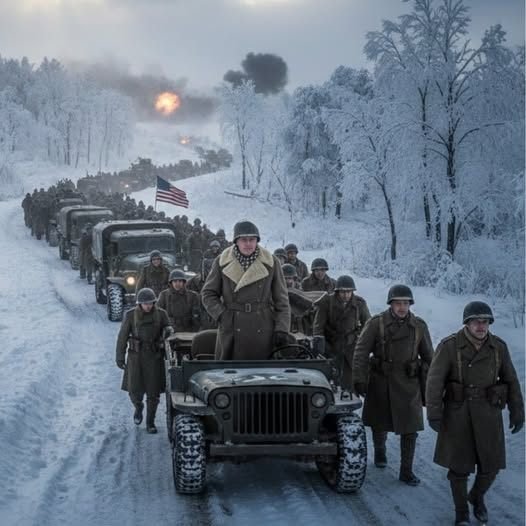
The next hours were frantic. Convoys formed on icy roads. Tank engines thundered in the cold. Infantrymen packed gear and marched north through deep snow. The scale of the maneuver was unprecedented, but the soldiers trusted Patton’s urgency. They knew he pushed hard, but they also knew he achieved results.
Patton rode ahead in his jeep, refusing any shelter from the elements. Snow blew across his coat and helmet. He waved to each unit he passed, shouting encouragement. His confidence seemed to sweep through the ranks like a physical force. Men who could barely feel their feet marched faster when they saw him.
The weather turned worse, grounding Allied air support. Patton confronted the chaplain and demanded a prayer for clear skies. Father O’Neill nervously wrote one, and Patton ordered thousands of copies printed and distributed. Soldiers repeated the prayer quietly as they marched or rode in frozen trucks. Whether by faith or coincidence, the skies cleared the next day, and planes returned to support the advance.
In Bastogne, conditions were dire. The 101st Airborne endured endless shelling, dwindling supplies, and severe cold. Medical staff worked with almost nothing—heating scalpels over candles and treating injuries with limited bandages. When German officers demanded surrender, General McAuliffe sent back the single word “NUTS,” confusing the enemy and lifting the spirits of his own men. The paratroopers believed reinforcements would come, and that belief kept them going.
Patton’s divisions fought their way through towns and forests, pushing back German units one by one. He promised they would reach Bastogne by Christmas, and the men accepted this impossible deadline because Patton spoke with absolute certainty. Fighting grew more intense as they approached the German encirclement.
On December 26, tanks from the 4th Armored Division finally broke through. Paratroopers rushed from their foxholes to greet the arrival of American armor. Soldiers cheered and embraced each other despite the bitter cold. Patton received the news with a calm nod, then told his commanders to keep pressing the attack. Bastogne was relieved, but the Germans were far from defeated.
Clear skies later in the campaign allowed bombers to strike German forces retreating through the Ardennes. Patton joked that the chaplain’s prayer worked too well, though he kept a copy in his pocket. The winter battles were brutal, and Patton visited the graves of fallen soldiers whenever he could. Snow covered their markers like a white shroud. He paused at one grave of a young paratrooper and whispered a prayer of his own.
The German offensive collapsed completely. Hitler’s ambition to split the Allied forces failed, and his armies began to retreat all along the Western Front. Patton, never one to slow down, pushed forward relentlessly. His men battled through ruined towns and icy landscapes, knowing victory was approaching.
The winter took a terrible toll on both sides. The forests remained scarred long after the fighting ended. Patton often said that war was a matter of momentum and will, and the winter of 1944 proved it. The courage of the men who held Bastogne and the speed of those who raced to save them turned the tide of the war. When the last guns finally fell silent, the scars of that winter stayed with those who survived, reminding them of the battle that changed everything.