
I married the paralyzed 20-year-old millionaire I cared for — that same night, behind his bedroom door, he said, “there’s no way back now. I’ll tell you why I really married you.”
At forty-three, I wasn’t the kind of woman men noticed twice.
Not that it mattered anymore.
My entire world revolved around one hospital room and one fragile hope.
My daughter, Lisa, was nineteen years old. Six months earlier, a drunk driver had run a red light and slammed into her car. Since that day, she had remained in a coma.
Every morning before work, I sat beside her bed.
Every night, I returned and told her about my day as if she could hear every word.
Maybe she could.
Maybe she couldn’t.
I spoke anyway.
Then came the meeting that nearly broke me.
“If you can’t find the money for this experimental treatment, ma’am,” the doctor said gently, “Lisa may never wake up at all.”
The number he gave me made my stomach drop.
It was more money than I could earn in years.
I worked every job I could find.
Cleaning offices.
Cooking in cafeterias.
Night shifts at nursing homes.
Anything.
Then, somehow, fate intervened.
I was hired as a live-in caregiver for Adrian Whitmore.
Twenty years old.
Heir to one of the largest corporations in the country.
Paralyzed from the waist down after the same accident that had killed both of his parents.
I expected arrogance.
Instead, I met a lonely young man carrying more grief than anyone his age should ever know.
“Don’t call me sir,” he told me during my first week after tasting soup I’d accidentally burned.
“You make me feel like an antique vase.”
I laughed.
A real laugh.
The first one in months.
Over the next six months, caring for Adrian became routine.
I helped him dress.
Changed bandages.
Managed medications.
Read books aloud whenever his migraines became unbearable.
And slowly, an unexpected friendship grew between us.
He never treated me like an employee.
He treated me like a person.
One rainy Thursday evening, I was standing in the kitchen scrubbing coffee from my sleeve when I heard the soft hum of his wheelchair.
I turned around.
Adrian sat in the doorway watching me.
“Marry me.”
The mug nearly slipped from my hands.
“What?”
“Marry me.”
I stared at him.
“Adrian, I’m old enough to be—”
“You’re not my mother,” he interrupted calmly.
His eyes never left mine.
“I want you to marry me.”
“This isn’t funny.”
“I’m not joking.”
“Why would you even ask me that?”
“You’ll never have to worry about money again.”
His words hit harder than they should have.
Because all I could see was Lisa.
Lisa lying motionless in that hospital bed.
Lisa running out of time.
I should have refused.
Every sensible part of me knew that.
But desperation makes people consider impossible things.
That night, I sat beside my daughter’s hospital bed.
I held her hand.
And I cried.
Then I said yes.

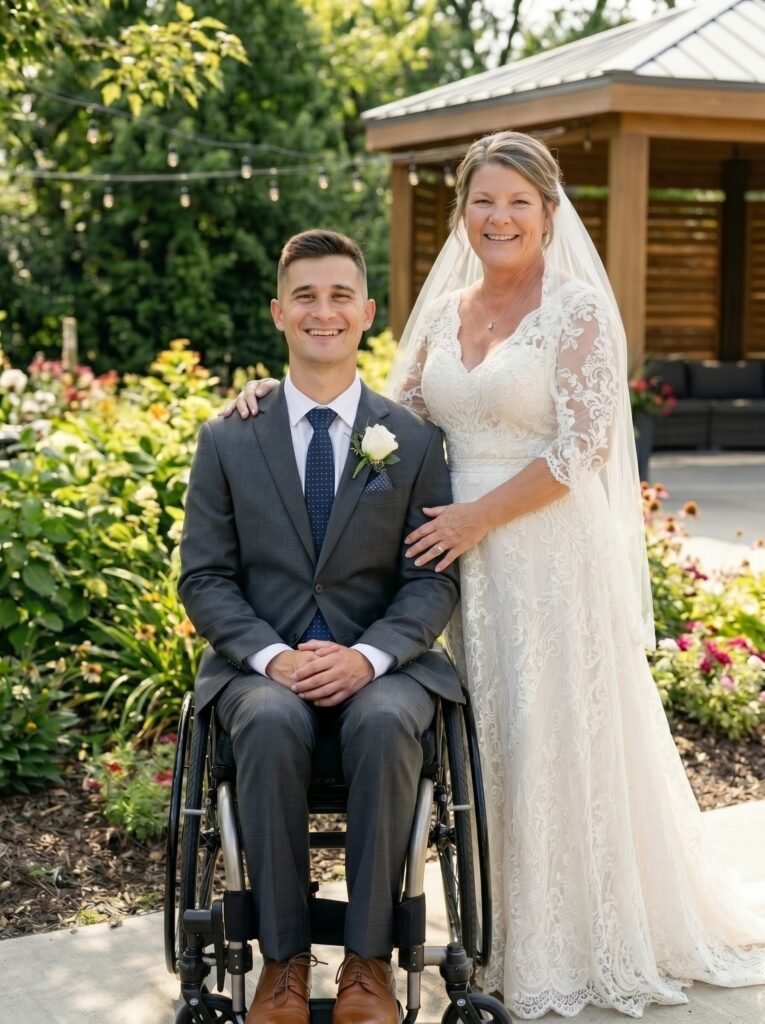
The wedding happened one week later.
It was small.
Quiet.
Almost painfully ordinary.
No elaborate decorations.
No guests beyond a few lawyers and company representatives.
The only flowers were the bouquet his driver purchased at a gas station on the way to the ceremony.
When we exchanged vows, Adrian’s fingers tightened around mine.
No kiss followed.
No celebration.
Just silence.
By evening, I was sitting inside the enormous mansion that now legally belonged to both of us.
The staff disappeared one by one.
Then Adrian asked everyone to leave.
Everyone except me.
The last door clicked shut.
The mansion became silent.
He rolled toward me slowly.
And for the first time since I’d met him, I saw tears in his eyes.
“There’s no way back now,” he whispered.
A chill ran through me.
“What are you talking about?”
His hands trembled.
Then he reached into a drawer beside his bed and removed a crimson envelope.
My breath caught.
Because written across the front was a name.
Lisa.
My daughter’s name.
I stared at him.
Unable to speak.
Unable to breathe.
“How do you know my daughter?”
Adrian swallowed hard.
Then he handed me the envelope.
“You need to read this.”
My hands shook as I opened it.
Inside was a police report.
An accident report.
The same accident that had changed my life forever.
The same accident that had killed Adrian’s parents.
The same accident that had left my daughter in a coma.
My eyes scanned the pages.
Then I saw something that made my knees weaken.
The final page contained witness statements.
One witness claimed there had been a second vehicle involved.
A black SUV.
A vehicle that had fled before police arrived.
I looked up.
“What is this?”
Adrian’s voice broke.
“My father was driving.”
I froze.
“He wasn’t supposed to be.”
The room spun.
“He had been drinking.”
I couldn’t move.
Couldn’t speak.
Couldn’t think.
“My mother begged him not to drive.”
Tears rolled down Adrian’s face.
“They hit your daughter’s car first.”
My heart stopped.
“What?”
“The collision pushed them into oncoming traffic.”
I stared at him.
The words felt impossible.
“My parents died because of what happened afterward.”
His voice shook violently.
“But your daughter… your daughter paid the highest price.”
I sank into a chair.
The police report slipped from my fingers.

For six months I had believed a random tragedy had destroyed our lives.
Now I was learning the truth.
The accident had never been entirely random.
Adrian lowered his head.
“My family’s lawyers buried everything.”
I looked at him in horror.
“What?”
“They protected the company.”
The room felt smaller.
Harder to breathe in.
“They paid settlements.”
“They manipulated reports.”
“They made sure my father’s reputation survived.”
I could barely hear him anymore.
“My parents died before I learned the full truth.”
His voice cracked.
“But I spent months investigating after the accident.”
Then he looked directly at me.
“And when I found out about Lisa… I couldn’t live with it.”
The silence between us felt endless.
“So you married me because you felt guilty?”
The question came out harsher than I intended.
He closed his eyes.
“At first? Maybe.”
The answer hurt.
“But that’s not why I’m telling you now.”
He handed me another folder.
Inside were legal documents.
Trust agreements.
Bank statements.
Medical authorizations.
And a single letter.
I unfolded it.
Every penny of Adrian’s personal inheritance had been transferred into a medical trust.
For Lisa.
Enough money to pay for the experimental treatment.
Enough money for years of rehabilitation.
Enough money to give her every possible chance.
I looked up in shock.
“You did this?”
He nodded.
“I sold everything that belonged to me personally.”
My eyes filled with tears.
“Why?”
His answer came immediately.
“Because she deserves a future.”
The room fell silent again.
For the first time, I understood.
He hadn’t married me to buy forgiveness.
He hadn’t married me for appearances.
He married me because he knew I never would have accepted the money otherwise.
Because he knew pride and grief would have made me refuse.
And because he believed it was his responsibility to make things right.
Months later, Lisa received the treatment.
Then came weeks of waiting.
Weeks of fear.
Weeks of uncertainty.
Until one morning, a nurse called my phone.
I nearly dropped it answering.
“Mrs. Whitmore?”
“Yes?”
“You need to come to the hospital.”
My heart stopped.
When I arrived, Lisa’s eyes were open.
Tears streamed down my face.
“Mom?”
One word.
Just one.
But it felt like a miracle.
Behind me, I heard another sound.
The soft hum of a wheelchair.
I turned.
Adrian sat quietly in the doorway.
Watching.
Smiling.
For the first time in years, hope filled the room.
Not because the past had been erased.
Not because the pain had disappeared.
But because two broken families had finally found a path forward.
And sometimes, that’s what healing looks like.
Not forgetting.
Not undoing.
Simply choosing to move forward together.
Note: This story is a work of fiction inspired by real events. Names, characters, and details have been altered. Any resemblance is coincidental. The author and publisher disclaim accuracy, liability, and responsibility for interpretations or reliance. All images are for illustration purposes only.