Part 2 — What We Found in the Warehouse
The rescue operation took the rest of the night and most of the next morning.
People imagine raids as fast, loud, and simple because television compresses suffering into minutes. The truth is slower. Every dog had to be evaluated before being moved. Every chain had to be photographed. Every cage, collar, ledger, medication bottle, and stain on the floor had to be documented. Every person arrested had to be processed correctly because if evidence collapsed, the animals would lose their voice in court.
That was what I kept reminding myself.
The dogs needed us to be careful, not just angry.
Still, anger was hard to contain.
The warehouse held thirty-two dogs, most of them Pit Bull-type mixes, ranging from young adults to older animals whose bodies carried years of forced violence. There were treadmills, heavy chains, filthy buckets, crude medical supplies, and logs that investigators believed tracked weight, injuries, and fights. I will not describe those details more than necessary because the point of this story is not the cruelty. Cruelty does not deserve the spotlight. Survival does.
But survival was everywhere.
A brown male with a scarred muzzle licked a vet technician’s glove after trying to hide beneath a table.
A white female shook so hard inside her crate that the metal rattled, then relaxed when someone covered the bars with a towel.
A black dog with one cloudy eye pressed his body flat to the floor and refused to move until Mara sat beside him for nearly twenty minutes, whispering, “You can take your time.”
Take your time.
That phrase became the rescue’s quiet anthem.
Grace needed more time than anyone.
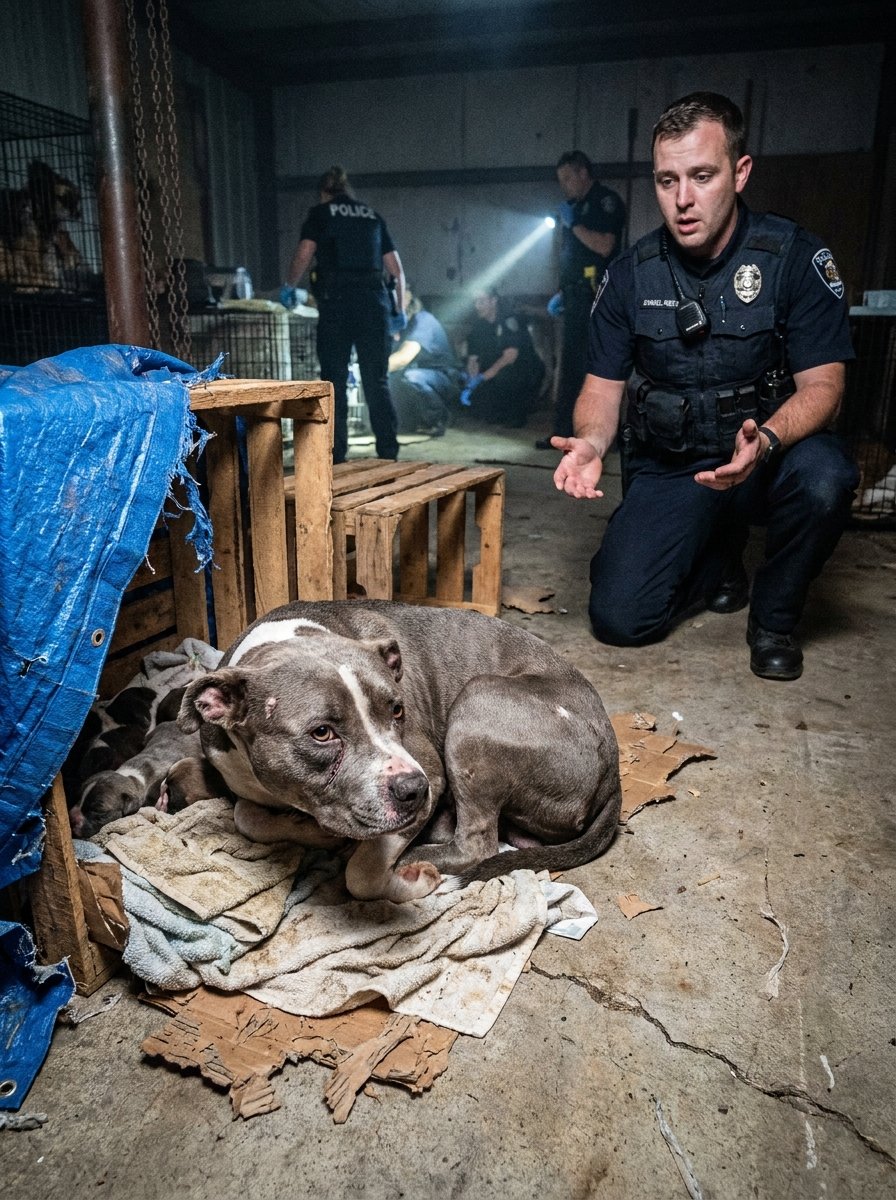
She would not allow us near the puppies at first. I did not blame her. Every human she had known in that building had probably taken something from her: safety, food, rest, puppies from previous litters, trust, choice. Now strangers wearing badges and gloves were asking her to believe this time would be different.
Mara crouched beside me with a towel in her lap.
“She’s postpartum and injured,” she said. “We need to move them together. If we separate her from the puppies, she may panic.”
“I’ll stay here.”
“You don’t have to.”
I looked at Grace’s face in the flashlight glow. Her left cheek had a long pale scar. Her front leg trembled. Her body was angled around the puppies so tightly that she looked like a living barricade.
“Yes,” I said. “I do.”
The veterinarian, Dr. Simone Hart, arrived in a navy jacket with her hair pinned up and exhaustion already visible beneath her eyes. She had treated cruelty cases before. She knew not to approach directly. She sat on the floor several feet away, opened a can of soft food, and slid it across the concrete.
Grace stared at it.
Then at me.
Then at Dr. Hart.
The puppies wriggled beneath her belly.
Her hunger finally overcame her suspicion. She leaned forward and took one small mouthful. Then another. She ate slowly, never turning her body away from the puppies.
“That’s good,” Dr. Hart whispered. “Good mama.”
Grace’s ears moved at the word mama.
Maybe tone mattered more than meaning.
Maybe every mother understands when someone recognizes the job.
It took almost forty minutes before Grace allowed Dr. Hart to examine one puppy. Even then, she watched every finger. No sudden movements. No lifting too high. No passing the baby from person to person. One puppy at a time, checked, dried, warmed, and placed back against her.
Seven puppies.
All alive.
Two were underweight. One had a weak suckle reflex. All needed warmth and close monitoring. Grace herself was in worse shape than she let on. Her front leg had an old injury that had healed badly. Her skin showed untreated infections. Her body was malnourished, dehydrated, and exhausted from nursing.
But her eyes never left the puppies.
When we finally moved them, we used a wide transport crate lined with clean blankets. Dr. Hart placed the puppies inside first while I sat near Grace’s head. Grace growled once, deep and warning, then looked at me.
I do not know why I did what I did next.
Maybe because instinct sometimes speaks before training.
I placed my hand flat against the concrete between us, palm down, not reaching.
“You go with them,” I said. “Nobody takes them without you.”
Grace smelled my hand.
Her nose was dry.
Her breath was warm and sour with hunger.
Then she stood, painfully, and stepped into the crate with her puppies.
The door closed softly.
Not like a cage.
Like a promise.
Outside, dawn was turning the sky pale over the gravel lot. One by one, the dogs were loaded into climate-controlled vehicles bound for emergency shelter, veterinary care, and forensic evaluation. Reporters had not arrived yet. Neighbors had not gathered. The world beyond the warehouse still slept.
Inside Grace’s crate, a puppy squeaked.
She lowered her head and covered it with her chin.
I stood beside her until the transport vehicle pulled away.
For the first time that night, I felt my anger turn into something heavier.
Responsibility.
Part 3 — The Dog People Feared Before They Knew Her
Grace became a legal evidence animal first.
That sounds cold, but it mattered. Until the criminal case moved forward, the rescued dogs could not simply be adopted out. Their injuries, conditions, and identities had to be documented. Veterinary records were not only medical files; they were testimony. Every scar, infection, broken tooth, healed fracture, and sign of repeated confinement helped prove what had been done.
The emergency shelter was set up in a converted county facility with separate quiet areas for the most fragile dogs. Volunteers brought blankets, crates, food, laundry detergent, and coffee for staff who did not sleep much that week. Each dog received a number at first because names could complicate evidence tracking.
Grace was Dog 17F.
I hated that.
Mara understood.
“Names come after paperwork,” she said.
“She needs one now.”
“She has seven newborn puppies and a dedicated medical team. She does not care what we put on the chart.”
“She might.”
Mara looked through the observation window at Grace curled around her litter.
“What would you call her?”
I did not answer immediately.
The name Grace did not come from softness. It came from contradiction. She had been forced into a world built to remove gentleness from dogs, and yet every movement she made toward her puppies was careful. Every time a technician changed bedding, Grace watched with suspicion but did not lash out if the puppies were handled respectfully. She had restraint no one had ever taught her kindly.
“Grace,” I said.
Mara nodded once.
“Then we’ll call her Grace in the room and 17F on the forms.”
That was good enough.
Public reaction came fast after the department released a statement. The photos were limited and respectful, but people still saw enough: rows of crates, evidence bags, animal transport vehicles, and the blurred outlines of dogs being carried into safety.
Most people were horrified.
Some were compassionate.
Some were ignorant in the way people become when fear arrives before information.
“They should put them all down,” one comment read.
“Fighting dogs can’t be trusted.”
“Pit Bulls are dangerous anyway.”
I read those comments at two in the morning and felt something hard settle in my chest.
I had been inside that warehouse.
I had seen what humans did.
Then I watched humans blame the dogs for surviving it.
At the shelter, Grace did not behave like a monster. She behaved like a mother who had learned that the world was dangerous and her babies were all she had. She allowed Mara to change water bowls. She allowed Dr. Hart to examine her leg. She allowed me to sit outside her pen and read reports aloud in a low voice while the puppies nursed.
She did not wag.
Not for weeks.
She did not seek touch.
She did not play.
She did not know play was allowed.
The puppies grew quickly because puppies do not understand the weight of their own beginnings. We named them after virtues, at Mara’s suggestion, because she said if the world could label dogs by fear, we could label them by hope.
Hope.
Mercy.
Brave.
Joy.
Promise.
Honor.
Little Faith, the smallest.
Grace watched us name them with the weary patience of a mother unimpressed by human ceremonies.
When the puppies were four weeks old, one crawled over Grace’s front paw and bit her ear with tiny gums. Grace froze. For a second, I thought pain memory might make her snap.
Instead, she turned her head and nudged the puppy back toward her belly.
So gentle.
So deliberate.
I thought of the comments online.
Dangerous.
Untrustworthy.
Beyond saving.
And I wished every person who had typed those words could see a scarred dog choose not to hurt the fragile creature annoying her ear.
The criminal case strengthened. Investigators identified six primary suspects and several others involved in transporting, betting, or housing dogs. Financial records, witness statements, messages, and physical evidence from the warehouse created a case far larger than one night’s raid.
The men arrested looked angry in court.
Not ashamed.
That part bothered me most.
Grace did not know about court. She knew pain meds, food bowls, clean bedding, and the rhythm of people who came and went without hurting her. Slowly, that rhythm mattered.
One evening, after a twelve-hour shift, I stopped by the shelter and found Grace awake while her puppies slept in a pile beside her.
I sat on the floor outside her pen.
“You did good today,” I said.
She looked at me.
I placed my hand near the gate, not through it.
She stared for a long time.
Then she moved her nose forward and touched one finger.
Barely.
One second.
But it was contact she chose.
I sat there after she pulled away, afraid that if I moved, the moment would disappear from history.
Mara found me like that ten minutes later.
“She touched you?”
“Yes.”
“She’s in trouble now,” Mara said.
“Why?”
“Because you’re going to fall in love with her.”
I already had.
Part 4 — When the Puppies Left
Grace’s puppies became healthy, round, loud, and completely unaware that their mother’s body had once stood between them and a room full of cruelty.
That is one of the mercies of rescue.
The young do not always have to remember what the old survived.
At eight weeks, the puppies were moved into foster homes approved through the court and shelter system. They were not adopted yet, because the legal case remained active, but foster placement allowed them to develop normally outside the emergency facility. Each foster family received strict instructions: socialization, vet visits, gentle handling, no dog parks, no chaotic introductions, and regular reports.
Grace watched the first puppy leave with a tension that made everyone in the room hold their breath.
Hope went first.
A soft-spoken foster woman named Elaine Porter knelt near the pen while Mara lifted Hope into a carrier. Grace stood, ears forward, eyes sharp. She did not growl. But her entire body asked one question.
Are you taking my baby where I cannot follow?
Mara spoke softly the whole time.
“Hope is safe. Hope is going to a warm house. Hope is coming back for checkups. You did your job, mama.”
Grace did not understand the words.
But she understood tone.
After Hope left, Grace paced for twenty-three minutes.
I counted.
Then she lay down and rested her head where the puppy pile had been.
Over the next week, all seven went to foster homes. Each departure was painful. Not dramatic. Painful in the quiet way of necessary things. By the time Little Faith left, Grace seemed both anxious and exhausted, as if motherhood had been her only mission and now she did not know who she was without a body to protect.
That was when the deeper rehabilitation began.
A dog used for fighting is not healed by being removed from a fighting ring. Removal ends the immediate harm. Healing begins afterward, in the long and often boring work of teaching safety to a nervous system shaped by violence.
Grace had to learn that food would arrive without competition.
That hands could touch without grabbing.
That leashes did not always lead to pain.
That other dogs did not always mean danger.
That rest was allowed.
That being alone in a room did not mean abandonment.
Dr. Hart referred Grace to a behavior specialist named Nadine Brooks, a woman whose patience made ordinary calm look amateur. Nadine did not speak about dogs as “good” or “bad.” She spoke about thresholds, triggers, stress signals, reinforcement, and choice.
“Grace has had every choice taken from her,” Nadine said during the first session. “We give them back carefully. Too much freedom too quickly can scare a dog who survived by controlling one small space.”
That surprised me.
I had assumed freedom would feel good immediately.
Nadine shook her head.
“Open space can feel unsafe if all you know is confinement and threat. Healing is not just removing the bad thing. It is building enough good things that the body believes the bad thing is over.”
I thought about people I had met on calls. Survivors of abuse who still checked exits. Children who hid food. Veterans who sat with their backs to walls. My own father, who had come home from Vietnam before I was born and never slept without a light in the hall.
Maybe bodies are bodies.
Human or dog, they remember what kept them alive.
Grace progressed slowly. At first, she tolerated my presence, then Mara’s, then Dr. Hart’s. She learned to walk on a leash in quiet areas behind the shelter. She sniffed grass like it was a foreign country. The first time a bird flew out of a hedge, she dropped to the ground and trembled. I sat beside her for seventeen minutes until she rose again.
“You don’t have to be brave fast,” I told her.
That became something I repeated often.
To her.
To myself.
After the court officially released the dogs for placement, adoption discussions began. Some dogs went to specialized rescues. Some required sanctuary care. Some, after careful evaluation, moved into experienced foster-to-adopt homes. None were rushed. No one pretended love alone could replace training, decompression, and structure.
Grace received few adoption inquiries.
People loved her story from a distance. Up close, they saw scars, breed stigma, medical needs, and a dog who did not perform gratitude on command. They wanted the happy ending but not the slow work.
I understood more than I wanted to.
At the shelter, Grace began greeting me with a small tail movement.
Not every time.
Not if the day had been stressful.
But often enough that staff started noticing.
Then one day, after a behavior session, she leaned against my leg.
Her weight was careful.
Testing.
I lowered one hand to her shoulder.
She stayed.
Nadine watched from across the room.
“You know,” she said, “some dogs choose before humans catch up.”
I looked down at Grace.
She looked up at me with scarred eyes that had seen the worst of people and still had not entirely given up on one.
The adoption application was ten pages long.
I filled out every line.
Part 5 — The House Where Nothing Was Demanded
Grace came home on a rainy Tuesday.
I had prepared my house the way some people prepare for a newborn: gates, rugs, beds, bowls, quiet rooms, covered crate with the door removed, medication schedule on the refrigerator, emergency vet number taped near the phone, and a list of instructions from Nadine so detailed it looked like a legal document.
My house sat at the edge of town, small and brick, with a fenced backyard and a pecan tree that dropped branches whenever wind got dramatic. I lived alone. That helped. No children rushing. No other pets. No unpredictable roommates who thought “she loves dogs” meant an immediate hug.
Grace entered slowly.
She sniffed the threshold, froze, and looked back toward my truck.
“It’s okay,” I said. “We can take all day.”
It took forty-three minutes for her to cross fully into the living room.
She did not explore.
She went straight to the corner where I had placed her bed, circled twice, and lay down facing the door.
For three days, she watched me more than she slept.
I moved quietly. I did not invite visitors. I did not turn on the television loudly. I did not reach over her head. I announced myself before entering the room. If she chose distance, I respected it. If she came closer, I stayed still enough to make closeness safe.
Grace ate only when I sat across the room.
By the second week, she ate while I stood at the counter.
By the fourth, she ate with her back turned to me.
That felt like trust.
People wanted updates.
The department wanted photos. The community wanted to see the famous mother dog smiling on a couch, wrapped in blankets, healed by kindness in one beautiful frame. I understood why. People need proof that horror can turn into softness.
But Grace did not owe anyone proof.
For months, the only photos I shared were simple: Grace sleeping near sunlight, Grace sniffing the yard, Grace’s paw beside a chew toy she had not yet touched. No forced costumes. No dramatic captions. No “look how grateful she is.” Gratitude is not a rescue dog’s job.
Her job was to exist without fear.
My job was to make that possible.
Spring came.
Grace discovered the backyard in layers. First the porch. Then the steps. Then the patch beneath the pecan tree. One morning, she rolled in grass for the first time. Not a full joyful roll. More like a cautious tilt, shoulder first, then back, then a sudden look of surprise when nothing bad happened.
I laughed.
She startled.
Then she looked offended, as if joy was private and I had interrupted.
By summer, she carried toys from room to room but rarely played with them. By fall, she brought me one when I came home from shift. A blue rubber ring, held gently between teeth that had once been used by men for violence.
That image stayed with me.
A mouth trained for harm choosing to carry a toy.
The therapy dog idea did not begin with me.
It began with Grace and a child named Milo.
Milo was nine years old, the son of one of our dispatchers. He had been through a house fire the previous year and struggled with anxiety around loud noises. During a department family picnic, he slipped away from the crowd and sat behind a storage shed, covering his ears because someone had dropped a tray of metal utensils.
Grace, who had come only for a controlled short visit with Nadine’s approval, saw him before I did.
She did not rush.
She walked slowly toward the shed, stopped several feet away, and lay down with her body turned sideways. Non-threatening. Quiet. Present.
Milo looked at her.
Grace rested her chin on her paws.
For ten minutes, neither moved.
Then Milo whispered, “She has scars too.”
I stood nearby, careful not to make the moment too large.
“Yes,” I said.
“Did she get scared?”
“Yes.”
“But she’s still nice?”
I looked at Grace, who had every reason not to be.
“Yes,” I said. “She’s still nice.”
Milo crawled closer and placed one hand in the grass near her paw. He did not touch her. Grace did not move away.
That night, Nadine said, “She may have a gift.”
I said, “She has been through enough.”
“Those can both be true.”
So we began carefully.
Not therapy work yet.
Just evaluation.
Temperament.
Stress tolerance.
Recovery time.
Response to children.
Comfort with medical equipment.
Comfort with wheelchairs, crutches, sudden sounds, crying, and crowded rooms.
Many dogs are kind at home and overwhelmed in public. Many rescued dogs love their people but should never be asked to comfort strangers. Grace’s welfare came first. Nadine made that clear.
But Grace surprised us.
She did not love chaos.
She loved quiet sadness.
A crying child in a corner.
A teenager frozen outside a counselor’s office.
A little girl in a hospital waiting room holding a stuffed animal too tightly.
Grace approached pain the way she wished people had approached hers: slowly, sideways, without demands.
After a year and a half of rehabilitation, training, testing, and supervised visits, Grace became a certified therapy dog through a legitimate program.
The day she received her blue bandana, I thought of the warehouse.
Then I thought of the puppy under her chin.
She had always been protecting something.
Now the world finally gave her safe places to do it.
Part 6 — The First Child She Helped
Grace’s first official therapy visit was at Willow Bend Children’s Center, a small counseling and family support clinic that served kids dealing with trauma, grief, foster transitions, medical fear, and anxiety.
I wore plain clothes because the uniform made some children nervous. Grace wore her blue therapy bandana and a soft harness. Nadine came with us for evaluation. The visit was scheduled for thirty minutes with one child, a seven-year-old girl named Avery who had recently entered foster care and refused to speak in counseling sessions.
No one expected a miracle.
That word was not allowed.
Therapy dogs do not fix children. They create openings. They soften rooms. They give frightened hearts something safe to notice.
Avery sat on a beanbag chair near the window, knees pulled to her chest, face half-hidden behind tangled brown hair. Her therapist, Ms. Lillian Carter, sat nearby with a notebook closed on her lap. The room held soft lamps, shelves of toys, a sand tray, and a mural of trees painted along one wall.
Grace paused at the doorway.
I watched her body carefully.
Loose tail.
Soft eyes.
Ears neutral.
No tension along her back.
“Okay,” I whispered.
Grace entered slowly and stopped six feet from Avery. She did not approach head-on. She turned slightly sideways and lay down.
Avery looked at her scars first.
Children often did.
Adults looked away politely. Children saw what was there.
“What happened to her?” Avery whispered.
It was the first thing she had said in that room in weeks.
Ms. Carter’s eyes lifted to mine, but she did not interrupt.
I sat on the floor near Grace.
“Some people hurt her,” I said carefully. “Then a lot of people helped her get safe.”
Avery stared at Grace.
“Did she bite them?”
“No.”
“Why not?”
I thought about every simple answer that would be false. Because she was good. Because she was sweet. Because dogs forgive. None of that was enough.
“Because what happened to her was not who she wanted to become.”
Avery’s face changed.
Grace rested her chin on her paws.
The room stayed still.
After several minutes, Avery slid off the beanbag and sat on the floor. She did not touch Grace. Grace did not move closer.
“She looks sad,” Avery said.
“Sometimes.”
“Is she scared?”
“Sometimes.”
“Even now?”
“Sometimes even now.”
Avery nodded as if this was the first honest thing an adult had said in a while.
Then she whispered, “Me too.”
That was the opening.
Not a dramatic breakthrough. Not a movie scene. Just two words placed gently in a room with a scarred dog who understood quiet.
Grace visited Avery weekly for three months. At first, Avery only sat near her. Then she brushed Grace’s back with a soft grooming mitt. Then she read picture books to her. Eventually she told Ms. Carter things she had not been able to say before, sometimes while holding Grace’s bandana, sometimes while tracing the white patch on Grace’s shoulder.
Grace never performed tricks.
She did something harder.
She remained.
Children trusted that.
The therapy program expanded slowly. Grace visited hospitals, counseling rooms, school reading programs, and grief groups. She never worked more than her limits allowed. If she turned away from a doorway, we listened. If she became tired, we left. If a child moved too fast, I blocked gently and taught safer handling.
Her past was never used as a spectacle.
But when appropriate, and when a counselor believed it could help, I told children a simple version.
“Grace was hurt by people who wanted her to be mean. But she had kindness inside her, and with time, safety, and help, that kindness grew stronger.”
Children understood that better than adults.
Adults wanted categories.
Dangerous or safe.
Broken or healed.
Victim or hero.
Children understood becoming.
One boy with anger problems asked if Grace had ever been angry.
“Yes,” I said.
“What did she do?”
“She learned she did not have to live in the place that made her angry forever.”
He sat with that for a while.
Then he patted the floor beside him.
Grace walked over and leaned her shoulder gently against his knee.
By then, her puppies had all been adopted into carefully screened homes. We held a reunion two years after the raid at a private training field. Grace recognized them slowly, scent by scent. Hope was taller than her. Brave had her eyes. Little Faith, once the weakest, ran circles around everyone until Grace huffed as if embarrassed by her children’s manners.
Watching her there, surrounded not by cages but by families, I felt the full weight of what had almost been stolen.
Not only their lives.
Their futures.
Hope became a beloved hiking dog.
Mercy slept in bed with two retired teachers.
Brave lived with a firefighter.
Joy belonged to a young couple who sent too many photos, which I secretly appreciated.
Promise helped a teenager recover from depression.
Honor became a calm companion to an older widower.
Little Faith ruled a house with three children and one patient cat.
Grace watched them all, scarred and steady, as if counting proof that what began in darkness did not have to end there.
Part 7 — What Grace Chose to Become
Grace lived with me for ten years.
Her muzzle turned white. Her front leg stiffened with age. The scars across her face softened beneath silver fur but never disappeared. I never wanted them to. They were not shame. They were history.
She retired from therapy work when she began choosing naps over visits. Nadine helped me make that decision before I could turn my love into selfishness. Grace had given enough. More than enough.
Her final therapy visit was at Willow Bend Children’s Center, the place where she first helped Avery speak.
Avery was seventeen by then, tall, confident, and preparing to graduate high school. She had asked to be present for Grace’s retirement visit. When she walked into the room, Grace lifted her head from the blanket and thumped her tail once.
Avery knelt beside her.
“You still remember me?”
Grace licked her hand.
Avery cried, but softly.
“I used to think scars meant something was ruined,” she said. “Then I met her.”
No one in the room spoke for a moment.
There are sentences that need space around them.
Grace spent her retirement in my house beneath the pecan tree, on the couch she had gradually claimed, and beside the kitchen window where morning light warmed her back. She still carried the blue rubber ring when I came home, though by then she moved slowly and sometimes forgot where she had dropped it.
The men convicted in the fighting case served their sentences. Some received prison time. Some received probation and bans on owning animals. The case led to more investigations in neighboring counties. Laws were strengthened. Training improved. Our department learned to recognize signs sooner, document better, and coordinate faster with animal welfare professionals.
But laws were not the only legacy.
Grace changed people.
She changed officers who had once used the words “fighting dog” too casually.
She changed children who thought anger made them bad.
She changed parents who watched a scarred Pit Bull lie patiently beside their hurting child and realized gentleness can survive almost anything when protected properly.
She changed me.
Before Grace, I believed rescue was the moment you opened the cage, cut the chain, or carried the animal out. Grace taught me rescue is often the easiest part to photograph and the hardest part to complete.
Rescue is the vet appointment six months later.
The training session that ends early because the dog is tired.
The visitor you tell no because your dog is not ready.
The slow introduction.
The refusal to turn trauma into entertainment.
The patience to let trust arrive on its own feet.
The humility to admit love does not erase history, but it can give history somewhere safer to rest.
Grace died on a warm May morning with her head in my lap and the blue therapy bandana folded beside her. Mara came. Dr. Hart came. Nadine came. Avery came with flowers. My house filled with people who had known different versions of her: the mother in the warehouse, the guarded shelter dog, the cautious house companion, the therapy dog who lay beside children when words were too hard.
Before Dr. Hart helped her rest, I told Grace what I had promised in the warehouse.
“Nobody is making you fight again.”
Her breathing was slow.
Her eyes were soft.
“And look what you did instead.”
Avery placed one hand gently on Grace’s shoulder.
“She made people feel safe,” she whispered.
Yes.
She did.
The dog once forced into violence became a place where frightened children put their hands when they wanted to remember they could still be gentle.
The mother once found guarding newborns behind broken crates became the dog who walked into counseling rooms and chose the quietest child.
The scarred survivor people feared before they knew her became proof that no one should be defined only by what was done to them.
We buried Grace’s ashes beneath the pecan tree in my backyard, where she had first rolled in grass and looked surprised that joy did not hurt. I placed a small stone there with words Avery helped choose:
GRACE
THEY TRIED TO MAKE HER FIGHT.
SHE CHOSE TO HEAL.
I still keep her blue bandana in my desk drawer.
Sometimes, before a hard shift, I open it and remember the warehouse. Not the cruelty. I do not give that place more power than it deserves.
I remember the growl.
The mother’s warning.
The seven puppies.
The scarred face watching my hands.
The moment she stepped into the transport crate because she believed, for one second, that her babies would go where she went.
That was where Grace’s story truly began.
Not in the ring.
Not in the warehouse.
In the choice she made after humans gave her every reason not to trust.
She chose to protect.
Then she chose to rest.
Then she chose to love.
Then she chose to help.
People still ask me whether a dog with her past can really become gentle.
I tell them they are asking the question backward.
The real question is how much goodness must live inside a dog for her to survive what Grace survived and still offer comfort to a crying child.
She was never what they tried to make her.
She was what remained when cruelty failed.
Follow this page for more unforgettable dog stories about rescue, healing, and the animals who prove that love can survive even the darkest places.