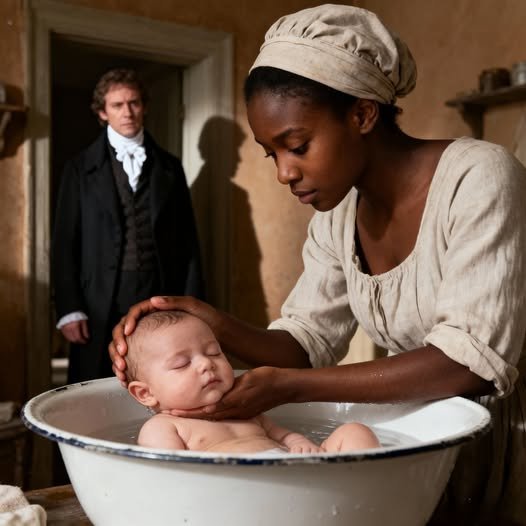
The great house of Santa Clara had become a tomb for the living. Baron Sebastião moved through its rooms like a ghost, haunted by the memory of his dead wife and the silent, unseeing child she left behind. Doctors had declared baby Felipe blind, and the Baron’s grief had built walls around them both—until a servant named Renata entered with a song.
She came quietly, this young woman with eyes that noticed everything. While cleaning, she heard the Baron’s desperate pleas to his son—”Show that you’re in there”—and saw the child’s strange stillness. Where others saw only blindness, Renata saw mystery. Where physicians saw a hopeless case, she saw patterns that didn’t add up.
Her investigation began with humming—an old song her mother taught her. When Felipe turned toward the sound, the Baron wept for the first time in months. Day by day, she conducted gentle experiments: a breath near his lips, a rattle by his hand, watching, always watching. Then came the discovery—a film so thin it was nearly invisible, covering the child’s eyes like a veil.
The confrontation with the doctors, the race to find a specialist, the tense surgery—all flowed from that initial moment of noticing. When Felipe finally opened his eyes to sunlight and his father’s face, the silence that had gripped Santa Clara shattered. The story reminds us that sometimes the most powerful medicine isn’t found in medical texts, but in the courage to see what others have overlooked, and the love that persists when hope seems lost.