You don’t expect your life to split open under chandelier light. You don’t expect a Tuesday-night restaurant shift to turn into a courtroom, a crime scene, and a resurrection all at once. But that’s exactly what happens the moment you step into the Grand Hall of the Skyline Restaurant with a damp rag in your hand and your uniform still smelling faintly like bleach. You’re not supposed to be seen in a room like this, not by people in linen suits and diamond watches, not by the kind of men whose names can shut down highways with one phone call. You’re supposed to glide between tables like air, collect empty glasses, fix stains before anyone notices they exist. That’s what you’ve trained yourself to be: silent, invisible, harmless.
Tonight, you fail at invisibility.
Not because you make a mistake.
Because you wear the only thing you’ve ever owned that felt like a promise.
The medallion rests at the base of your throat, warm from your skin, old gold that has dulled with time but never stopped looking like something sacred. You’ve worn it so long you forget it’s even there, like a second heartbeat. You don’t wear it for style. You wear it because it’s the only proof you were ever somebody’s baby. It came with you, tied in a double knot, tucked into a thin jacket that smelled like tobacco and rain and panic. That’s what the orphanage told you when you were old enough to ask questions. That’s what Sister Maura said when you asked why you didn’t have a birthday, why your life began like a rumor instead of a record.
“You were found,” she told you, voice gentle, eyes careful. “And you were loved enough for someone to leave you with a piece of their heart.”
So you keep it close.
Always.
Even when your life turns into mopping floors for people who wouldn’t look at you twice.
The Grand Hall is a museum of money. Crystal everywhere. Soft music. A live mariachi band that sounds like it was hired to decorate the air. The guests move in shimmering herds, laughing the way people laugh when they don’t mean anything. They’re here to celebrate a deal, a merger, a signature worth more than your entire childhood. You don’t know the details. You’re not paid to know. You’re paid to wipe away fingerprints from glass and make sure no one sees the sweat under their own privilege.
You’re moving between tables when you feel eyes on you.
Not a casual glance.
A lock.
The kind of stare that pins you like a needle through fabric.
Sebastián Cruz rises from his seat like a storm pulled upright. You’ve seen his face on screens in the staff room and on news clips that play above the cash register at the corner store. The most feared businessman in Puerto San Plata, they say. The kind of man who turns rivals into cautionary tales. The kind of man who owns half the coastline and still looks hungry. You’ve never been close enough to notice how tired his eyes are, how grief can sharpen a jawline the way hunger does.
But tonight, you’re close enough to hear him inhale.
Close enough to see his gaze drop to your throat.
Close enough to see his body forget manners and remember pain.
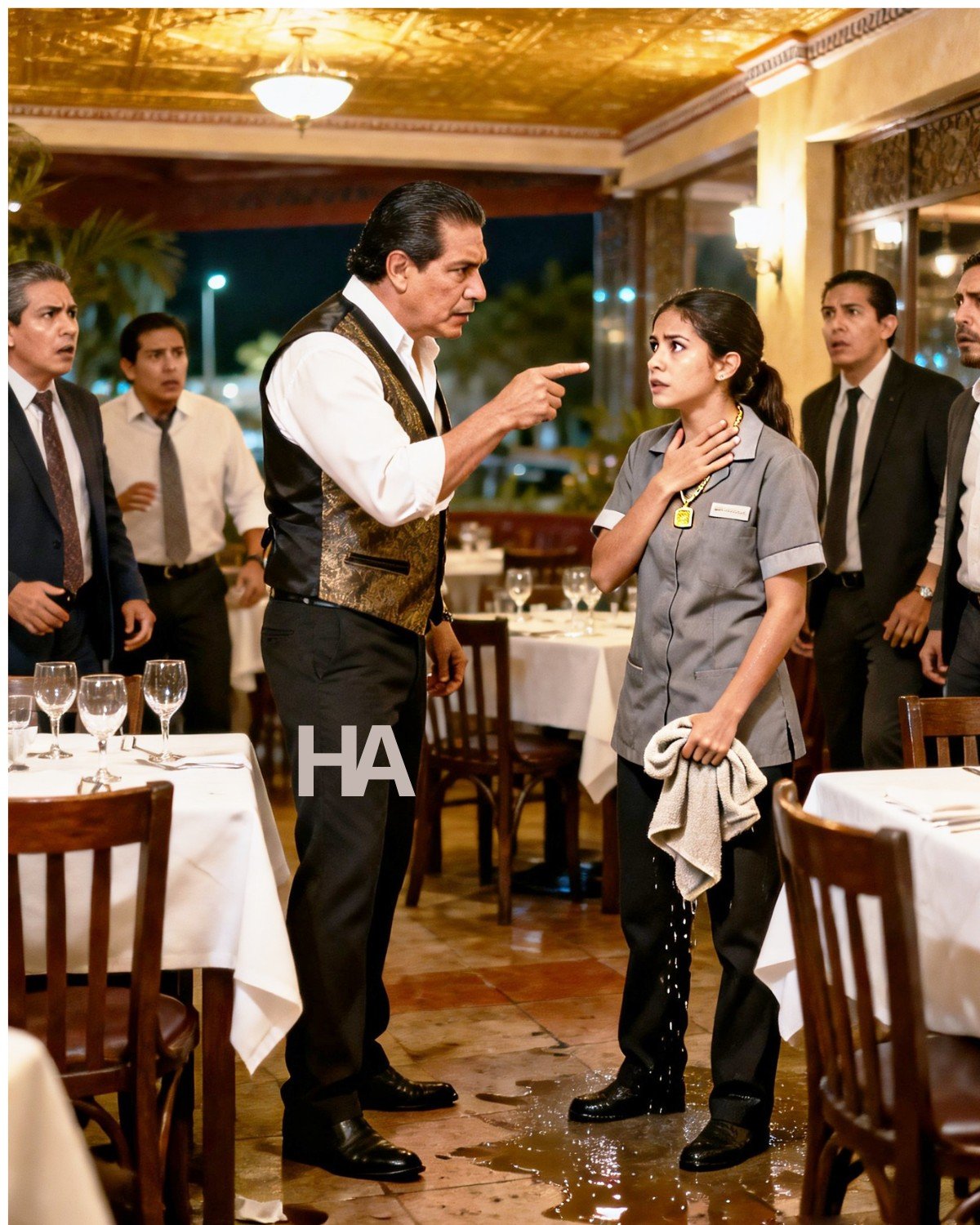
His shout detonates through the room.
“THAT NECKLACE WAS MY WIFE’S!”
The mariachi band stumbles into silence like someone cut the oxygen. Conversations die mid-syllable. A hundred heads turn in unison, all curiosity and cruelty. Your rag slips from your hand as if your fingers stop believing in gravity. Your instincts don’t tell you to run. They tell you to protect the medallion. Both hands fly up to cover it, as if palms could undo eyes.
“I didn’t steal anything,” you manage, voice shaking but stubborn. “I swear on my mother.”
You don’t even know if that oath counts, because you don’t know who your mother is.
But you say it anyway.
You say it because you need it to be true.
Sebastián doesn’t hear your words. He hears a memory. He hears a woman laughing, a car door slamming, a phone call that never connected. He shoves his chair back so hard it scrapes like a scream across the floor. He advances, furious and focused, and the guests part for him instinctively the way water parts for a blade. You back up until your spine meets cold marble. His face is inches from yours now. You smell expensive tequila and something else underneath it, something bitter and metallic like old fear.
“Don’t lie to me,” he growls. “I’ve been looking for it for twenty-three years. Where did you get it?”
You swallow and shake your head.
“It’s mine,” you whisper. “It’s all I have.”
And that’s when the manager, Vargas, runs in with panic poured all over his suit.
He doesn’t look at Sebastián like a person. He looks at him like a god with a temper. Vargas raises his hands as if he can hold back disaster with palms.
“Mr. Cruz, my deepest apologies,” he babbles. “She’s new. If she stole—”
Then he turns to you with the cruelty of a man trying to save himself.
“You’re fired,” he snaps. “Get out before I call the police.”
He grabs your arm like you’re a mop bucket he can drag into the back and forget.
You yelp, more in humiliation than pain, and you try to pull away.
But Sebastián’s hand clamps down on Vargas’s wrist with a force that stops the room again.
“Let her go,” Sebastián says quietly.
It’s not loud. It doesn’t need to be.
Danger doesn’t shout when it’s certain.
Vargas releases you immediately, face draining white.
Sebastián doesn’t even spare him a glance.
“Touch her again,” he adds, voice like ice, “and tomorrow you won’t own this restaurant. You’ll be cleaning it.”
Vargas stumbles back, trembling, and disappears like a coward swallowed by his own carpet.
Now it’s just you and Sebastián in the thick of everyone’s attention. Your cheeks burn under the heat of a hundred stares. This is the part where people like you get blamed, humiliated, erased. You can feel the verdict forming in the air, the way the wealthy love a story that reminds them of their own superiority. Housekeeper steals sentimental jewelry. Tycoon destroys her. Crowd gets entertainment with their dinner.
Except Sebastián doesn’t look entertained.
He looks haunted.
“Give it to me,” he demands, holding out his hand. “Right now.”
You clutch the medallion harder, knuckles whitening.
“No,” you say, voice breaking but firm. “It’s mine. It was on me when they found me as a baby.”
His jaw tightens.
“My wife wore it the night she died,” he hisses. “The night of the accident. Nobody survived. Nobody.”
The word nobody hangs between you like a curse.
Your stomach flips, but your spine straightens.
If you’re going to be destroyed, you won’t be destroyed lying down.
“Then prove it,” you say, surprising yourself.
He blinks, thrown off by your defiance.
“There’s an engraving,” you continue, and your voice steadies because you’ve stared at that engraving in mirrors your whole life. “Tell me what it says on the back.”
The room seems to lean in. Even the chandeliers feel like they’re listening.
Sebastián’s anger flickers, replaced by something rawer.
His voice drops to a whisper.
“It says… S + E forever.”
Your breath catches like you just swallowed lightning.
You turn the medallion with shaking fingers, letting the light catch the worn gold. The letters shimmer into view, simple and permanent.
S + E FOREVER.
Sebastián makes a sound that isn’t quite a sob and isn’t quite a laugh. He reaches for it, not like a thief, but like a drowning man reaching for air. When his fingers touch the metal, you see his hands tremble. A man like him doesn’t tremble for stock prices. He trembles for ghosts.
“How old are you?” he asks suddenly, voice tight.
“Twenty-three,” you answer.
His throat moves like he’s swallowing glass.
“When’s your birthday?”
“I… don’t know,” you admit. “They said they found me around December twelfth.”
The world stops.
December twelfth.
The day his wife’s car went off the cliff during the storm.
The day he buried Evelina and the baby the doctors swore never took a breath.
Sebastián’s face shifts like someone hit him with truth. His eyes go distant, then snap back to you with an urgency that scares you more than his anger did.
“You’re coming with me,” he says, gripping your elbow.
You jerk away.
“Give it back,” you demand. “That’s mine.”
He throws a thick stack of cash on the table without counting. Bills fan out like an insult.
“Ten thousand dollars for ten minutes,” he says. “Twenty if you come now.”
Your stomach twists. Money like that isn’t help. It’s power trying to buy obedience.
You set your jaw.
“Thirty,” you say, forcing your voice not to shake. “And I get the medallion back when we’re done.”
Sebastián studies you, and for the first time his expression changes.
Respect.
Not kindness. Not pity. Respect.
“Deal,” he says.
He orders a private room with a single word to security, and suddenly doors open like the building is afraid of him. You are led through hallways that smell like perfume and old money into a smaller lounge where the air is still. Sebastián locks the door himself. He doesn’t trust anyone else with this moment. He calls a doctor, voice clipped and shaking.
“Dr. Rivas. Now. DNA test. Emergency.”
Then he points to a sofa.
“Sit.”
You don’t sit. You stand with your back against the wall, arms folded like armor, eyes sharp.
“You said ten minutes,” you remind him.
“I said we’d talk,” he says. “Now you’re going to tell me everything you know.”
So you tell him. You tell him about the orphanage near the coast, the storm night Sister Maura described like a legend, the basket that arrived at dawn, the worn leather jacket tied around it with a double knot. You tell him the medallion was tucked inside, pressed against your skin like whoever left you wanted the gold to remember your heartbeat. You tell him you grew up with no paperwork, no birth certificate, no story that made sense. You tell him you learned early that the world doesn’t care why you’re here, only whether you’re useful.
Sebastián listens without interrupting, eyes fixed on your throat like he’s trying to see through time.
When Dr. Rivas arrives, gray-haired and irritated, Sebastián doesn’t apologize. He just says, “Paternity test. Tonight.”
The doctor argues. Sebastián writes a check.
The doctor stops arguing.
The swabs are quick. The silence afterward is not. Sebastián doesn’t let you leave. He escorts you out through a private elevator into a penthouse that looks like a magazine and feels like a cage. Your phone is taken “for security.” The doors lock with soft clicks that sound too polite for kidnapping. You tell yourself you can scream, but your pride refuses to give the building that satisfaction. Instead, you watch him pace like an animal trapped in a memory.
Then his lawyer shows up: Arturo Salcedo, suit too perfect, smile too empty. He looks at you like dust on a rich man’s shoe.
“This is a scam,” he says flatly. “A cleaning girl with a half-million-dollar necklace?”
You lift your chin.
“Call the orphanage,” you say. “Call Sister Maura.”
Sebastián hesitates, then hands you the phone on speaker. You dial with trembling fingers, and when Maura answers, her voice is older but still gentle. She confirms the night you were found. She confirms the jacket. She confirms the medallion. And then she says something she never told you before, something that makes Sebastián’s breath catch.
“There was a man,” Maura says slowly. “A shadow. He was limping. He carried the basket like it weighed more than a baby. And before he left, I heard him whisper… ‘Forgive me, God.’”
Sebastián’s hands ball into fists.
“If Evelina died,” he murmurs, voice hoarse, “and you’re here… somebody lied.”
You stare at him.
Because if somebody lied, then your entire life was built on someone else’s crime.
At three in the morning, the call comes.
Dr. Rivas doesn’t waste words.
“Ninety-nine point nine percent,” he says. “Sebastián… she’s your daughter.”
Arturo’s pen slips from his fingers like it’s suddenly too heavy.
You clamp a hand over your mouth, your legs going weak.
Sebastián drops to his knees like the air got knocked out of him by a miracle. His face collapses into something human. Something broken.
“You’re alive,” he whispers, voice shattering.
The word alive trembles between you like a bridge.
And before you can stop it, before your pride can catch up, you whisper the word you’ve never said in your life.
“Dad.”
That should be the ending, right there. The lost daughter found. The necklace returned to its story. The world reassembled.
But life doesn’t give you neat endings when money and betrayal are involved.
It gives you sequels.
The threats start the next day. Anonymous calls. A black SUV parked across from the penthouse. A message slipped under the door that reads: Stop digging or you’ll join her. You don’t even know who her is until Sebastián takes you to the cemetery at dusk. He stands in front of a stone that reads EVELINA CRUZ, and the way he says her name is like a man tasting grief again after years of pretending he forgot.
“I looked for you,” he tells you, eyes wet but furious. “I looked until I couldn’t breathe.”
You don’t know what to do with that.
Because your whole life, you’ve survived by not needing anyone.
And now you’re standing next to a man who was supposed to be a myth in your blood.
Sebastián hires a private detective, Cárdenas, the kind of man who moves like he already knows where bodies are buried. In two days, Cárdenas brings a name: Elías “The Limp.” The shadow from Maura’s memory. A man who used to drive for Sebastián’s company, who vanished after the crash. A man rumored to live in a state-run elderly shelter outside the city.
You go with Sebastián because you refuse to be left behind again.
The shelter smells like bleach and loneliness.
Elías sits in a wheelchair by a cracked window, eyes sunk deep into guilt.
When Sebastián steps in, Elías starts shaking.
“Boss,” he croaks. “I didn’t mean—”
Sebastián’s voice is cold.
“You stole my child,” he says. “Tell me why you’re still breathing.”
Elías breaks. Not dramatically. Not with movie villain flair. He breaks like an old man who carried a secret too long. He confesses that the crash wasn’t an accident. That “they” paid him. That the road was slick and the brakes were tampered with. That Evelina begged him to save the baby, and he did, but he panicked. He feared the men who paid him. He feared the company’s internal war he didn’t understand. So he took you, delivered you to the orphanage, and disappeared.
Sebastián’s hands tremble again, but this time it’s rage, not hope.
“Who paid you?” he demands.
Elías whispers a name that makes Arturo’s face go blank when Cárdenas repeats it later.
Arturo Salcedo.
You feel the room tilt.
Because you’ve been sleeping under the same roof as the man who helped erase you.
And Sebastián realizes it at the same moment, his gaze snapping to his lawyer like a loaded weapon.
Arturo raises both hands.
“Sebastián, think rationally,” he says, voice smooth. “You’re emotional. This is dangerous.”
Sebastián smiles without humor.
“The only dangerous thing,” he says, “is that I trusted you.”
That night becomes a chase. Not through glossy hotel corridors, but through industrial outskirts where the air smells like rust and old rain. Cárdenas tracks Arturo to an abandoned grain silo by the river. You ride in Sebastián’s armored vehicle, heart pounding so hard you taste metal. You tell yourself you’re not a victim anymore. You tell yourself you’re not going back to being a nobody dropped in a basket.
Gunfire erupts before you even step out.
Sebastián yanks you behind the car, his body shielding yours without thinking.
You hear your own breath, fast and jagged, and you realize this is what fathers do.
They stand between you and the bullet.
They don’t ask if they deserve the role.
They just do it.
Arturo appears in the distance, suit still clean, gun in hand, eyes empty as a shark’s.
“It was business,” he calls out. “She was in the way. The baby was leverage. That’s all.”
Sebastián steps out with his hands raised, voice loud enough to carry.
“FEDERAL AGENTS ARE ON THEIR WAY,” he lies, buying time.
Arturo laughs, bitter.
“You always thought money made you untouchable,” he sneers. “Tonight you learn the truth.”
Then a helicopter’s rotors chop the sky.
Lights wash over the silo.
Agents swarm in.
Cárdenas signals from behind a barricade, and you realize he wasn’t just a private detective. He was the hook Sebastián set into the system.
Arturo tries to run. He doesn’t get far.
He’s tackled in the mud, cuffs clicking onto wrists that signed away lives with ink.
Elías is taken into protective custody.
The men who helped tamper with the brakes are arrested one by one like dominoes.
In the chaos, Sebastián grabs your face gently, like you might vanish if he doesn’t hold on.
“Are you hurt?” he asks, voice wrecked.
You shake your head, tears spilling without permission.
“No,” you whisper. “But I’m… I’m tired.”
He nods like he understands.
“I know,” he says softly. “I’m so sorry.”
Days later, the city explodes with headlines. The tycoon’s dead wife wasn’t just a tragedy. It was a crime. The missing baby wasn’t a rumor. It was you. Cameras wait outside the courthouse. Sharks in suits circle. People say your name like it’s a story they’re entitled to.
But you don’t belong to them.
You walk into the courtroom wearing a simple white suit that doesn’t scream wealth, it whispers dignity. The medallion rests on your throat again, not as a question, but as an answer. Sebastián sits behind you, not as an owner, not as a savior, but as a man trying to earn the right to be present. Arturo, in cuffs, looks smaller than he ever did in his tailored power.
The judge reads charges.
Evidence plays.
Maura’s testimony cracks the room open.
Elías sobs through his confession.
And when the court accepts you as Sebastián’s daughter legally, officially, on paper that can’t be erased, you feel something inside you unclench for the first time in your life.
You go to the cemetery at sunset with Sebastián. No cameras. No speeches. Just wind and quiet. You kneel by Evelina’s grave and trace the carved letters with your fingertips as if you can read her through stone.
“Hi, Mom,” you whisper. “I came back.”
Sebastián stands beside you, shoulders shaking.
“I’m sorry I didn’t find you sooner,” he says.
You look up at him, eyes burning.
“Don’t buy me a life,” you tell him. “Walk with me while I build it.”
He nods, swallowing his pride.
“I will,” he promises. “I swear.”
And he proves it, not with diamonds or press conferences, but with paperwork and purpose. He creates a fund for children without birth records. He finances shelters that don’t just store kids, but protect them. He hires therapists, social workers, people who actually know how to mend fractures like yours. He makes sure the orphanage where you grew up never runs out of medicine again.
Elías, the man who stole you and saved you in the same breath, receives a small house far from the coast and a battered old dog that limps like he does. Sebastián doesn’t forgive him easily, but he doesn’t let hatred rot him either.
“He did something unforgivable,” Sebastián tells you. “But he also kept you alive.”
You hate that both can be true.
But you learn to live with complicated truths.
That’s adulthood.
That’s survival.
One night, you stand on the balcony of Sebastián’s penthouse watching Puerto San Plata glow like a jeweled throat under the moon. The city feels different now. Less like a monster. More like a place you might actually belong. You hold the medallion in your palm, feeling the worn grooves of S + E forever, and you realize it doesn’t hurt the same way anymore. It still carries sorrow, but it also carries return. It’s no longer a mystery chained around your neck. It’s a key.
Sebastián steps beside you quietly, careful not to scare you with closeness.
“We’re late,” he murmurs.
You nod, swallowing the ache in your chest.
“Yeah,” you whisper. “We are.”
He looks at you with a softness that doesn’t demand anything.
“But we’re here,” he says.
You lean your head against his shoulder, and for the first time in twenty-three years, the word family stops sounding like a fairy tale and starts sounding like a door that actually opens. The city keeps shining. The wind keeps moving. The past doesn’t disappear.
But you’re not alone inside it anymore.
And that changes everything.
THE NECKLACE DOESN’T FEEL HEAVY ANYMORE
You think closure is a door that slams shut.
You learn it’s more like a window you have to keep opening, morning after morning, even when your hands still shake. The weeks after the trial blur into a strange new rhythm: lawyers, signatures, cameras you keep dodging, and a city that suddenly thinks it owns your name. Sebastián tries to shield you from all of it, but he doesn’t do it by barking orders anymore. He does it by asking first, by waiting for your nod, by learning your silences like a language. You notice the way he flinches whenever someone calls you “the heiress,” as if the word steals something from the girl who used to scrub floors for tips. You notice, too, the way you still wake up at night expecting someone to yank the rug out from under your life again. Some fear doesn’t leave politely. It has to be walked out of the room.
On a quiet Saturday, you ask him to take you somewhere that isn’t marble or glass or guarded by men with earpieces.
You tell him you want to go back to Sister Maura, and for the first time, Sebastián doesn’t try to “upgrade” your request into a private jet or a security caravan. He drives you himself in a plain SUV, wearing a cap like a normal man, hands tight on the steering wheel like he’s terrified the road might betray him again. When the orphanage comes into view, your throat closes, because you can still smell the bleach and cheap soup in your memory. The children run across the courtyard with the kind of wild laughter you didn’t realize you missed until it hits you. Sister Maura steps outside, slower now, hair whiter, but her eyes land on you like they’ve been waiting for this scene to finish for years. She doesn’t call you “miracle” or “poor thing.” She just says your name, soft and steady, like it always belonged to you.
You walk through the halls where your life once fit inside a metal bed frame and a single locked drawer.
You show Sebastián the corner where you used to sit and braid your own hair because nobody had time. You point at the old storage closet where you hid when you cried, because you learned early that crying in front of people invites opinions. Sebastián stands there silently, jaw clenched, not trying to defend himself with excuses like I didn’t know. He just keeps breathing, like he’s forcing himself to stay in the truth instead of running from it. Then you do something that surprises you: you take off the medallion and place it in Sister Maura’s palm. Maura’s fingers close around it gently, like she’s holding a heartbeat. You tell her you don’t want it to be a chain anymore, and you don’t want it to be a trophy either. You want it to be a door key for kids who don’t have doors.
That’s how the program starts, not with a press conference, but with a handshake in a hallway that smells like soap.
You and Sebastián set up a fund that pays for birth registration, legal aid, emergency shelters, and safe placement for infants found like you were. You insist on one rule: no child gets treated like a case number, and no caregiver gets treated like “the help.” Sebastián doesn’t argue, even when the board members raise eyebrows at your “sentimental policies.” He watches you speak, and you see something shift in him again and again: pride that isn’t possessive, love that doesn’t demand repayment. When reporters ask you if you’re “forgiving” him, you don’t give them a headline. You tell them forgiveness isn’t a statement. It’s a practice. Some days you can do it. Some days you can’t. Either way, you keep walking.
Your hardest day arrives on December twelfth.
Not because the world remembers it, but because your body does. You sit at the edge of your bed and stare at the medallion, now kept in a small box by your nightstand, and it feels like staring at a date written in fire. Sebastián knocks softly and asks if he can come in, and you almost say no out of habit. Instead, you let him sit on the floor beside you, because something in you refuses to let this day be lonely again. He tells you about Evelina, not as a saint, not as a tragic headline, but as a real woman who laughed too loud and danced barefoot in the kitchen. You listen, and you realize you’re not jealous of a ghost. You’re grateful for a mother you never got to meet, and angry that you never got the chance. Sebastián doesn’t try to fix your anger. He just stays.
That night, you go back to the cemetery with one candle and no cameras.
You set it at the base of Evelina’s stone and whisper the only promise that matters: you will live loudly enough for both of you. Sebastián places his hand over yours for a second, then removes it, letting you choose closeness instead of taking it. When you leave, the city looks the same, but you don’t. You feel different walking through the world with a name that isn’t borrowed, with a father who isn’t a stranger, with a past that no longer owns you in silence. The medallion stays in its box now, not because you’re ashamed of it, but because you finally understand you don’t need proof to be real. You are real. You always were. And for the first time, you’re not surviving your story, you’re steering it.
THE END