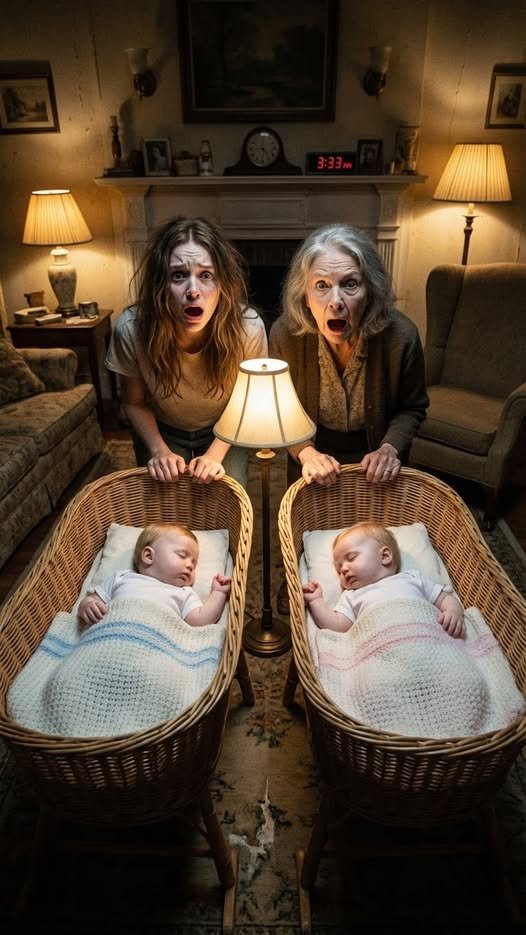
The call came at 11:47 p.m., the precise hour when the world feels thin and fragile, and even the smallest sound echoes like a gunshot.
I was sitting on the beige sectional in my townhouse in Evanston, Illinois, a cup of cold chamomile tea resting on a coaster I hadn’t used in hours.
My left arm was draped over the edge of the bassinet, my fingers resting lightly on the fleece blanket. Inside, my three-month-old daughter, Lily, was asleep. Her chest rose and fell in a soft, rhythmic cadence that was the only thing keeping my anxiety anchored to the earth.
I had been watching her for forty minutes. It’s a habit new mothers develop—a biological imperative to count breaths, terrified that if we look away, the universe might forget to keep their lungs working.
Then, my phone buzzed against the coffee table.
The screen lit up with a single word: Mom.
A spike of adrenaline hit my stomach. My mother, Carol, was a retired ER nurse. She didn’t call late just to chat. She called for emergencies, or she didn’t call at all.
I swiped answer, keeping my voice to a whisper. “Mom? Is everything okay?”
“When are you coming to get the baby?”
Her voice wasn’t panicked. It was tight, clipped with the specific irritation she used to reserve for doctors who didn’t sign their charts correctly.
I frowned, confusion clouding my sleep-deprived brain. “What?”
“The baby, Clara,” she snapped. “I have been patient. I know you’re overwhelmed with the new job and the transition, but it has been a month. I’m tired. My knees are acting up. You said you’d be here by dinner.”
I stared at the bassinet. Lily let out a tiny, bird-like sigh and turned her head.
The room felt suddenly, violently quiet.
“Mom,” I said, enunciating every syllable. “What are you talking about?”
“I’m talking about your daughter,” she said, her patience evaporating. “I’ve been taking care of her for four weeks. I change her, I feed her, I walk the floor with her when she has colic. But I need a break. You need to come pick her up.”
My hand began to tremble. I gripped the edge of the bassinet so hard my knuckles turned white.
“Mom,” I whispered, “Lily is sleeping right next to me.”
There was a pause on the other end of the line.
It wasn’t a normal silence. It was the sound of a reality fracturing. I could hear the hum of her refrigerator, the ticking of the grandfather clock in her hallway—familiar sounds from my childhood that suddenly felt sinister.
“That’s not funny, Claire,” she said, her voice dropping.
“I’m not laughing,” I said. tears pricked my eyes—not from sadness, but from a primal, rising fear. “I am looking at her. She is right here. She has never left this house, Mom. I haven’t seen you in six weeks.”
The silence stretched for ten seconds. Then fifteen.
Finally, my mother whispered, and the terror in her voice made my blood run cold.
“Then whose baby is in my house?”
A chill moved up my spine, distinct and icy, like a wet finger tracing my vertebrae.
“Describe her,” I commanded. My voice sounded foreign, authoritative, terrified.
“She… she’s small,” Mom stammered. The nurse-like efficiency was gone, replaced by confusion. “She has dark hair. A little darker than yours was. And she has that little birthmark behind her left ear. The one you told me not to worry about. You said the pediatrician called it a ‘stork bite’.”
My stomach dropped through the floor.
“Lily has blonde fuzz,” I said, my voice shaking. “She has blue eyes. And Mom… she doesn’t have a birthmark. She has never had a birthmark.”
I heard a sharp intake of breath on the other end. “But… you dropped her off. I remember it. You stood on my porch. You were crying. You said you couldn’t do it anymore, that you needed a month to get your head straight for work. You handed me the diaper bag. You hugged me.”
“I never did that,” I said. “I would remember giving away my child.”
“You looked tired,” she whispered, as if talking to herself. “You’ve lost weight. Your hair was different—pulled back, darker. But you sounded like yourself. You smelled like that vanilla perfume you’ve worn since high school.”
We sat in the silence of two different houses, separated by twenty miles of highway, connected by a nightmare.
Somewhere in the distance, outside my window, a car drove past, its bass thumping. Lily stirred, stretching a tiny hand upward.
“Mom,” I said, forcing a calm I didn’t feel. “I need you to listen to me very carefully. That baby is not mine. And the woman who gave her to you was not me.”
“Oh my God,” Carol breathed. “I have been… I have been loving a stranger’s child.”
“Is the baby safe?” I asked.
“Yes. She’s asleep in the portable crib in the living room.”
“Don’t touch her,” I said, irrational panic taking over. “I mean… keep her safe, but lock your doors. I’m coming. I’m coming right now.”
“Claire,” she said, her voice breaking. “If this isn’t Lily… then something is very, very wrong.”
I hung up. I didn’t pack a bag. I grabbed Lily, wrapped her in a thick blanket, and strapped her into the car seat with hands that shook so badly it took me three tries to click the buckle.
I ran to the car. As I backed out of the driveway, I looked at the dark windows of my neighbors’ houses. They looked normal. Safe.
But as I sped toward the interstate, I realized that safety was an illusion. Someone hadn’t just broken into my life; they had studied it. They had worn it like a costume. And they had walked right through the front door of the person who knew me best in the world.
The drive to my mother’s house usually took thirty minutes. I made it in eighteen.
My mind raced in tight, agonizing circles. I replayed every text message I’d sent my mother in the last month. Had I sent them? Or had I just thought I sent them? I checked my phone history at a red light.
There were gaps. Days where I thought we had texted, but my log showed nothing.
But my mother claimed we had been in constant contact. Updates on the baby. Photos. Requests for money for formula.
The realization hit me like a physical blow: The imposter hadn’t just dropped off a baby. She had intercepted my relationship. She had blocked my real number on my mother’s phone and replaced it with a spoofed one. She had been living my life, digitally, for weeks.
I pulled into my mother’s driveway. The house looked exactly the same as it had for thirty years. White siding, neatly trimmed boxwood hedges, the porch light casting a warm, yellow glow. It was the picture of suburban stability.
I grabbed Lily’s carrier and ran to the door.
Carol opened it before I could knock. She was wearing her bathrobe, her face pale and drawn, her eyes rimmed with red. She looked ten years older than she had the last time I saw her.
She looked at the carrier in my hand. She looked at Lily’s sleeping face—the blonde hair, the round cheeks.
Then she looked at me.
She burst into tears.
“I’m so sorry,” she sobbed, pulling me into a hug that crushed the breath out of me. “I’m so stupid. I’m a nurse, I should have known, I should have seen…”
“Shh,” I soothed her, though my own heart was hammering. “Show me.”
We walked into the living room. It smelled of baby powder and old lavender. In the center of the room stood the Graco Pack ‘n Play my mother kept for visits.
Inside, a baby was sleeping.
She was beautiful. Dark curls matted against her forehead. Olive skin. She looked slightly older than Lily, maybe four months.
I leaned over the edge. The baby shifted, turning her head.
There, behind the left ear, was the mark. A jagged, reddish splotch shaped like a small leaf.
“I don’t know who this is,” I whispered.
Mom sat heavily on the sofa, burying her face in her hands. “She called me ‘Grandma’. The woman. She stood right there in the entryway. She knew about your dad’s passing. She knew about the promotion you were gunning for. She knew everything.”
“Social media,” I said, the anger rising through the fear. “Everything is online. My dad’s obituary. My LinkedIn. My photos.”
“She brought diapers,” Mom said, staring at the ceiling. “She brought a specific brand. The organic ones you said you wanted to try. She was so… convincing.”
I pulled out my phone. “We have to call the police.”
“Wait,” Mom said. She reached out and touched the sleeping stranger’s hand. The baby’s fingers curled instinctively around my mother’s thumb. “What happens to her?”
“I don’t know,” I said gently. “But she has a mother somewhere. Or she was stolen. We can’t keep her, Mom.”
Mom nodded, a fresh tear sliding down her cheek. “I’ve been singing to her every night,” she whispered. “I loved her. I thought I was loving your daughter.”
That was the true violation. It wasn’t just identity theft. It was emotional theft. This stranger had stolen a month of my mother’s love, a month of her energy, a month of her heart, and poured it into a lie.
I dialed 911.
“911, what is your emergency?”
“I need to report…” I hesitated, not knowing how to phrase it. “I need to report an abandoned child. And a case of criminal impersonation.”
The next six hours were a blur of uniforms, flashing lights, and social workers.
Detective Miller, a woman with kind eyes and a tired demeanor, took our statements at the kitchen table. She listened without interrupting as my mother described the “drop off,” the daily texts, the photos the imposter had sent—photos that, upon closer inspection, were taken from angles that hid the baby’s face or were stolen from random Instagram accounts.
“We traced the number she used to text you,” Miller said, looking up from her tablet. “It’s a burner app. Untraceable. But the digital footprint tells a story.”
She turned the screen toward us. It showed a timeline of my social media posts matched against the texts my mother received.
“Every time you posted about a sleepless night, Claire, the imposter texted Carol complaining about exhaustion. Every time you posted about work stress, the imposter used it as an excuse not to visit. She was mirroring you in real-time.”
“But why?” I asked. “Why give up her baby? Why not just leave her at a fire station?”
“She didn’t want to abandon the baby,” Miller said softly. “She wanted the baby to be cared for. Specifically, by a grandmother.”
By dawn, they had a lead. A neighbor’s Ring doorbell camera across the street had captured the “drop off” four weeks ago. The footage was grainy, but it showed a woman exiting a beat-up sedan. She had dark hair pulled back in a messy bun, wearing a coat similar to one I owned. She held the baby tight, kissed her forehead, and walked up the steps.
When she walked back down alone, she was wiping her eyes.
They ran the license plate.
“Rachel Meyers,” the detective read.
The name hit me like a splash of cold water.
“I know her,” I said. “We went to college together. Freshman year lit class. We weren’t friends, really. Just… acquaintances. We follow each other on Instagram.”
I pulled up her profile. It was a tragedy told in squares. Pictures of a pregnancy. Pictures of a nursery set up in a small, cramped apartment. Then, silence. No birth announcement. No baby photos. Just vague, melancholic quotes about survival and storms.
“She was likely watching you,” Miller said. “Watching your life. The stable home. The supportive mother. Maybe she was struggling. Maybe she had postpartum psychosis. She saw you as the ideal version of herself, and your mother as the safety net she didn’t have.”
“She stole my life because she couldn’t handle hers,” I whispered.
A social worker arrived to take the baby—Maya, the records showed.
Watching my mother say goodbye to that baby was the hardest thing I have ever witnessed. She packed the diaper bag. She included the stuffed lamb she had bought. She wrote down the feeding schedule.
“She likes to be rocked on her left side,” Mom told the social worker, her voice shaking. “And she hates cold wipes.”
When the door closed, the house felt empty in a way that had nothing to do with furniture.
They found Rachel two weeks later in a motel in Indiana.
She didn’t fight. She didn’t deny it. According to the police report, when they asked her why she did it, she simply said, “I wanted her to have a grandma. I couldn’t be a mom right now, but I knew Carol would be a good grandma.”
She had chosen us. She had chosen my mother’s kindness as the sanctuary for her child. It was twisted, criminal, and deeply, heartbreakingly sad.
Rachel was charged with fraud and child abandonment, though the courts ordered intense psychiatric evaluation. Maya was placed in temporary foster care with a relative of Rachel’s who stepped forward.
I visited my mom every weekend after that. We didn’t talk about it much, but the shadow was there.
One evening, about two months later, we were sitting on her porch. Lily was in my lap, awake and babbling, grabbing at my necklace.
Mom was watching her, but her eyes were distant.
“I feel stupid, Claire,” she said suddenly. “I look at Lily, and I love her. But part of me… part of me misses Maya. Is that terrible?”
“No,” I said, reaching over to take her hand. “You saved that baby, Mom. Rachel was drowning. If she hadn’t brought Maya here, who knows what would have happened? You gave her a month of safety. You gave her love.”
“I was kind to a lie,” she said bitterly.
“You were kind,” I corrected. “The lie doesn’t negate the kindness. It just makes it braver.”
Trust didn’t snap back into place quickly. Mom installed a security system. She double-checked caller IDs. If I texted her, she would often call me back immediately, just to hear my voice—to make sure it was really me.
I changed my social media to private. I stopped posting real-time updates. I realized that the window I had opened to the world was also a door for anyone who wanted to walk in.
As for Lily, she slept through the coup d’état of her infancy, unaware that for a month, she had been replaced. I watched her more carefully now—not out of fear of abduction, but out of a fierce, protective gratitude.
Life returned to normal, but it was a quieter, more deliberate normal.
We assume the people who hurt us will come with masks and weapons. We prepare for monsters. But sometimes, the danger comes in the form of a desperate woman who just wants what you have.
Sometimes, the most terrifying moment isn’t a scream in the dark. It’s a phone call from your mother, asking a question that undoes your entire reality.
Then whose baby is in my house?