THE GIRL WITH THE BABY AND THE MAN WHO NEVER STOPPED
The afternoon sun burned down on downtown Seattle like it had something to prove.
Glass towers reflected the light so harshly it hurt to look at them. Traffic crawled. Horns blared. People moved fast, eyes locked to screens, shoulders tight, minds already somewhere else. It was a city built on momentum—if you stopped moving, you disappeared.
That was why no one noticed the girl at first.
She sat just outside the automatic doors of a grocery store on Pine Street, tucked beside a concrete pillar meant to hold shopping carts. She couldn’t have been more than ten. Her knees were pulled to her chest, arms wrapped protectively around a baby bundled in an old gray blanket that had once been white.
The baby cried softly.
Not the loud, demanding cry of a child who expects to be answered—but the weak, tired sound of hunger that had learned not to waste energy.
The girl rocked him gently, whispering words no one could hear.
“It’s okay, Noah. I know. I know.”
Her clothes were too thin for the season. Sneakers with torn soles. A sweatshirt two sizes too big, sleeves frayed at the cuffs. Her hair was tangled, pulled into a messy knot that had clearly been done without a mirror.
She watched people pass.
Men in suits. Women with shopping bags. Couples laughing. Parents pulling children along impatiently.
She didn’t stop everyone.
She waited.
Then she chose.
A man in an expensive charcoal suit stepped toward the entrance, phone pressed to his ear, voice sharp and efficient.
“Yes, I said close the deal by Friday,” he snapped. “If they hesitate, walk away.”
The girl stood quickly, almost losing her balance as the baby shifted in her arms.
“Sir,” she said, her voice barely louder than the street noise. “Please.”
The man stopped, annoyed, covering the phone with his hand.
“What?” he said.
She swallowed.
“I’m sorry,” she said quickly. “I won’t take much time. I just… I need a small box of milk. For my brother.”
He frowned, scanning her like a problem he didn’t want to solve.
“I’ll pay you back,” she added fast, panic creeping in. “When I’m grown up. I promise.”
The baby whimpered, his tiny face scrunching in discomfort.
The man looked down at the child.
Then at the girl.
Something in his expression shifted—not kindness, not yet—but hesitation.
“Where are your parents?” he asked.
The girl looked down.
“They’re gone,” she said quietly.
That was all.
No explanation. No story. Just a fact she had clearly repeated too many times.
The man exhaled sharply and ended the call. “I don’t have time for this,” he muttered—more to himself than to her.
People slowed nearby, pretending not to stare while staring anyway.
That man was David Lawson.
Everyone in Seattle knew the name.
Real estate magnate. Self-made millionaire. Ruthless negotiator. Headlines described him as brilliant, cold, untouchable. He had turned entire neighborhoods into profit margins.
People also knew what he wasn’t.
Charitable. Gentle. Soft.
He didn’t donate. He didn’t attend fundraisers. He didn’t smile for causes.
And yet… he didn’t walk away.
He crouched down in front of the girl, expensive suit pressing against dirty pavement.
“What’s your name?” he asked.
“Lily,” she replied, surprised.
“How old are you?”
“Ten.”
“And the baby?”
“My brother. Noah. He’s one.”
David studied the baby’s pale lips. The way his tiny fingers clenched weakly around the edge of the blanket. Hunger wasn’t new to him—David recognized it instantly.
Because once, a lifetime ago, it had been him.
A flicker of memory hit hard.
Cold mornings. Empty cupboards. His mother watering down soup. The shame of asking for help and being told no.
He stood abruptly.
“Stay here,” he said.
The girl’s eyes widened with fear. “Please don’t call anyone,” she whispered. “We didn’t do anything wrong.”
He paused.
“I’m not,” he said. “I’m getting food.”
Inside the store, the clerk looked up, startled by the urgency in his voice.
“I need milk. Formula. Diapers. Baby food. Bread. Fruit,” David said, already pulling out his card. “Whatever she needs. Enough for a while.”
The clerk blinked. “Sir—”
“Everything,” David repeated. “Now.”
People whispered behind him.
“Is that David Lawson?”
“What’s he doing?”
“Is this for a photo?”
David ignored them.
When he came back out, Lily stood exactly where he’d left her, arms aching but unyielding.
He placed the bags gently at her feet.
“There,” he said.
She stared at them like they might vanish.
“You don’t have to—” she began.
“Yes, I do,” he said.
Tears welled in her eyes, but she blinked them back fiercely.
“I’ll pay you back,” she said again. “I promise.”
David smiled—just a little.
“You already did,” he replied. “By reminding me.”
She didn’t understand.
But he did.
As he walked away, he didn’t see the girl hugging the bags like treasure.
He didn’t hear her whisper, “Thank you,” to the empty air.
And he had no idea that this moment—this small, inconvenient pause in a busy afternoon—had just rewritten the future of both their lives.
Because some acts of kindness don’t end when you walk away.
They begin.
THE SEED HE DIDN’T KNOW HE PLANTED
David Lawson didn’t think about the girl again that night.
Or at least, he told himself he didn’t.
He returned to his penthouse overlooking Elliott Bay, kicked off his shoes, loosened his tie, and poured himself a glass of scotch that cost more than most people’s weekly groceries. The city glittered outside his windows—cold, efficient, untouchable.
He told himself the groceries had been a one-time thing. A moment of weakness. A reminder from a past he’d outgrown.
That’s what he told himself.
But when he lay in bed, staring at the ceiling instead of sleeping, the image came back anyway.
The way Lily had held her brother.
The way she hadn’t begged—only negotiated.
The way she’d promised to pay him back someday, like the future was something she was absolutely certain she’d reach.
David hadn’t heard that kind of certainty in years.
THE GIRL WHO REFUSED TO DISAPPEAR
Across the city, Lily Turner sat on a narrow cot in a temporary shelter, Noah asleep beside her for the first time in days with a full stomach.
She didn’t cry when the social worker tucked them in. She didn’t cry when the lights went out.
She cried later—silently—when she was sure no one was watching.
Because kindness was harder than cruelty.
Cruelty made sense. Cruelty was predictable.
Kindness confused her.
For years, Lily had learned to expect doors to close. People to look away. Adults to decide she was someone else’s problem.
David Lawson hadn’t.
She pressed her forehead against Noah’s and whispered, “We’re gonna be okay. I promise.”
And for the first time, that promise didn’t feel like a lie.
DAVID’S RESTLESSNESS
Weeks passed.
David went back to being David Lawson—the man who crushed negotiations, bought properties sight unseen, and fired executives without blinking. But something was off.
He found himself distracted in meetings.
Numbers blurred. Projections felt hollow.
One afternoon, his assistant paused mid-briefing.
“Are you all right, Mr. Lawson?”
He looked up sharply. “Why wouldn’t I be?”
“You’ve asked about the same zoning permit three times,” she said carefully.
He dismissed her with a wave—but later, alone, he realized the truth.
For the first time in decades, success didn’t feel like enough.
That night, he opened a file on his laptop he hadn’t touched in years: Lawson Foundation — Inactive.
It had been created by his lawyers long ago for tax purposes. He’d never funded it. Never cared.
He stared at the blank mission statement field for a long time.
Then he typed:
Emergency food and education support for children with no advocates.
He paused.
Then added:
No publicity. No conditions.
He funded it with an initial transfer so large his bank called to confirm.
David didn’t tell anyone why.
A SYSTEM THAT FINALLY SAW HER
The foundation’s money moved quietly.
It paid for Lily and Noah’s placement in a stable transitional home.
It covered formula, medical checkups, clothing.
It funded school supplies Lily had never owned—new notebooks, pencils that weren’t borrowed or broken.
Lily didn’t know where the money came from.
She only knew that someone, somewhere, had decided she was worth investing in.
At school, she sat in the front row.
She asked questions.
She stayed late to help teachers clean up—not because she had to, but because she liked being useful.
One teacher wrote in a report:
Lily Turner displays unusual resilience and focus for her age.
Another added:
Protect this one.
THE UNSEEN CONNECTION
David received quarterly reports from the foundation.
Statistics. Charts. Numbers.
He skimmed them.
Until one line stopped him cold.
Beneficiary ID: LT-0912 — Female, age 10, primary caregiver for infant sibling. Academic performance: exceptional.
He stared at the initials.
LT.
He closed the report without reading the rest.
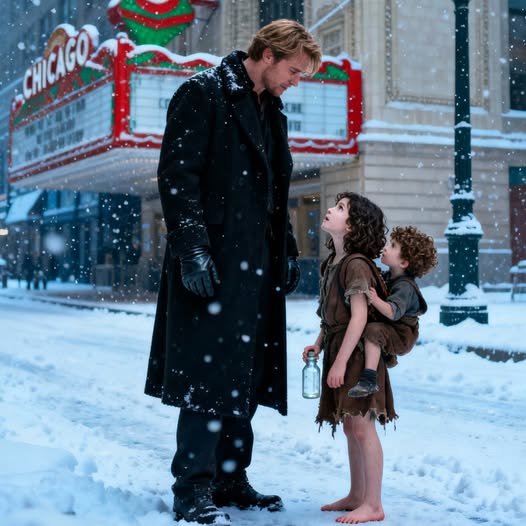
That night, he dreamed of a little girl standing in a snowstorm, holding a baby, staring up at him—not begging, not crying—just waiting.
LILY GROWS — QUIETLY
Years passed.
Noah grew strong. Loud. Curious. A child who laughed easily because hunger was no longer his constant companion.
Lily grew taller, sharper, steadier.
She worked part-time as soon as she was legally allowed. Tutored younger kids. Saved every dollar she could.
When counselors asked what she wanted to be, she didn’t say doctor or lawyer.
She said, “Someone who makes sure kids don’t disappear.”
She didn’t know why she felt drawn to that idea.
She just did.
When she graduated high school, her acceptance letter came with a full scholarship—funded by the Lawson Foundation.
She read the name twice.
It felt familiar, though she couldn’t explain why.
THE MAN WHO COULDN’T FORGET
David attended fewer galas. Fewer parties.
Instead, he asked harder questions of his board.
“Why is this clinic underfunded?”
“Why are these kids aging out with nothing?”
“Who decided this was acceptable?”
People noticed the change.
“Lawson’s gone soft,” someone joked.
David didn’t care.
Because every time he signed a check, every time he approved a program, he saw Lily’s face.
Not the child she had been—but the woman she might become.
And somewhere deep inside him, something long buried began to heal.
Not guilt.
Purpose.
THE RECOGNITION THAT CHANGED EVERYTHING
Lily Turner almost didn’t attend the gala.
She stood in the tiny bathroom of her shared apartment, staring at herself in the mirror, tugging nervously at the hem of a borrowed navy-blue dress. It fit well enough, but she felt out of place already—like she always did in rooms built for people who had never gone to sleep hungry.
Noah, now seventeen and taller than her, leaned against the doorframe, adjusting his tie with clumsy fingers.
“You look like you belong there,” he said confidently.
Lily laughed softly. “That’s because you don’t know what ‘belonging’ feels like in rooms like that.”
“You belong anywhere you walk into,” Noah replied. “You always have.”
She swallowed.
The invitation read:
Annual Lawson Foundation Gala — Benefactor & Leadership Reception
She had been invited because of her work. Because of her results. Because she had helped expand the foundation’s outreach into three new states while finishing college with honors.
Still, something about the name Lawson made her uneasy.
She couldn’t explain it.
THE MAN IN THE ROOM
The ballroom buzzed with polished laughter and expensive confidence. Crystal glasses clinked. Soft music floated above conversations about markets, policies, and impact metrics.
Lily kept to the edges, speaking when spoken to, listening more than she talked—an old habit that never fully left her.
Then the room shifted.
Not loudly. Not dramatically.
But subtly—like gravity changing direction.
People straightened. Voices lowered.
David Lawson had arrived.
Lily saw him from across the room and felt a strange tightening in her chest.
He was older now. His hair silvered at the temples, his shoulders slightly stooped. But there was something unmistakable about the way people made space for him without being asked.
He didn’t look like a man who needed to prove anything.
He looked… tired. And thoughtful.
Lily watched him greet staff first. Thanking them. Asking names. Listening.
That, more than the tailored suit or the reputation, unsettled her.
Because she had seen that posture before.
A memory stirred.
A MEMORY FINDS ITS VOICE
David moved through the crowd, nodding politely, stopping when board members spoke, but clearly distracted.
Then his eyes found her.
For a moment, neither of them moved.
Something passed between them—unspoken, electric.
David frowned slightly, as if trying to place a familiar face.
Lily felt her heart begin to pound.
She didn’t know why she was walking toward him until she already was.
“Mr. Lawson,” she said quietly.
He turned fully toward her.
“Yes?”
Up close, she could see it—the same sharp eyes, softened now by time. The same stillness.
“You don’t know me,” she said, her voice steady despite the storm inside her, “but… years ago, outside a grocery store in downtown Seattle… you bought milk for a baby and his sister.”
David froze.
The room seemed to disappear around them.
Slowly, his expression changed—not into confusion, but recognition.
“The girl,” he whispered.
Lily nodded. “That was me. Lily Turner.”
He stared at her like he was afraid she might vanish.
“You said you’d pay me back someday,” he said softly.
Her eyes filled. “I tried.”
David exhaled—a long, trembling breath he hadn’t realized he’d been holding for over a decade.
THE TRUTH BETWEEN THEM
They moved to a quiet corner of the room, away from cameras and conversation.
“I never expected this,” David said. “I didn’t even know your name.”
“I didn’t know yours either,” Lily replied. “But your foundation paid for my school. For my brother’s health care. For our chance.”
David closed his eyes briefly.
“I thought I was fixing something small,” he admitted. “I didn’t know it would become… this.”
Lily shook her head. “You didn’t just give us food. You gave us stability. And when people grow up with that, they do different things with their lives.”
Noah appeared then, hovering protectively.
“This is my brother,” Lily said.
David extended his hand. Noah shook it firmly.
“Thank you,” Noah said simply. “For everything.”
David nodded, unable to speak for a moment.
A QUESTION THAT CHANGED THE ROOM
Later that evening, Lily stood at the podium unexpectedly.
She hadn’t planned to speak.
But sometimes, truth demands space.
“When I was seven,” she began, her voice steady, “I begged a stranger for milk. Not charity. Milk.”
The room stilled.
“That stranger didn’t ask for my story. He didn’t judge. He didn’t lecture. He acted.”
David watched from the front row, his hands clasped tightly together.
“I’m standing here because of one moment of kindness that never made headlines,” Lily continued. “And I know I’m not the only one.”
Applause broke out—not polite, but genuine.
People wiped their eyes.
And David felt something crack open in his chest.
THE OFFER
After the gala, David found Lily again.
“You should be running this foundation,” he said bluntly.
She blinked. “What?”
“You already are,” he replied. “In everything but title.”
Lily hesitated. “I don’t want power.”
David smiled gently. “Neither did I. That’s why you’re right for it.”
He paused. “I’m not going to be here forever.”
She understood what he meant.
“I’ll think about it,” she said.
“Take your time,” he replied. “Some promises are worth waiting for.”
THE PROMISE THAT OUTLIVED THEM BOTH
David Lawson did not announce his illness.
He never liked dramatics, and he disliked sympathy even more. Only a small circle knew that his health had begun to fail—quietly, stubbornly, the way he had once lived his life before compassion softened him.
What Lily noticed first wasn’t weakness.
It was urgency.
David began asking different questions in meetings. Less about numbers. More about people.
“Who’s falling through the cracks?”
“Who aren’t we reaching?”
“What happens when I’m not here?”
At first, Lily thought it was strategic planning.
Then she understood.
THE TRANSFER OF TRUST
Six months after the gala, David asked Lily to meet him in his office.
Not the one in the foundation building—but his original office. The one overlooking downtown Seattle. The one where contracts had once been signed without a second thought about consequences.
Lily arrived early.
She stood by the window, looking down at the same street where, years earlier, she had sat on cold concrete with a crying baby in her arms.
David entered slowly, leaning on a cane.
“You came full circle,” he said quietly.
“So did you,” Lily replied.
He smiled faintly and gestured for her to sit.
“I’ve rewritten my will,” he said without preamble.
Lily stiffened. “David—”
“Listen,” he said gently. “This isn’t about money. It’s about continuity.”
He slid a folder across the desk.
Inside were documents transferring operational leadership of the Lawson Children’s Fund to Lily Turner.
Effective immediately.
She stared at the papers, breath caught in her throat.
“I didn’t save you,” David said softly. “You saved the best part of me. This foundation was born from guilt. You turned it into purpose.”
Tears slid down Lily’s face.
“I was just a child,” she whispered.
“And you kept your promise,” he replied. “That matters.”
THE MILK PROMISE
Lily’s first act as executive director wasn’t a rebrand.
It wasn’t an expansion.
It was something smaller—and infinitely more powerful.
She launched a program called The Milk Promise.
No applications.
No income verification.
No humiliating paperwork.
Just nutrition packages—milk, formula, diapers, basic food—delivered discreetly to families with infants in crisis.
Hospitals partnered in silence. Shelters followed. Grocery stores donated without logos.
Within a year, infant malnutrition rates dropped significantly in three cities.
People asked Lily how she thought of it.
She always answered the same way.
“Because hunger doesn’t wait for approval.”
THE LAST CONVERSATION
David passed away quietly one winter morning.
No press release. No spectacle.
Just a folded letter on Lily’s desk, sealed and handwritten.
She opened it alone.
Lily,
You once told me you’d pay me back when you grew up.
You did. A thousand times over.
Don’t ever forget: the world doesn’t change because of people like me.
It changes because of people like you—who remember what it feels like to need help.
Keep your eyes open. The next miracle will knock softly.
—David
Lily wept—not from loss alone, but from gratitude so deep it hurt.
THE PLAQUE IN THE LOBBY
Years later, visitors to the Lawson Foundation headquarters stop in the lobby.
There’s no statue.
No marble bust.
Just a simple plaque and a photograph.
The photo shows a man in an expensive suit kneeling beside a small girl holding a baby wrapped in a blanket.
The plaque reads:
ONE ACT OF KINDNESS CAN CHANGE A LIFE — OR THOUSANDS.
Below it, in smaller text:
THE MILK PROMISE
Because no child should have to beg to survive.
FULL CIRCLE
On a bright afternoon, Lily stood outside a grocery store in downtown Seattle.
Not begging.
Waiting.
A young mother sat nearby, rocking an infant, panic written across her face.
Lily approached gently.
“Do you need milk?” she asked.
The woman looked up, startled. “I—I’ll pay you back.”
Lily smiled.
“You already will,” she said.
And somewhere—in the quiet space where promises are kept—
a man who once believed only in numbers finally rested, knowing that kindness had outlived him.
END.