The car door slammed into the side of my head, leaving my ears ringing and my thoughts spinning. My father leaned in with a cold sneer, mocking me the way he always had. My mother’s drunken laughter blurred into the background as my vision dimmed. Just as he raised the door again, everything slowed to a halt. They didn’t realize it yet—but their cruelty had already left proof behind.
The heat of the August afternoon shimmered off the parking lot asphalt, turning the world into a hazy, warped mirage. It was the kind of heat that made the air feel heavy, pressing down on your lungs, but it was nothing compared to the suffocating pressure inside the silver sedan.
My skull cracked against the edge of the car door—a sound like a dry branch snapping—and the metallic taste of blood flooded my mouth before I even understood what was happening. Pain didn’t register immediately; it was too big, too sudden. Instead, there was a high-pitched ringing in my ears, drowning out the hum of the highway traffic nearby.
My dad’s voice cut through the ringing, cold and vicious. “Maybe now your skull matches your IQ,” he snarled.
I slumped against the seat, my vision swimming. Through the haze, I saw his eyes in the rearview mirror. They were gleaming with a hatred I had lived with for my entire sixteen years, a hatred that felt ancient and bottomless.
From the passenger seat, my mother’s drunken laugh floated back—sharp, cruel, careless. She turned, a half-empty bottle of cheap Pinot Noir resting loosely in her lap. “She looks better with blood,” she giggled, her words slurring together. “Finally… finally some color in her worthless face.”
Dad reached back, grabbing the handle of the rear door. I knew the rhythm of his rage. I had memorized it like a dark nursery rhyme. First came the silence, then the insults, then the strike, and finally, the positioning. He was pulling the door back to slam it again. I was nothing more than trash he was positioning for disposal.
I had survived this all my life. Broken wrists explained away as clumsy falls. Cigarette burns hidden under long sleeves in July. But this time… this time, something in his eyes looked final. Deadly. There was no “lesson” here. This was an erasure.
My hand twitched against the seat fabric. That was when I felt it—the cool, smooth glass of my phone, still clutched in my sweaty grasp. I had pre-dialed 911 three months ago, leaving it on the emergency screen, waiting for the moment when fear finally became a survival plan.
A strange, icy calm settled over me, displacing the panic.
This time, I thought, the words echoing in my head like a prayer. This time, I will have proof.
Dad grabbed a fistful of my hair, yanking my head into place. Pain shot across my skull, white-hot and blinding. Something warm slid down my cheek—blood or sweat, I couldn’t tell.
“Do it already,” Mom urged, leaning back to watch as if this were some twisted form of family entertainment. “She’s been whining all day. Shut her up, Frank.”
My thumb moved. It was a microscopic movement, invisible to them, but it felt like shifting a mountain.
The call connected.
I didn’t lift the phone. I didn’t look at it. As the faint electronic buzz of the connection vibrated against my palm, I forced three words out through the taste of iron and tears.
“Help… parking lot…”
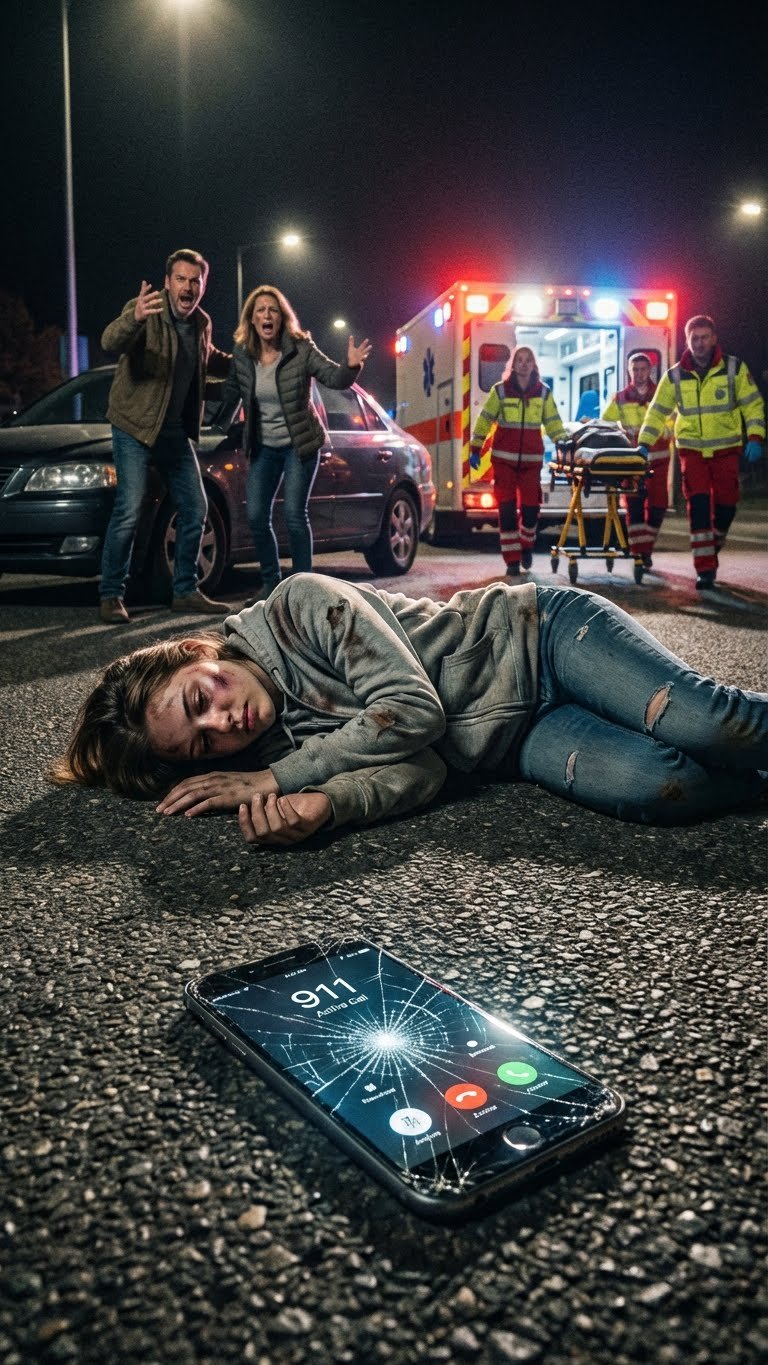
Then, I did the hardest thing I have ever done. I let my body go limp. I allowed gravity and shock to pull me halfway out of the car, my upper body sagging onto the blistering asphalt. My blood pooled beneath me, dark and stark against the grey ground.
Dad froze. The silence in the car was absolute.
“She called,” he hissed, his voice dropping to a terrified whisper. “You little—”
But it was too late. The line was open. The world was listening.
Cliffhanger: Dad raised his heavy boot, aiming for my ribs to silence me permanently, just as a shadow fell over me and a stranger’s voice shattered their control.
The shadow belonged to a woman. She was wearing a faded teal uniform, an apron tied around her waist—a waitress from the roadside diner we had just left. She stood ten feet away, a tray of dirty dishes clutched to her chest like a shield.
“Sir!” she shouted, her voice trembling but loud. “Sir, is she okay?”
Dad whipped his head toward her, his face contorted in a mask of fury. “Mind your own damn business! My daughter is sick, we’re handling it!”
“She’s bleeding!” the waitress yelled back, taking a step closer rather than retreating. “I’m calling the cops!”
“I already did,” I whispered into the asphalt.
And right then—like a miracle made of wailing sirens—a police cruiser screeched into the lot, tires smoking as it drifted to a halt blocking our car. The lights flashed, red and blue, bouncing off the diner windows.
Mom dropped her wine bottle. It shattered on the pavement, spilling red wine into the puddle of my blood, creating a grotesque watercolor of our family’s dysfunction.
Dad’s face drained of color. He looked from the police car to me, and for a split second, I saw him calculate. He pulled the door back for one desperate, final swing—to finish me, to hide the evidence, to silence the witness.
Click.
Time seemed to freeze.
The officer was out of the car, weapon drawn. “Step away from the vehicle! Now! Hands where I can see them!”
Dad’s hand hovered over the door. He looked at me, and I looked back. My one eye was swollen shut, but with the other, I stared him down.
This is the moment, I realized. My life stops being yours to destroy.
He stepped back, raising his hands slowly.
The next thing I clearly registered was a female EMT kneeling beside me. Her knees pressed into the hot tar, ignoring the discomfort. Her hands were steady and warm as she stabilized my neck.
“You’re safe now, sweetheart,” she whispered, her voice cutting through the fog of pain. “We’ve got you.”
Her face hardened when she saw the door-shaped imprint swelling across my temple. She looked up at the officer standing nearby.
Behind her, officers were surrounding my parents. One officer was holding his phone, listening to the dispatch recording that had been relayed to him. He replayed the 911 call on speaker—my gasped plea, the sounds of the assault, my parents arguing about “dealing with” me when they got home.
“That’s attempted murder,” the officer muttered, his jaw tight. “And the premeditation is on the recording.”
Dad lunged forward against the hood of the cruiser, shouting, “She’s a liar! She threw herself into the door! She’s mentally unstable!”
Another officer stepped between them, forcing Dad’s face onto the hot metal of the car hood. “Sir, you have the right to remain silent. I suggest you use it.”
Mom staggered out of the car, slurring excuses, trying to wipe the wine from her skirt. “I had a drink, so what? Kids exaggerate. She’s dramatic. Olivia, tell them you fell!”
The EMT helping me shot her a glare that could have cut glass. “Your daughter has a depressed skull fracture, ma’am. That is not drama. That is a felony.”
In the ambulance, pain thundered through my head like a freight train, but for the first time in my life, I didn’t swallow it. I didn’t try to hide the grimace. I let myself feel the truth:
I was finally out. But as the doors closed, blotting out the sight of my parents in handcuffs, a new fear seized me.
What if they get out?
Cliffhanger: As the morphine drip began to take hold, Dr. Reed, the trauma surgeon, leaned over me. Her expression was grave. “Olivia, the police found something else in the trunk of your father’s car. You need to rest, because tomorrow… tomorrow is going to be the fight of your life.”
The hospital room was sterile, white, and smelled of antiseptic and lemon floor cleaner. It was the most beautiful place I had ever been.
Dr. Reed was meticulous. She wasn’t just treating me; she was building a fortress of evidence. She documented every injury—not just the fresh skull fracture, but the old fractures in my ribs that had healed wrong, the deep scars on my back, the cigarette burns on my shoulders.
“These aren’t accidents,” she said quietly to the detective standing in the corner. “This is a map of torture.”
“The 911 call saved your life,” the detective said, looking at me with a mixture of pity and respect. “But your father has already called a lawyer. A big one. They’re claiming you were having a psychotic break and attacked them.”
My heart hammered against my ribs. “They always lie,” I whispered. “He can make anyone believe anything.”
“Not this time,” a voice came from the doorway.
I turned my head carefully. Standing there, clutching a wet purse and looking like she had run through a hurricane, was Aunt Vivian.
I hadn’t seen my mother’s sister in six years. Dad had banned her from our house after she noticed a bruise on my arm at Thanksgiving. He told me she was crazy, that she hated us.
When she saw me—bandaged, bruised, connected to machines—she collapsed into the plastic chair beside my bed, sobbing.
“I knew,” she choked out, burying her face in her hands. “I knew something was wrong. They kept me away, always with excuses… ‘Olivia is at camp,’ ‘Olivia is sick,’ ‘Olivia hates you.’ I should have fought harder. I should have kicked the door down.”
“You’re here now,” I whispered, reaching out a hand.
She took it gently, terrified to hurt me. That touch—soft, trembling, loving—felt like coming home to a place I’d never known.
“I’m not leaving,” she vowed, wiping her eyes. “I have a guest room. I have a lawyer. And I have a lot of rage.”
The next few weeks were a blur of pain management and legal strategy. The prosecutor, Ms. Jackson, was a woman made of steel and intellect. She came to the hospital to prep me for the pre-trial hearing.
“Your parents are facing significant charges,” she said, her voice clipped and professional. “Attempted murder, aggravated child abuse, conspiracy. But they have hired the Anderson firm. They are going to play dirty. They will try to paint you as the abuser, the unstable teenager.”
“I know,” I said.
“They will say things that hurt,” Ms. Jackson warned. “But your testimony will make the truth undeniable. Are you ready for that?”
I touched the bandage on my head. Underneath, the bone was knitting back together.
“I’ve survived sixteen years of his fists,” I said. “I can survive his lawyer.”
Cliffhanger: The morning of the hearing, my phone buzzed with a notification from a blocked number. It was a photo—a picture of me sleeping in my hospital bed, taken from the hallway through the glass. The caption read: Family protects family. Don’t say a word.
The courtroom was freezing. I later learned they keep it cold to keep people alert, but that day, it felt like the temperature of my father’s heart.
When I entered, Dad glared from the defense table. He was in an orange jumpsuit, his wrists cuffed, but his posture was still arrogant. He looked at me like I was a rebellious employee he was about to fire. Mom wouldn’t look at me at all; she stared at the table, picking at her fingernails.
“Please state your name for the record,” the judge instructed.
“Olivia Wilson,” I said. My voice was steady, even though my legs trembled so hard I had to grip the arms of the witness chair to keep them still.
Ms. Jackson guided me through the timeline. I told them everything. I spoke of the basement lock, the withheld meals, the beatings for getting a B-plus, the silent cries in my room where I wasn’t allowed to shut the door. The courtroom grew cold and still as I spoke.
Then came the cross-examination.
Dad’s lawyer, Mr. Anderson, stood up. He was smooth, handsome, and smiled like a shark.
“Olivia,” he began, his voice dripping with fake sympathy. “Isn’t it true that you have a history of self-harm?”
“No,” I said.
“We have journals,” he said, lifting a black notebook I recognized immediately. It was my diary. He had stolen it. “Entries where you talk about wanting to die. About hurting yourself.”
“I wrote that I wanted the pain to stop,” I corrected him. “Because my father was breaking my ribs.”
“Isn’t it true you attacked your mother in the car because she refused to buy you a new iPhone?”
“I have a cracked skull,” I said, pointing to my head. “How did I do that to myself in a car?”
“You threw yourself into the door in a tantrum,” Anderson said dismissively. “You’re a troubled young woman, Olivia. You wanted to punish your parents.”
He was good. He was twisting my trauma into a weapon against me. I could see some of the people in the gallery shifting, looking unsure.
But then Ms. Jackson stood up.
“Your Honor, the State would like to enter Exhibit A: The 911 recording.”
Mr. Anderson objected immediately. “Prejudicial!”
“Overruled,” the Judge said, his expression carved from stone. “Play it.”
The room went silent. Then, my voice filled the air—thin, terrified, gasping through blood.
“Help… parking lot…”
Then came the sounds. The sickening thud of the door hitting bone.
Then Dad’s voice, clear as day: “Maybe now your skull matches your IQ.”
Then Mom: “Do it already. She looks better with blood.”
Then the damning conversation: “Wait until we get home. I’ll finish this in the basement. No one hears anything down there.”
Silence fell thick and horrified. It was a heavy, suffocating silence.
Mom’s lawyer looked at his client with disgust. Mr. Anderson stopped smiling.
The judge looked slowly from the recorder to my father.
“I think we’ve heard enough,” the judge said, his voice low and dangerous.
But the nightmare wasn’t over. As the bailiff moved to take my father back into custody, Dad lunged. Not at me, but at the table. He grabbed a metal water pitcher and hurled it across the room.
Cliffhanger: The pitcher missed my head by inches, smashing into the wall behind me. As officers tackled him, he screamed a secret he had kept for sixteen years—one that would change everything about who I thought I was.
“She’s not even mine!” Dad screamed as three officers pinned him to the floor. “I stole her! She’s trash, just like her real mother!”
The words hung in the air, vibrating with the violence of his arrest.
Chaos erupted. The judge was banging his gavel. Aunt Vivian was on her feet, screaming. I sat frozen in the witness chair, the breath knocked out of me.
Stolen?
The next forty-eight hours were a whirlwind of DNA tests and federal agents. The trial was paused. My entire identity was suspended in a vacuum.
The results came back on a Tuesday evening.
Aunt Vivian sat me down in her living room. Ms. Jackson was there, along with a federal agent named Miller.
“Is it true?” I asked, my voice barely a whisper.
“Yes and no,” Agent Miller said gently. “You weren’t stolen from a stranger, Olivia. You were taken from your grandmother.”
He laid a file on the table.
“Your biological mother died when you were an infant. Your father—Frank—was her boyfriend, but he wasn’t your biological father. When she died, you were supposed to go to your grandmother. Frank took you and fled across state lines. He forged a birth certificate. He raised you as his own solely to claim the social security benefits and trust fund left by your mother.”
I felt the room spin. The hatred in his eyes… it wasn’t just abuse. It was resentment. I was a paycheck to him. A hostage.
“And Mom?” I asked.
“She knew,” Aunt Vivian whispered, clutching my hand. “She met him later. She helped him hide you. They used you.”
A strange sensation washed over me. It wasn’t sadness. It was relief.
I don’t share his blood.
I wasn’t poisoned. I wasn’t made of his rage. I was something else entirely.
The trial resumed a week later, but the dynamic had shifted. There was no defense left. The kidnapping charges were added to the pile.
The courtroom was packed on the final day. Local reporters sat in the back. Our community had followed the case obsessively.
Dad entered, wrists and ankles chained. He looked smaller now. Defeated.
When I took the stand again for the victim impact statement, I didn’t look at the floor. I looked my father—my captor—dead in the eyes. He flinched—for the first time in his life—at the sound of my breathing. Loud, deliberate, defiant breathing.
“You tried to kill me for existing,” I said into the microphone. “You told me my breath was annoying. You told me I was worthless trash. But you were wrong.”
I took a deep breath.
“I am not your daughter. I am not your victim. I am the evidence of your failure.”
Mom cried softly at her table. Whether it was guilt or fear, I didn’t care.
“You stole sixteen years of my life,” I continued, my voice ringing off the mahogany walls. “But you will not take one second more. My voice will follow you to every parole hearing. My truth is louder than your violence.”
When the jury returned, the verdicts were swift.
Frank: Life in prison without the possibility of parole for kidnapping, attempted murder, and aggravated child abuse.
Linda: 25 years for accessory to kidnapping, accessory to attempted murder, and failure to protect.
As the bailiff led them away, Dad didn’t look back. He was already a ghost.
Cliffhanger: As I walked out of the courthouse, into the blinding sunlight, a woman in a teal uniform was waiting at the bottom of the steps. It was the waitress. She was holding a small, wrapped box.
Eighteen months later.
The auditorium buzzed with the restless energy of five hundred teenagers and their families. The air smelled of cheap cologne and floor wax.
I adjusted the gold sash over my gown. Valedictorian.
Aunt Vivian sat in the front row, dabbing her eyes with a tissue. Next to her sat Sarah—the waitress from the diner. We had Sunday dinner together every week. The box she had given me that day at the courthouse contained a simple silver locket. Inside, she had placed a tiny clipping of the newspaper article where I had won my freedom. “To remind you that you saved yourself,” the note had said.
I walked up the steps to the podium. The scar on my temple caught the stage lights—a quiet, stubborn silver line running into my hairline. I didn’t hide it with makeup anymore. It was my map.
I looked out at the sea of faces.
“They tell us that high school is about finding who we are,” I began, departing from the speech I had written on my index cards. “But sometimes, it’s about surviving who people want us to be.”
The room went quiet.
“I learned that breathing can be an act of rebellion,” I said. “I learned that a cell phone can be a weapon. And I learned that family isn’t blood. Family is the person who runs toward you when you’re bleeding on the asphalt. Family is the person who believes you when you speak.”
I saw Sarah smile. I saw Aunt Vivian beam.
“Breathing isn’t a crime,” I told the audience, my voice strong and clear. “Sometimes, it’s a revolution.”
When I finished, the applause sounded different than the polite clapping for the other speakers. It sounded like a storm.
Now, I volunteer at a crisis hotline on Tuesday nights. The headset feels heavy, a reminder of the weight of the phone in my hand that day in the car.
When scared teens whisper their fears into the line—fears about parents, about bruises, about secrets—I tell them:
Keep breathing.
Keep the phone ready.
Your truth deserves to be heard.
My captor once tried to silence me with a car door. He thought he could erase me.
But he forgot one thing: asphalt cracks if you apply enough pressure, but the flower that grows through the crack? That is unstoppable.
Now I speak loudly—for myself and for every kid who thinks their voice doesn’t matter.
It does.
It always will.