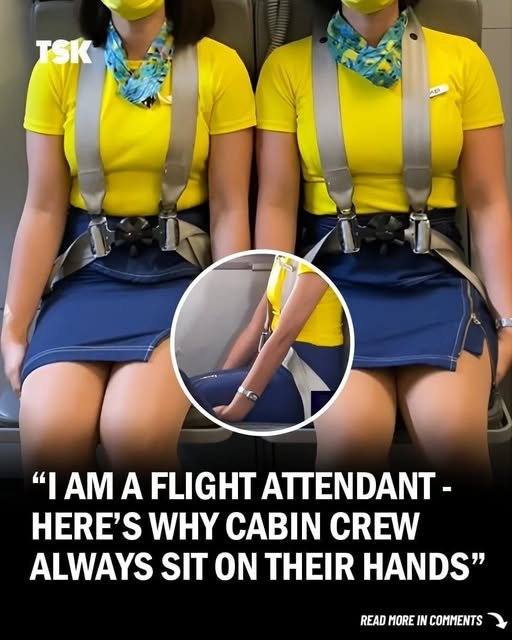
If you’ve ever taken a seat near the front or rear of a plane, you’ve likely seen a flight attendant sitting stiffly in a jump seat during takeoff, often with their hands placed underneath their thighs. It might look uncomfortable or even strange to the average passenger. But there’s an important reason behind this posture—and it has everything to do with safety, readiness, and reaction time.
Let’s explore the fascinating reason why cabin crew are trained to sit on their hands during takeoff and landing, and why this routine move can mean the difference between chaos and control during an emergency.
1. The “Brace Position” for Crew Members
Flight attendants are required to assume a specific position during takeoff and landing known as the “brace position.” This is a safety protocol designed to reduce injury risk in the event of a sudden impact. For cabin crew, the brace position is slightly different than for passengers. While passengers are told to lean forward and place their hands on their head or seat in front, crew members sit upright in their jump seat, with their feet flat on the floor, back straight, head against the headrest, and hands under their thighs.
This posture is not random—it’s calculated for maximum injury prevention. By sitting on their hands, flight attendants are anchoring their arms and stabilizing their bodies. This minimizes the risk of flailing or limb movement during impact.
2. Muscle Tension and Reaction Readiness
There’s another clever reason behind the practice: muscle tension and immediate action. Sitting on their hands helps the cabin crew stay tense and focused, rather than relaxed or distracted. In an emergency situation—especially one that occurs within the first few minutes of flight—every second counts. If something goes wrong, the flight attendants must be ready to jump into action instantly.
By keeping their muscles tense and hands pinned, they prevent involuntary movement and can spring into action more quickly once the aircraft comes to a stop or once it’s safe to unbuckle. It’s a subtle way of telling their body: stay alert, be ready.
3. Standardized Safety Training
This practice is not something cabin crew come up with on their own. It’s a universal protocol that’s taught and reinforced in airline safety training programs across the globe. Whether you’re flying in Asia, Europe, or the Americas, you’ll likely find flight attendants following the same routine.
Sitting on their hands ensures a uniform safety response and also provides a clear visual cue to other crew members and even passengers that the flight attendant is focused and in position. It shows preparedness and signals that the safety phase of the flight (takeoff or landing) is being taken seriously.
4. Preventing Injury From Loose Objects or Impact
Aircraft accidents or rough landings often result in sudden jolts or unexpected turbulence. In such cases, loose hands can hit armrests, seat frames, or other hard surfaces, causing bruises or fractures. By sitting on their hands, cabin crew protect their fingers and wrists from impact-related injuries.
Additionally, with hands secure and out of the way, there’s less chance of injury from flying objects or carts that may shift in turbulence or a crash scenario.
5. Psychological Impact: Staying Focused and Calm
Believe it or not, there’s also a psychological benefit. The routine of sitting on their hands can be calming and centering for flight attendants. It helps them mentally shift into “safety mode,” signaling the importance of the moment. With limited control over what happens during takeoff and landing, this small ritual helps them stay grounded and mentally sharp.
Final Thoughts
The next time you’re flying and you see a flight attendant sitting on their hands before takeoff or landing, you’ll know it’s not discomfort or boredom—it’s a lifesaving technique backed by rigorous training and years of aviation safety research.
It’s just one of the many behind-the-scenes ways that flight attendants ensure your flight is not only smooth, but safe from the very moment the plane leaves the ground.