At My Engagement Dinner, My Mom Toasted My Sister, Said She Was Worthy Of My Fiancé. I Exposed Her Secret Texts About Me To The Entire Family. ..
I was born as an insurance policy. That isn’t a metaphor; it was the unspoken doctrine of my childhood. My older sister, Sophia, was the prototype—the golden child, the masterpiece. I was the contingency plan, the “backup daughter” kept in reserve just in case the actual one died or failed. But Sophia never failed. She was the sun around which our family orbit spun, and I was merely the dark matter—present, necessary for gravity, but invisible.
When I got a B on a calculus test, my mother would sigh, wondering aloud why I lacked Sophia’s intellectual rigor. When I poured my heart into soccer, sweating through double sessions in the summer heat, my mother called my efforts “cute,” before pivoting immediately to Sophia’s state championship in volleyball. Even my college choice—a respectable state university—was viewed as a quaint consolation prize compared to Sophia’s Ivy League coronation.
I learned early on that the only way to survive was to make myself scarce. I left home at eighteen, built a career, and constructed a life specifically designed to be out of their reach. Then I met Daniel.
Daniel was the first person who didn’t see me as a comparison. He saw me. His kindness was a foreign language I was desperate to learn. When he proposed five months ago, I accepted without hesitation, not just because I loved him, but because he felt like safety. Against my better judgment, we agreed to a joint engagement dinner to blend our families. My friend Emily insisted it would be a fresh start.
She was wrong. It wasn’t a fresh start; it was an ambush.
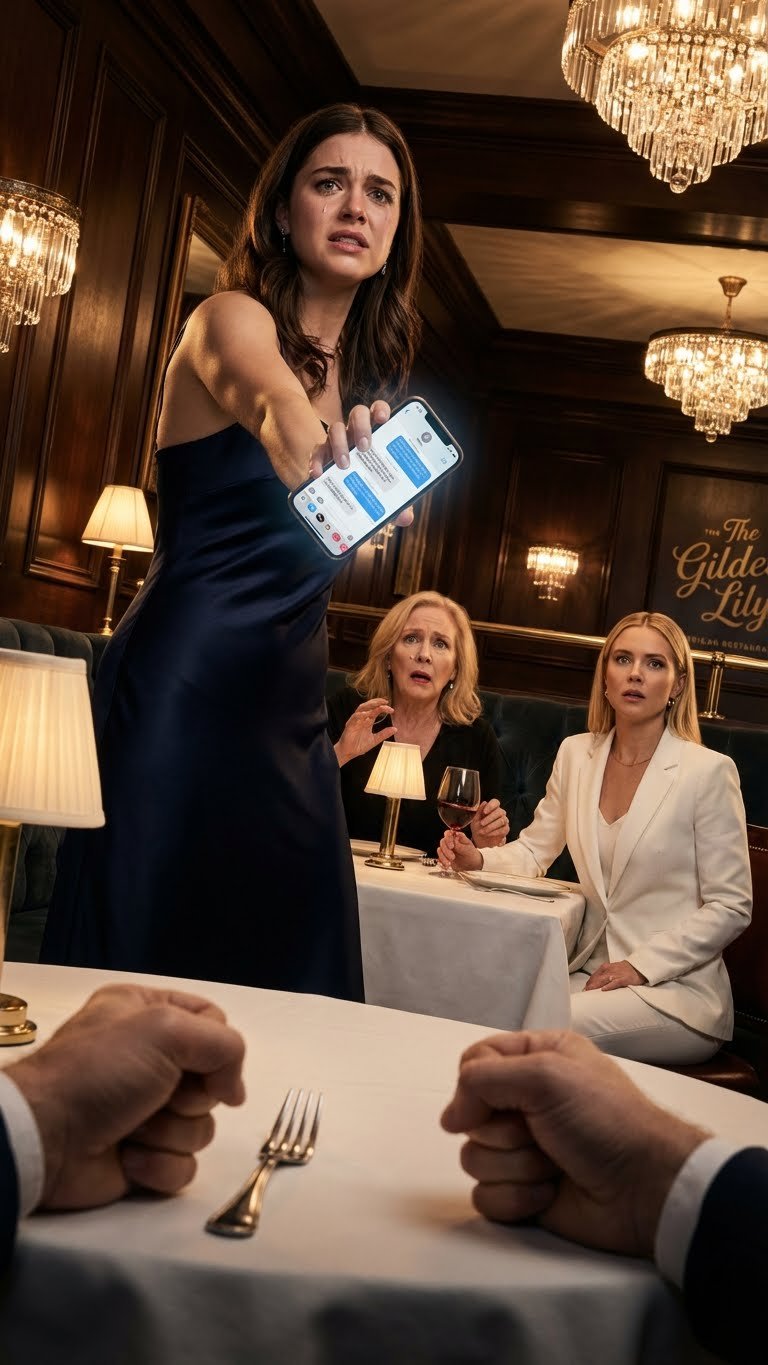
The dinner was held at The Gilded Lily, a posh restaurant with low lighting and white tablecloths so stiff they felt like parchment. For the first hour, things were deceptively calm. My mother complimented my dress—a rare occurrence that put me on edge. But then Sophia arrived.
She didn’t just walk in; she made an entrance, thirty minutes late, wearing a tailored white suit that looked suspiciously bridal. She claimed she was coming from a “crucial negotiation” for her promotion. Instantly, the atmosphere shifted. My mother’s eyes, previously dull when looking at me, lit up with a terrifying adoration. For the next half-hour, the engagement dinner became the Sophia show. My promotion, my wedding planning, Daniel—all of it was bulldozed by Sophia’s corporate conquests.
I tried to steer the conversation back to the reason we were all there. “So, about the wedding venue…” I started.
My mother stood up, tapping her spoon against her wine glass. “A toast,” she announced, her voice syrupy sweet. I straightened up, a foolish hope blooming in my chest. Maybe, just this once, she would validate me.
“To Daniel,” she began, beaming at my fiancé. “We are so thrilled to welcome you into the fold. You are such a catch. Honestly…” She paused, her gaze drifting to my sister. “It’s a shame you met the wrong sister first.”
The air left the room.
She laughed, a tinkling, artificial sound. “I’m joking! But really, Sophia has always been the one with the head for business and beauty. She’s much wiser, prettier… frankly, more worthy of a man of your caliber.” She turned her eyes back to me, cold and assessing. “I just hope Daniel knows what he’s getting into with you, darling. But, everyone can upgrade eventually, right?”
Silence descended like a guillotine. Across the table, Daniel’s parents looked furious, their faces flushing a deep crimson. Daniel looked as if he wanted to flip the table. But Sophia? She just grinned, sipping her wine as if she agreed with every word.
My hands trembled beneath the table. My cheeks burned with the accumulated heat of twenty-six years of rejection. The backup daughter. The disappointment. The afterthought.
But something inside me snapped. It wasn’t a break; it was a realignment.
I stood up. My legs felt like lead, but my voice was surprisingly steady. “I have something to say.”
My mother looked annoyed at the interruption. “Sit down, don’t make a scene.”
“No,” I said. “You wanted a toast? Let’s have a toast to the truth.”
Two months prior, I had set up my mother’s new smartphone. Being the ‘tech-savvy’ backup daughter, she had handed it over to me without a second thought. She didn’t know that I had seen the texts. And she certainly didn’t know that I had screenshotted every single hateful message exchanged between her and Sophia.
“You think I’m embarrassing?” I asked, pulling my phone from my clutch. “That’s what you texted Sophia when I arrived, isn’t it? And Sophia, you replied that I was ‘trying too hard’ and that you could ‘outperform’ me with Daniel if you tried.”
My mother’s face went pale. “Sophia said I was flashy,” I continued, scrolling through the mental catalog of their venom. “And Mom, you agreed. You said you didn’t see what Daniel saw in me. You said Sophia’s plan to flirt with him tonight was ‘a fun little game’ to turn his head.”
I looked at Daniel. “They planned it. The white suit. The lateness. The flirting. It was a strategy.”
Daniel stood up abruptly, his chair scraping loudly against the floor. “Get out,” he ordered, pointing at my mother and sister.
My mother burst into tears—not of remorse, but of victimhood. “You’re ruining the family!” she sobbed, pointing a shaking finger at me. “How could you be so cruel?”
“No,” I said, the clarity washing over me like cold water. “You ruined it. Twenty-six years ago. You told me I was never good enough. Tonight, I’m finally believing you. I’m not good enough for your abuse.”
Daniel escorted them out. As they left, Khloe’s mother—Daniel’s mom—walked around the table and hugged me so hard I thought my ribs would crack. “You handled that with more grace than they deserved,” she whispered.
But I wasn’t done.
I sat in my car outside the restaurant for twenty minutes. My phone was connected to the family group chat—39 relatives: aunts, uncles, cousins, grandparents. I looked at the “Send” button.
My breath fogged the glass. My hands were freezing on the steering wheel. I read the screenshots one last time. The mockery. The cruelty. The strategic dismantling of my happiness.
Press send.
The message went out. Every hateful text, every conspiracy to humiliate me, every word of the “black and white strategy” for the night.
The reaction was instantaneous. Ping. Ping. Ping.
1… 3… 7… 15 messages. The screen lit up like a strobe light. I muted the phone and dropped it into the cup holder. Daniel slid into the passenger seat, his presence a silent anchor. He saw the phone flashing, reached over, and gently turned it off. He didn’t ask questions. He just held my hand as I sobbed, finally letting the adrenaline crash.
The next morning, the silence of my apartment felt heavy, but not oppressive. It felt like the calm after a hurricane. I turned my phone on.
215 notifications.
The number scared me. I sat on the couch, Daniel next to me, while his mother sat in the armchair with her reading glasses, sorting through the digital wreckage. She became my filter, telling me who was safe and who was hostile.
“Uncle Andrew sent a long letter,” she said softly. “He says he always suspected your mother treated you differently but never realized how horrible it was. He regrets not speaking up sooner.”
Then Aunt Olivia called. We spoke for an hour. She cried, apologizing for not protecting me. “She always needed someone to degrade to feel superior,” Olivia told me, her voice trembling. “Even before you were born, she criticized my cooking, my clothes, my husband. You were just the most convenient target. I should have been braver.”
The floodgates had opened. My father’s three cousins, usually quiet observers, spoke up. They shared memories of my mother’s snide comments during unguarded moments at family gatherings. One cousin wrote: “Your mother told me I was lucky to have a job given my ‘limitations.’ I see now the pattern of cruelty is extensive.”
But not everyone was supportive. My grandmother—my mother’s mother—sent a blistering defense. She claimed I was “exaggerating,” that I was “too sensitive,” and that I was splitting the family over a simple joke.
Ding. A new text from Mom.
You are ungrateful. You humiliated me. Delete the messages and apologize immediately. If you don’t answer, I’m coming to your house.
Daniel didn’t hesitate. He changed our door codes and called security. “She’s not getting near you,” he said, his voice hard.
Then came the “Flying Monkeys”—the enablers. Sophia texted, claiming she was the victim, that I had turned the family against her. She demanded an apology for “invading her privacy.” It was a masterclass in gaslighting.
I didn’t respond. I blocked them. Mom. Sophia. Grandma. One by one, I cut the digital cords that had tethered me to their toxicity.
Three days later, my father called. His voice sounded thin, tired. He admitted Mom’s toast was “emotional” and “bad,” but suggested family therapy.
“I won’t repair anything she doesn’t want to fix,” I told him. “She doesn’t think she did anything wrong, Dad.”
His silence was an answer in itself. He hung up.
I felt a strange hollowness, but Daniel’s friend Ethan brought takeout over that night. He cracked jokes, remembered his own mother’s boundaries, and made me laugh for the first time in days. Validation from the outside world was a balm. I wasn’t crazy. I wasn’t “oversensitive.” I was just done.
The stalking began a week later.
It started with a letter. Daniel found it in the mailbox. On the envelope, in my mother’s immaculate cursive: Thicker than water.
Inside were six pages of vitriol. She insisted I had misinterpreted the toast. She claimed she had always loved us equally. She listed her “sacrifices”—driving me to soccer, helping with homework—as if basic parenting duties were currency she could trade for abuse. There was no apology. Only a demand that I apologize to her and Sophia in the group chat to “restore the family honor.”
I read it twice, my hands shaking. Then I stood up, grabbed my keys, and walked around the block three times in the freezing cold air until the rage settled into a cold resolve. She would never see me. She was incapable of it.
“We need a break,” Daniel said when I returned.
We drove three hours to a mountain B&B. No cell service. No family drama. Just us, hiking trails, and the sound of a creek rushing over rocks. On the summit of a ridge, looking out over the valley, I realized something profound: I had wasted so much energy trying to satisfy a woman who was committed to being dissatisfied.
I stopped checking my phone for her validation.
When we returned, I found an email from Sophia sent to my work address. The subject line: I’m sorry.
I opened it, expecting a breakthrough. Instead, it was three paragraphs about her suffering. She claimed Mom’s pressure to be perfect forced her to compete with me. She wanted us to be “sisters and friends again.” But nowhere did she acknowledge the specific harm she caused. Nowhere did she admit that flirting with Daniel was her idea.
I deleted it. I wasn’t responsible for her closure.
I started seeing Dr. Miller, a therapist with sharp eyes and a gentle demeanor. She listened to my story and nodded slowly. “Narcissistic family systems need a Golden Child and a Scapegoat to function,” she explained. “You didn’t cause it, and you cannot cure it.”
Together, we wrote a “border letter.” It was short, clinical, and firm.
I will not have contact with you until you acknowledge the specific harm you caused throughout my life. I am not asking for an apology that shifts blame. Until then, do not contact me.
I mailed it certified.
My mother’s response wasn’t a letter. It was a Facebook post. A vague, passive-aggressive status about “ungrateful children” and how her heart was broken by “lies.”
I screenshotted it. Then, I posted the border letter in the comments.
Within an hour, three more relatives messaged me, appalled by her behavior. Mom deleted the post six hours later.
But she wasn’t done escalating.
On a Tuesday afternoon, security at my office called my desk. “Ma’am, your mother is in the lobby. She’s… distressed.”
My heart hammered against my ribs. I took the elevator down, stopping on the mezzanine. I saw her in the waiting area, weeping theatrically to the receptionist. She was putting on a show.
“She won’t call me back!” she wailed. “I just want to see my daughter!”
I walked down the stairs. My voice was ice. “Leave.”
She spun around, her face twisting from sorrow to rage in a split second. “You ungrateful brat! I am your mother!”
“Security,” I said, nodding to the guard.
“You’ll regret this!” she screamed as they escorted her out. “You’ll understand when you have children of your own!”
Shame warmed my face, but as I looked around the lobby, I didn’t see judgment. I saw pity—for her.
The wedding planning became an act of rebellion.
Daniel and I scrapped the original massive guest list my mother had insisted on. We found a small garden venue behind an old city building—stone paths, rose arbors, and intimate string lights. We cut the list to 40 people.
The Rule: Only people who support us. No “obligation” invites.
The list included Daniel’s family, Aunt Olivia, Uncle Andrew, my cousin Lillian, my high school friend Meline (who had reached out after hearing the news), and even Dr. Miller.
My father was the wildcard.
He asked to meet for coffee two weeks before the wedding. He looked older, his shoulders slumped. He told me he was staying at a hotel. He had separated from Mom.
“Watching you,” he said, staring into his black coffee, “watching you set boundaries… it made me realize what I’ve been tolerating. I’m sorry I didn’t protect you.”
It wasn’t a magic fix. It didn’t erase twenty-six years of neglect. But it was a start. I told him he could walk me down the aisle, on one condition: Mom and Sophia were not invited. He agreed without hesitation.
The week of the wedding, Khloe’s mother (my future mother-in-law) threw me a bridal shower. It was in Olivia’s living room. There were no backhanded compliments. No competitions. Just laughter, lasagna, and warmth.
Khloe’s mom stood up. “I have something for you.” She pulled out a delicate silver bracelet with tiny charms. “This belonged to my mother. It’s your ‘something borrowed,’ but really, it’s a welcome to the family. We don’t just gained a daughter-in-law; we gained a daughter.”
I wept. Not the tears of frustration I was used to, but tears of relief. This is what love was supposed to feel like. Safe.
The wedding day was perfect.
We had hired security, just in case. Lillian had volunteered to run interference if Mom showed up. But as I stood in the back room with my father, adjusting my veil, the phone remained silent.
“You look beautiful,” my dad said, his voice cracking. “Not because of the dress. Because you look… free.”
We walked out into the sunlight. The garden was blooming, the air scented with jasmine. Daniel stood at the altar, tears streaming down his face the moment he saw me.
I didn’t scan the crowd for disapproval. I didn’t brace myself for a critique. I saw Olivia beaming, Andrew giving a thumbs up, and Meline crying into a tissue.
We exchanged vows we had written ourselves. Daniel promised to be my family when my original one failed me. I promised to build a home where worth wasn’t a competition.
At the reception, under the glow of the string lights, Uncle Andrew gave a toast. “The strongest families,” he said, raising his glass, “are the ones we choose.”
We danced until our feet hurt. We ate cake without counting calories. And when Daniel and I finally left for the hotel, I realized I hadn’t thought about my mother or Sophia once. Their absence didn’t leave a hole; it left space for joy.
Three months later, Daniel and I were sitting on our balcony, drinking coffee. My phone rang. It was Dad.
“It’s official,” he said. “The divorce papers are signed.”
He sounded lighter. He told me Mom was spinning out, blaming everyone but herself, but he was done listening. He was getting a small apartment near us.
I hung up and looked at Daniel. “It’s over.”
“No,” he smiled, taking my hand. “It’s just beginning.”
I still have scars. Sometimes, when someone gives me a compliment, I flinch, waiting for the “but.” Sometimes, I check my phone expecting a barrage of hate. But those moments are becoming rare.
I realized that by stepping out of the role of the Backup Daughter, I forced the whole toxic play to be cancelled. I am no longer an insurance policy. I am the author of my own life. And for the first time in twenty-six years, the story is a happy one.
If you want more stories like this, or if you’d like to share your thoughts about what you would have done in my situation, I’d love to hear from you. Your perspective helps these stories reach more people, so don’t be shy about commenting or sharing.