“Damaged goods,” Mom said loudly at my sister’s baby shower. “Too broken to ever be a mother.” Thirty pairs of eyes turned toward me, full of pity. I simply smiled and glanced at my watch. That’s when the door opened. Maria, my nanny, walked in—guiding my two-year-old triplets. Behind her stood my husband, Dr. Alexander Cross, head of neurosurgery, holding our newborn twins. Mom’s teacup slipped from her hand when my husband calmly announced…
The air in the Wellington Conservatory smelled of expensive lilies, buttercream frosting, and thinly veiled judgment. It was a suffocating cocktail that I hadn’t tasted in three years, yet as soon as I stepped across the marble threshold, the flavor coated the back of my throat like ash.
I adjusted the silk cuffs of my blouse, a nervous tic I thought I had abandoned years ago. The room was a sea of pastel pinks and creams, a curated shrine to fertility and motherhood. Crystal flutes chimed against laughter that sounded more like breaking glass than joy. In the center of it all sat my sister, Chloe, perched on a velvet throne, her hands resting protectively over her baby bump. She looked radiant, the picture of the Golden Child she had always been.
And hovering over her like a hawk guarding a nest was our mother, Eleanor.
I stood in the entryway, uninvited but summoned. A text message from my father—the only member of the family who still spoke to me in hushed, secret phone calls—had given me the time and location. She wants the whole family there, Elara. Just make an appearance. For peace.
Peace. In my family, peace was just a ceasefire while they reloaded their weapons.
I took a breath, steeling myself. I was thirty-two years old. I was a different woman than the one who had fled this toxic dynamic with a suitcase and a broken heart. Or so I told myself. But as I walked further into the room, the old insecurity clawed at my ribs.
“Elara?” The voice was sharp, cutting through the low hum of conversation.
I turned to see my mother approaching. She hadn’t aged a day. Her hair was the same perfect, icy blonde, her skin pulled tight, her eyes scanning me for flaws like a jeweler inspecting a diamond for cracks.
“Mother,” I said, keeping my voice steady. “The decorations are lovely.”
She stopped a foot away from me, invading my personal space without touching me. She lowered her voice, though not enough to be private. It was a stage whisper, meant to be overheard by the nearby circle of her country club friends.
“I’m surprised you came,” Eleanor said, her lips curving into a pitying smile. “I told your father it would be too painful for you. Being around all this… life.”
She gestured vaguely at the room, at the pregnant women, the strollers, the celebration of impending birth.
“I’m happy for Chloe,” I replied, my spine stiffening. “Why would it be painful?”
Eleanor sighed, a theatrical sound that drew the attention of Mrs. Higgins and Lady Sterling, the twin pillars of local gossip. “Oh, darling. We don’t have to pretend. We know about your… situation. The struggles.” She reached out and patted my arm, her touch cold. “It’s brave of you to show up, knowing you’re… well, incompatible with this world.”
Incompatible. That was a new one. Usually, it was barren, defective, or unfortunate.
“I’m doing just fine, Mother,” I said, pulling my arm away.
“Are you?” She tilted her head. “You look tired. And that dress… is it off the rack? Oh, Elara. I always worried that without a husband to take care of you, you’d just fade away.”
She didn’t know. None of them knew.
They didn’t know about Alexander. They didn’t know about the life I had built in the city, two hours away but a universe apart. They didn’t know that the “struggles” she referenced—the severe endometriosis that had plagued my twenties—had been a battle I fought and won, not a sentence I was serving.
I opened my mouth to defend myself, to drop the truth right there in the appetizer line, but I stopped. Not yet. The timing wasn’t right. Alexander was parking the car. He had insisted on checking the car seats one last time. He was meticulous like that.
“I’m just here to wish Chloe well,” I said, deflecting.
“Well, grab a glass of champagne,” Eleanor said, turning her back on me dismissively. “It’s not like you have to worry about drinking, is it?”
The women around her tittered behind their hands. The sound grated on my nerves, but I forced a smile. I walked over to a quiet corner, checking my watch.
1:14 PM.
Five minutes. Just five more minutes of being the punching bag, and then the world would tilt on its axis.
I watched Chloe from my corner. She was opening gifts now, oohing and ahhing over cashmere blankets and silver spoons. She looked happy, but there was a fragility to her eyes that I recognized. She was performing. We were all performers in Eleanor’s theater; Chloe had just landed the lead role while I had been cast as the cautionary tale.
A waiter passed by with a tray of cucumber sandwiches. I waved him away. My stomach was a knot of adrenaline.
It wasn’t just the insults. It was the history. Five years ago, I had been engaged to a man Eleanor adored—a wealthy, spineless heir named Preston. When we discovered my fertility issues, Preston had broken the engagement at my mother’s urging. “The bloodline is important, Elara,” she had told me then, as I cried in my childhood bedroom. “A woman who cannot produce an heir is like a vase that cannot hold water. Decorative, perhaps, but ultimately useless.”
That was the day I left. I cut them off. I went back to school, got my masters in Art History, and started working at a gallery in Boston. That was where I met Alexander.
He wasn’t an heir. He was a man who worked with his hands and his mind. A neurosurgeon who spent twelve hours a day saving lives and the rest of his time trying to make mine better. When I told him about my medical history on our third date, expecting him to run, he had simply taken my hand and said, “I’m falling in love with you, Elara. Not your uterus.”
We married in a small ceremony in Italy. My parents weren’t invited.
And then came the miracle. Or rather, the science and the miracle combined. It hadn’t been easy. IVF is a brutal, exhausting road. There were losses. There were nights I screamed into my pillow while Alex held me. But then came the triplets. Leo, Sam, and Maya. Two years of chaotic, exhausting bliss.
And then, six months ago, the impossible happened. A natural pregnancy. Twins. Noah and Grace.
We had five children under the age of three. My house was a cacophony of laughter, crying, and love. It was messy and loud and perfect.
And Eleanor thought I was a barren spinster living in a studio apartment.
I checked my watch again. 1:17 PM.
“Elara!”
Chloe was waving at me from the throne. The room quieted as the guest of honor acknowledged the black sheep. I walked forward, my heels clicking on the hardwood floor.
“Hi, Chloe,” I said softly. “You look beautiful.”
“I’m so glad you came,” Chloe said, and for a moment, she sounded genuine. She reached for my hand. “I missed you.”
“I missed you too,” I said.
“It’s hard, isn’t it?” Chloe whispered, squeezing my hand. “Seeing all this? Mom said you might be… jealous.”
The sympathy in her eyes was worse than the malice in my mother’s. It was pity. She truly believed I was broken.
“I’m not jealous, Chloe,” I said. “I have a very full life.”
“Oh, sure,” Eleanor interrupted, swooping in like a vulture. She placed a hand on Chloe’s shoulder, claiming her. “Elara has her little… job. At the museum, is it?”
“Gallery,” I corrected. “I own an art gallery.”
“Right. A shop,” Eleanor dismissed. She turned to the room, raising her voice. She wanted an audience for this. She wanted to establish the hierarchy once and for all.
“You know, everyone,” Eleanor announced, her voice ringing clear as a bell. “We should all be extra kind to Elara today. It takes a lot of strength to celebrate a sister’s joy when you know you’ll never experience it yourself.”
The room went dead silent. Thirty guests stared at me. Some looked uncomfortable, others morbidly curious.
“Mom, don’t,” Chloe murmured, but she didn’t stop it.
“No, it needs to be said,” Eleanor continued, her eyes locking onto mine with predatory glee. “Some women are built for family, for legacy. And some are just… different. Damaged goods, really. Too broken to ever have children.”
She said it. The phrase she had whispered to me five years ago, now spoken aloud to a room full of strangers. Damaged goods.
I felt the heat rise in my cheeks, but it wasn’t shame. It was fury. It was the hot, white fire of a bridge burning down.
I didn’t look away. I didn’t cry. I smiled. A slow, dangerous smile that made Eleanor falter for a fraction of a second.
I checked my watch. 1:19 PM.
“Is that what you think, Mother?” I asked, my voice calm, projecting to the back of the room. “That a woman’s worth is defined solely by her ability to reproduce? And that without it, she is damaged?”
“I’m just stating facts, darling,” Eleanor sniffed. “Reality is harsh.”
“Reality,” I repeated. “Yes. Let’s talk about reality.”
I turned toward the double oak doors at the entrance of the conservatory.
“You might want to put your teacup down, Mother,” I said. “You have shaky hands.”
The heavy oak doors groaned as they were pushed open from the outside.
The sound broke the suffocating silence of the room. Every head turned. Eleanor looked annoyed at the interruption, ready to scold a waiter for the noise.
But it wasn’t a waiter.
Maria, our nanny—a wonderful, sturdy woman who had helped raise half the children in Boston—strode into the room. She was pushing a custom-made, triple-wide stroller that looked more like a tactical vehicle than a baby carriage.
Inside the stroller sat Leo, Sam, and Maya. My two-year-old triplets. They were dressed in matching navy blue outfits, looking around the room with wide, curious eyes. Leo was clutching his stuffed dinosaur. Maya was already waving at the strangers.
A collective gasp ripped through the room. It sounded like the air being sucked out of an airlock.
Maria navigated the stroller into the center of the room and parked it next to me. “Sorry for the delay, Mrs. Cross,” she said cheerfully. “Sam dropped his pacifier in the fountain outside.”
“Thank you, Maria,” I said, reaching down to smooth Sam’s hair.
Eleanor was frozen. Her mouth was slightly open, her eyes darting from the children to me. She looked like a computer trying to process a file format it didn’t recognize.
“Whose… whose children are these?” she stammered.
Before I could answer, the doors opened again.
A shadow fell across the threshold. My husband, Dr. Alexander Cross, stepped into the light.
He was an imposing figure—six-foot-two, broad-shouldered, wearing a charcoal suit that cost more than the catering for this entire party. He radiated a calm, commanding authority that usually silenced operating rooms.
But it wasn’t his suit or his height that stopped the room’s heart.
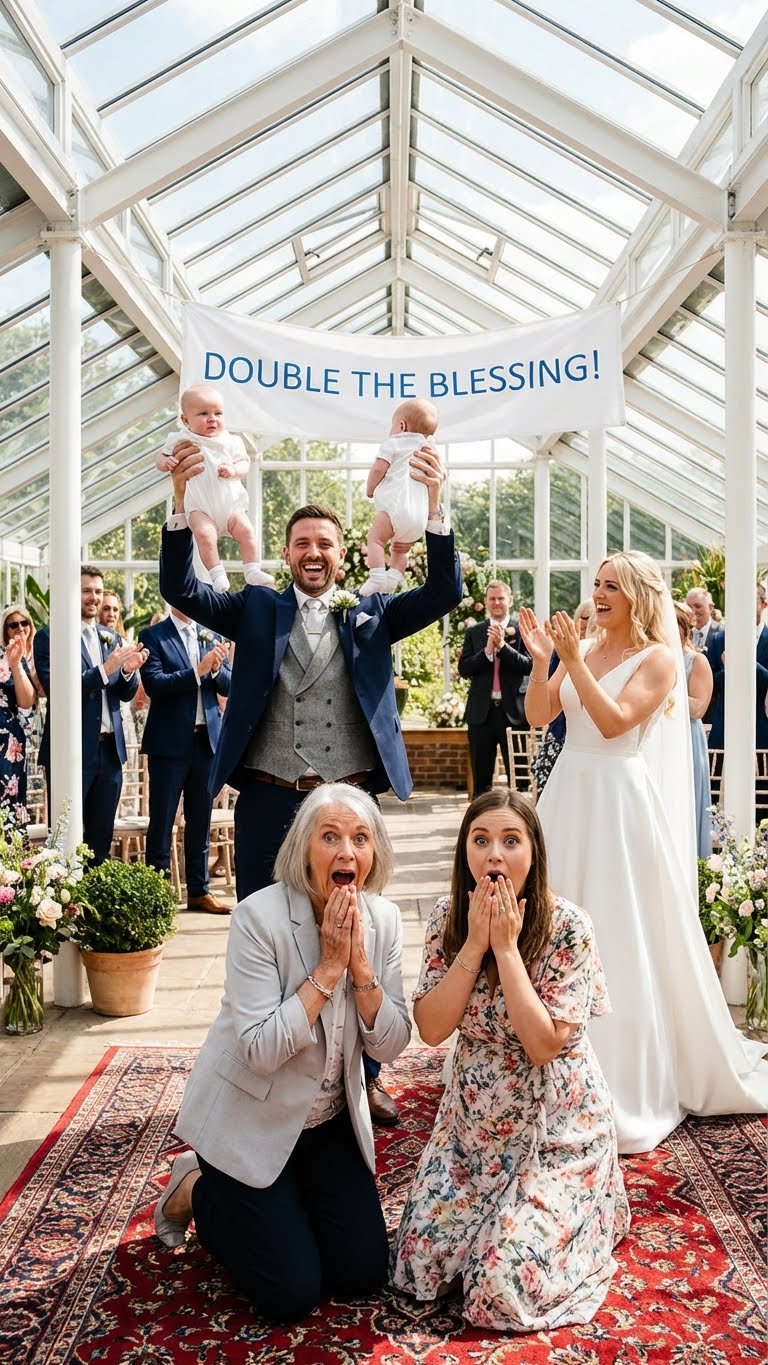
In his left arm, he cradled Noah. In his right, Grace. Our newborn twins, just eight weeks old, sleeping soundly against his chest.
Alexander walked toward me, his eyes fixed only on my face. He ignored the gaping guests. He ignored my mother, who was now clutching her pearls as if they were life preservers. He walked right up to me, kissed my forehead, and smiled.
“Sorry I’m late, love,” he said, his deep voice carrying effortlessly. “The hospital board meeting ran long. Being Chief of Neurosurgery involves more paperwork than they tell you in med school.”
He turned slightly, presenting the twins to the room, then looked directly at Eleanor.
“You must be Eleanor,” he said, his tone polite but with a razor’s edge. “Elara has told me very little about you. Which, having met you for ten seconds, I now understand was an act of mercy.”
Eleanor dropped her teacup.
It hit the saucer with a sharp clatter, tipping over and spilling Earl Grey tea all over the white linen tablecloth and down the front of her designer dress. She didn’t even notice the scald.
“Five?” she whispered, her voice trembling. “You have… five?”
“Triplets and twins,” I said, lifting Leo out of the stroller and settling him on my hip. He rested his head on my shoulder, the universal sign of a child who knows his mother. “It turns out I wasn’t broken, Mother. I just needed to be away from the person who was breaking me.”
Chloe slowly stood up from her throne. She waddled over, looking at the army of children with awe. “Elara… they’re yours? Biologically?”
“Every single one,” Alexander answered for me. “Though I like to think they get their stubbornness from their mother.”
“But how?” Eleanor demanded, her shock turning into indignation. “You lied! You let us believe…”
“I didn’t lie,” I cut her off. “I simply didn’t tell you. Because my children are not trophies for your vanity, Mother. They are not props for your social standing. They are people. And I vowed a long time ago that they would never, ever be exposed to the toxicity of this house until I was ready to shield them from it.”
I looked around the room at the thirty guests who had stared at me with pity just moments ago. Now, their expressions were a mix of envy, shock, and admiration.
“Dr. Cross?” Mrs. Higgins gasped, stepping forward. “Dr. Alexander Cross? The one who developed the Cross Protocol for spinal repair?”
Alexander nodded briefly at her. “That’s me. And this is my wife, Elara. The woman who built this family while running a successful business.”
He handed Grace to me, and I held my daughter close, inhaling the scent of baby powder and milk. I looked at my mother. She looked small. Defeated. The narrative she had constructed—the one where I was the failure and she was the martyr—had just been incinerated.
“You called me damaged goods,” I said to her, my voice low. “You said I was a broken vase. But look at me now, Mother. My cup runneth over.”
The silence that followed was heavy, but it was a different kind of weight than before. It wasn’t the weight of judgment; it was the weight of a paradigm shift.
“Can I… can I hold one?” Eleanor asked, her voice cracking. She took a step toward Alexander, reaching out a hand toward Noah.
Alexander took a subtle step back. It was a small movement, but it was a wall.
“No,” he said.
Eleanor blinked. “Excuse me?”
“You don’t get to hold them,” I said. “You don’t get to be the grandmother in the photos. You don’t get to brag about them to your friends at the club. You forfeited that right when you decided my worth was conditional.”
“Elara, please,” Chloe said, tears welling in her eyes. “This is family.”
“Family protects you,” I told my sister gently. “Family doesn’t watch you bleed and call it a weakness. I’m happy for you, Chloe. I hope your baby brings you joy. But my family…” I gestured to Alexander and our five children. “My family is leaving.”
“You can’t just walk in here, drop this bomb, and leave!” Eleanor shrieked, her composure finally shattering. “What will people think?”
I laughed. It was a genuine, bubbling sound of liberation. “Oh, Mother. After all this time, you still think I care what these people think?”
I turned to Maria. “Let’s load them up, Maria. We have a dinner reservation.”
“Yes, ma’am,” Maria said, smiling broadly as she maneuvered the stroller around.
I walked toward the door, Alexander at my side, my hand in his. I could feel the eyes of everyone on my back, but I didn’t feel the need to shrink.
“Elara!” my father’s voice called out.
I stopped near the door. My father, Richard, was standing by the buffet table. He had been silent the entire time, as he usually was. But now, he had tears in his eyes.
“They’re beautiful,” he said softly. “You did good, kid.”
I nodded to him. “Goodbye, Dad. Call me if you ever decide to stop being a spectator in your own life.”
We walked out into the cool afternoon air. The sun was shining. The birds were singing. It was a cliché, but it felt like the world had scrubbed itself clean.
As we reached the car—a sleek, black SUV that fit all seven of us—Alexander helped me buckle Leo in.
“You okay?” he asked, searching my face.
“I’m better than okay,” I said. “I’m done.”
He kissed me. “You were incredible in there. ‘My cup runneth over’? That was poetic.”
“I practiced it in the mirror,” I admitted with a grin.
“I know,” he laughed. “I heard you in the shower this morning.”
We loaded the stroller. We buckled the car seats. We did the headcount. One, two, three, four, five.
As we drove away from the Wellington estate, I looked back in the rearview mirror. I saw my mother standing on the porch, watching us leave. She looked like a ghost haunting a house that no longer held any treasure.
Three months later.
The morning light streamed through the kitchen windows of our brownstone in Boston. The floor was covered in toys—blocks, stuffed animals, a rogue pacifier. The smell of coffee and pancakes filled the air.
Leo was trying to feed his dinosaur a piece of banana. Maya was singing a song that consisted of only one word (“No”). Sam was fast asleep in his high chair, face covered in syrup.
In the living room, the twins were doing tummy time on a playmat.
I sat at the kitchen island, sipping my coffee, watching the chaos. It was loud. It was messy. It was exhausting.
My phone buzzed on the counter. A text from Chloe.
Mom is still furious. She told the bridge club you used a surrogate and that Alexander is actually an actor you hired. Dad moved into the guest room.
I smiled and typed back: Let her talk. Fiction is the only place she has any power left.
I’d like to come visit, Chloe wrote. Just me. No Mom.
I looked at Alexander, who was currently trying to wipe syrup off Sam’s face without waking him up. He looked up and caught my eye. He nodded.
Okay, I typed. Come meet your nephews and nieces. But leave the judgment at the door.
I put the phone down.
I wasn’t a broken vase. I wasn’t damaged goods. I was a mosaic—pieced together with gold, stronger for the fractures, holding more love than my mother could ever comprehend.
“Mama!” Leo shouted, pointing at the window. “Bird!”
“Yes, baby,” I said, walking over to pick him up. “It’s a bird.”
I held him close, feeling the solid weight of him, the beat of his heart against mine.
“Fly,” he whispered.
“Yeah,” I said, looking out at the open sky. “Fly.”