The cathedral’s stone ribs were traced in the flickering gold of a thousand candles, each flame a silent, weeping eye. The air, thick with the scent of lilies and old incense, felt heavy in my lungs, a shroud I couldn’t cast off. I sat alone in the front pew, a king in a hollowed-out kingdom, the silence inside me more absolute than the hallowed quiet of the church. This was the service no father should ever attend, a final, gut-wrenching farewell to my only daughter, Talia. The choir’s final notes, a soft, murmuring requiem, faded into the vaulted ceiling, leaving a void that echoed the one she had left in my life. I stared at the polished mahogany of the casket, a monstrously beautiful thing, and felt a grief so profound it had become a physical weight, pressing down on my chest until I could barely draw a breath. My business partner, Morton Keene, sat beside me, his hand a supposedly comforting presence on my shoulder. “It’s time to let her rest, Preston,” he’d murmured earlier, his voice oozing a practiced sympathy. “The media circus will only get worse. A quick, private service is what she would have wanted.” At the time, his words had sounded like wisdom. Now, they just felt like another layer of stone on the tomb of my heart.
That profound silence shattered.
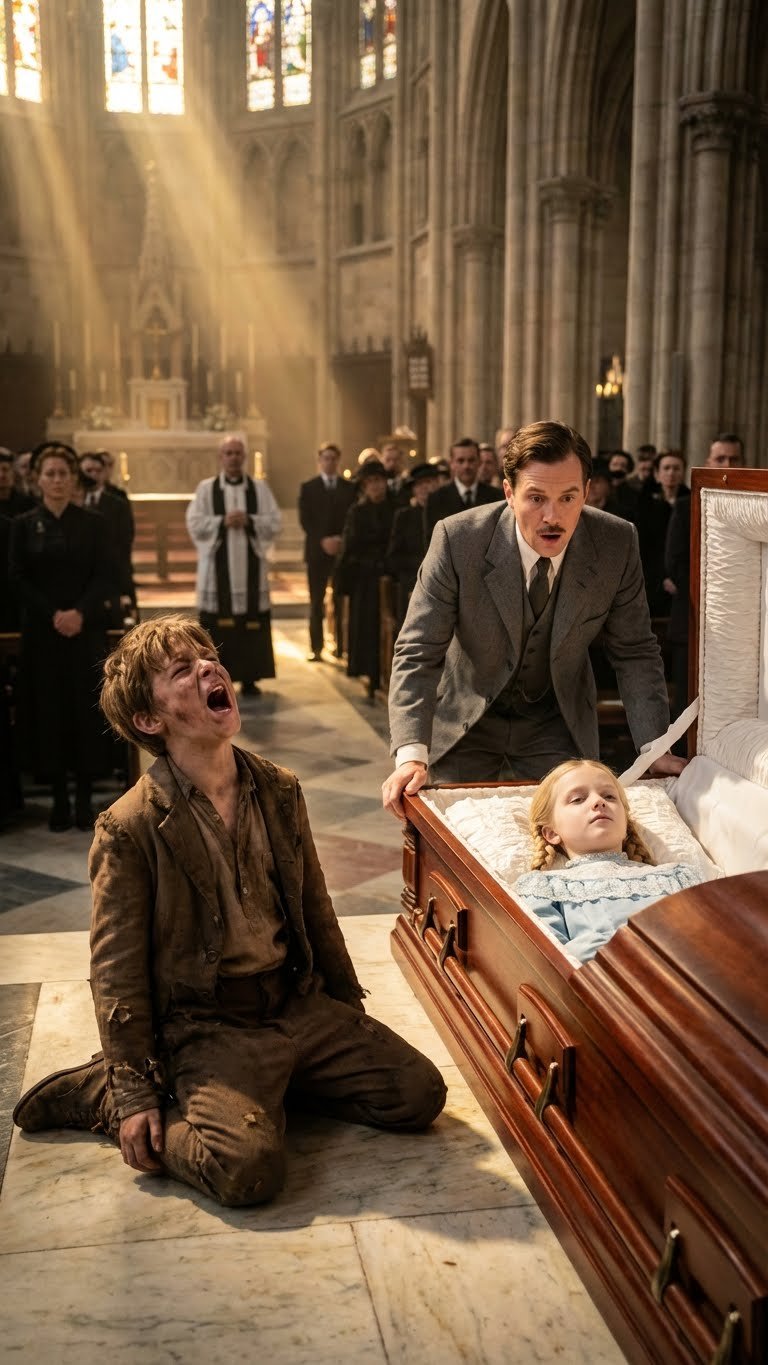
The great oak doors at the back of the cathedral burst open with a crash that echoed like a gunshot. A figure was silhouetted against the harsh afternoon light—a boy, thin and wiry, his clothes little more than stained rags. He stumbled inside, his chest heaving, his eyes wide with a desperate, frantic energy. A collective gasp swept through the mourners. Whispers erupted like wildfire, a wave of shock and indignation. Some recoiled in disgust; others glared as if he were a demon come to desecrate this sacred rite. For a moment, he just stood there, a specter of the streets in a temple of wealth and sorrow. Then he ran, his worn sneakers slapping against the marble aisle, a frantic, uneven rhythm that was the antithesis of our somber procession.
He ran straight for the altar, straight for the coffin. His voice, when he finally found it, was a raw, cracking thing, trembling with an urgency that cut through the murmurs and froze the blood in my veins.
“Stop the burial!” he shouted, his gaze locking onto mine. “Your daughter is alive!”
The world seemed to tilt on its axis. The whispers died instantly, replaced by a stunned, breathless silence. Morton’s hand tightened on my shoulder. “Security,” he hissed, his voice sharp. “Get this vagrant out of here. He’s delirious.” Two of my guards, massive men in sharp black suits, began to move from the periphery, their faces set like stone. But I didn’t look at them. I couldn’t look away from the boy. He had reached the casket and fallen to his knees, his palms slapping flat against the polished wood as if trying to feel a life force through it. He was breathing in ragged, painful gasps.
“My name is Jace Rowley,” he choked out, the words tumbling over each other. “I know what happened to Talia. I saw the truth. She’s not gone.“
The guards were closing in. The guests were beginning to stir again, their shock turning to anger. But in the boy’s eyes, I saw not madness, but a terrifying, desperate conviction. For weeks, a small, insistent voice in the back of my mind had whispered that the coroner’s report—a simple, tragic overdose—felt wrong. Too neat. Too simple for my vibrant, fierce Talia. This boy, this impossible intrusion, was like a match struck in the suffocating darkness of my grief.
Morton was on his feet. “Preston, for God’s sake, this is a mockery. We must have him removed.”
The guards reached for the boy. And I, moving as if in a dream, slowly raised a hand. The gesture was small, but it held the absolute authority they were trained to obey. They froze.
My voice was a hollow rasp, barely my own.
“—Let him speak.”
Jace swallowed hard, his Adam’s apple bobbing in his thin throat. The cathedral was so quiet I could hear the frantic beat of my own heart against my ribs. He took a deep, shuddering breath, and when he spoke again, his voice was steadier, laced with the chilling clarity of a witness.
“I was behind the Eclipse Club that night,” he began, his eyes still fixed on me. “I was looking for scraps, anything the kitchen had thrown out. I saw a man dragging her into the alley. She was struggling, but he was strong. He pinned her against the wall and gave her an injection in her neck.” A tremor of horror ran through the assembled guests. I felt a cold dread begin to rise in my chest, a chilling premonition that this boy was not mad, but a harbinger of a truth I was not prepared for. “I thought maybe he was helping her,” Jace continued, his voice dropping to a near-whisper, “until I saw her body go limp. She was alive, but her breathing was… shallow. So shallow. He left her lying on the cold pavement and drove off. He thought no one was watching.”
My own breath hitched. The alley behind the Eclipse. The police report had said she was found there, that she must have sought a private place after leaving the club. It had never sat right with me. Talia hated dark, enclosed spaces.
“I tried to wake her up. I yelled her name,” Jace said, his voice cracking with the memory of his own helplessness. “I called for help, but nobody comes to my neighborhood. People hear yelling, they lock their doors. They ignore calls from the street. So I stayed with her. I propped her head up on my jacket, tried to keep her warm. I stayed until I thought she was stable. Hours later, the police finally arrived. They took one look at her, one look at me, and said she was dead. They were wrong.”
His story was a stone cast into the placid, stagnant pool of my mourning, sending ripples of doubt and a terrible, fragile hope through me. Morton stepped forward, his face a mask of concern. “Preston, the boy is clearly disturbed. He’s a homeless kid spinning a fantasy. The police, the coroner—they all confirmed it. This is cruel, a new kind of torture.”
But I wasn’t listening to Morton anymore. I was taking one slow step, and then another, my shoes echoing ominously on the marble, until I was standing right in front of the boy. I towered over him, this scrap of humanity who dared to challenge the finality of death itself.
My voice was low, dangerous. “—Why did you wait until today to say this?”
Jace finally lowered his gaze, staring at the floor as if the words were too heavy to speak aloud. “No one listens to a kid like me. I tried to talk to the officers at the scene, but they pushed me off, told me to scram before they arrested me for vagrancy. I went to the station the next day, but they wouldn’t let me past the front desk. When I read in a discarded newspaper that the funeral was today, I knew… I knew I couldn’t let them bury her. Not while she was still breathing.”
The words hit me not like stones, but like shards of glass, tearing through the fog of my grief. Everything the boy said aligned with that nagging, persistent feeling that something was profoundly wrong. The rushed funeral, Morton’s insistence on avoiding a media spectacle, the neat and tidy cause of death that contradicted everything I knew about my daughter. That single thread of doubt was now coming undone, unraveling the entire tapestry of my loss.
A chilling resolve settled over me. I turned my back on Jace and faced the casket, the object of all my pain.
“Open it,” I said quietly.
Morton grabbed my arm, his grip surprisingly strong. “Preston, don’t. What will you find? Nothing but more pain. Don’t do this to yourself.”
I shook him off, my eyes cold. “Open it.”
The funeral directors looked at me, then at each other, their faces pale with uncertainty. But they saw the command in my eyes. With trembling hands, two of them stepped forward and unlatched the heavy lid. A soft hiss of air escaped as they lifted it. Light flooded in, and I leaned forward, my heart hammering against my ribs. I expected stillness. I expected the terrible, waxy chill of death. Instead, as I reached out and touched her hand, I felt… warmth. A faint, residual warmth where none should remain.
“It’s lukewarm,” I whispered, the words catching in my throat.
With a hand that shook uncontrollably, I placed two fingers against the side of her neck, searching for the carotid artery as I’d seen doctors do a hundred times in movies. I felt for something, anything, a flicker in the void. And then I found it. A pulse. Impossibly faint, a delicate flutter like a trapped bird’s wing, but it was there. Weak, but undeniable.
My head snapped up, my eyes wild.
“—Get a doctor. Right now!”
The cathedral erupted into a frenzy. Gasps turned to frantic shouts. A doctor who had been attending the service, a guest of a distant cousin, pushed his way through the stunned crowd. His eyes widened in shock as he checked for himself, his professional composure crumbling in the face of the impossible.
“She has a heartbeat!” he confirmed, his voice loud in the suddenly silent church. “It’s thready, but it’s present. My God. We have to get her to a hospital. Immediately!”
The next few minutes were a blur of controlled chaos. The solemnity of the funeral was shattered, replaced by the urgent, focused energy of a rescue. Paramedics, summoned by a frantic call, rushed in with a stretcher. As they carefully lifted Talia from the velvet lining of the coffin and hurried her out into the waiting ambulance, the sight of her being carried away, not to a grave but towards a chance at life, was so overwhelming I nearly collapsed.
Preston turned to the boy, who looked terrified, ready to be dragged away by the guards who still flanked him. “—You’re coming with me,” I said, my voice thick with an emotion I couldn’t name.
Jace tensed, his body coiling as if expecting a blow. “—I didn’t do anything wrong.”
“—You came because you cared,” I replied, my gaze softening. “That’s more than enough.”
We followed the stretcher to the ambulance and then to the hospital. The hours that followed were an agonizing crawl. I paced the sterile white corridor, a caged animal fueled by a terrifying cocktail of hope and fear. Jace sat on a hard plastic chair, his hands clasped so tightly his knuckles were white, as if trying to shrink into himself, not to intrude on the grief of a wealthy man whose world he had just detonated. I finally stopped pacing and sat next to him. The silence between us stretched, filled with the hum of hospital machinery and the frantic workings of my own mind.
“How did you know?” I asked, my voice low. “How were you so sure?”
Jace stared at his worn-out shoes. “Her chest. When I was with her in the alley, I put my ear to her chest. I could barely hear it, but it was there. A heartbeat. Like a mouse tapping behind a wall. The paramedics… they never even checked that closely. They just saw a girl on the ground and a street kid next to her and made up their minds.”
His words painted a damning picture of prejudice and neglect. A picture I, in my gilded world, had never had to look at. Finally, a doctor in a white coat approached, his face etched with a mixture of exhaustion and sheer disbelief.
“She’s stable now,” he reported, and I felt my knees go weak with relief. “Your daughter was given a powerful, non-standard barbiturate cocktail. It’s designed to mimic death, slowing the heart rate and respiration to almost undetectable levels. It put her into a medically induced coma. Her vital signs were misinterpreted at the scene. This boy… by speaking up, by forcing the issue, he saved her life. A few more hours, and it would have been irreversible.”
The doctor walked away, leaving me to absorb the enormity of his words. I turned to Jace, my mind reeling with disbelief and a gratitude so immense it was painful.
“Tell me more about the man you saw,” I said, my voice urgent. “Anything you can remember.”
Jace nodded, his brow furrowed in concentration. “He was tall. Wore a dark coat. He had a scar, a thin white line, near his right eyebrow. He pushed her into a silver van. I memorized the license plate number.” He looked up at me, a flicker of pride in his tired eyes. “I do that to stay alive. Memorize things. Faces, cars, numbers. You never know when you’ll need to.”
I held my breath, my entire world narrowing to this one, singular point.
“—What was the number?”
Jace recited it clearly, without a moment’s hesitation. G-K-4-8-1-Z-E.
The air left my lungs in a single, ragged gasp. My vision tunneled. I knew that number. I had seen it just last week. It belonged to a new fleet vehicle, a silver utility van. It belonged to a man who had a thin, white scar near his right eyebrow from a sailing accident we’d had in the Bahamas a decade ago. It belonged to Morton Keene. My lifelong business partner. My trusted advisor. The man who had stood beside me in the church, his hand on my shoulder, urging me to bury my daughter quickly and quietly.
Betrayal, cold and absolute, narrowed my vision. The motive slammed into me with the force of a physical blow. Our company bylaws stated that in the event of one partner’s incapacitation or death, the other assumed controlling interest if no direct heir was capable of taking over. With Talia gone and me shattered by grief, Morton would have had complete control of my entire stake, my legacy. He hadn’t just wanted my daughter gone.
“He wanted me destroyed,” I muttered, the words tasting like poison.
The next morning, the world had shifted. The grief was still there, a dull ache in my bones, but it was now overshadowed by a cold, clarifying rage. I sat beside Talia’s hospital bed, watching the steady rise and fall of her chest, a sight that was nothing short of a miracle. Her face was pale, but peaceful. She was here. She was alive. Jace waited silently near the door, a sentinel in borrowed hospital scrubs, as if still afraid he didn’t belong.
I turned my head to look at him, the boy who had walked through fire to deliver the truth.
“Jace,” I said, my voice low and steady. “Will you help me sink him?”
Jace met my gaze, and for the first time, I saw not fear or hunger in his eyes, but a fierce, unwavering resolve. He nodded without hesitation.
“—For her,” he said simply. “Yes.”
The investigators I hired, a private team of former federal agents, arrived within hours. They were discreet, efficient, and ruthless. Armed with Jace’s testimony, they pulled the club’s security footage. There it was, timestamped and undeniable: Morton’s silver van pulling into the alley. A tall figure in a dark coat getting out. More evidence surfaced in a torrential flood. Financial records showed Morton had leveraged himself to the hilt, betting on a corporate takeover that would have been impossible without control of my shares. He stood to gain everything from my downfall.
With Jace’s eyewitness account as the lynchpin, the official detectives finally had enough to act. They confronted Morton at his estate, the same place where he and I had celebrated countless successes. I was there, with Jace standing just behind me. I wanted to see his face.
Morton was arrogance personified, at first. He laughed, calling it a preposterous fantasy spun by a street urchin. “Preston, you can’t be taking this seriously! You’re not well. Grief is clouding your judgment.”
Then the lead detective played the security footage on a laptop. Morton’s face went slack, the color draining from it. The detective laid out the financial documents, a paper trail of his greed. Finally, Jace stepped forward.
“I saw you,” he said, his voice clear and strong. “I saw the scar on your face. I saw what you did to her.”
Morton stared at Jace, then at me, his eyes wide with the panicked fury of a cornered rat. The mask of friendship dissolved, revealing the monster beneath. He was charged with attempted murder and multiple counts of fraud. I watched them lead him away in handcuffs, his empire of lies crumbling around him.
A week later, I was sitting in Talia’s hospital room watching the news report on a flat-screen TV. Jace was next to me on the small sofa, no longer looking like a guest, but like someone who belonged.
“You saved her life twice,” I said gently, not taking my eyes off my daughter’s sleeping face. “First in the alley. Then at the funeral.”
“I just did what anyone should,” Jace replied quietly.
“—Not everyone would have risked everything to tell the truth,” I said, turning to him. “You did.”
A few days later, Talia finally opened her eyes. She found me beside her, and I took her hand, my own trembling with a relief so profound it felt like pain. Her gaze drifted past me and she saw the boy standing by the wall, watching them with a shy, uncertain expression.
“Father,” she whispered, her voice hoarse. “Who is that?”
I smiled, a real smile, with a warmth I thought had died with her. “—He’s the one who kept you alive, sweetheart. You wouldn’t be here without him.”
Talia extended a weak hand towards Jace. “Thank you,” she whispered, her eyes shining with unshed tears. “Thank you for not leaving me.”
Jace blinked rapidly, his composure finally cracking. His own voice was thick with emotion. “—I never could have.”
I stood and put my hand on the boy’s shoulder, a solid, grounding weight. “You’re not going back to the streets,” I told him, the decision as clear and certain as my own name. “From this moment on, you’re staying with us. You have a home now.”
Jace looked from my face to Talia’s, as if he couldn’t trust what he was hearing, as if waiting for the illusion to shatter.
“Is it safe?” he asked, a question born of a lifetime of uncertainty.
“—I’m completely sure,” I answered, my voice firm with promise.
The boy nodded slowly. His eyes still held the shadows of hunger and cold nights, but for the first time, a small, brilliant light of hope burned within them. He believed in the promise of safety. And Talia, my daughter, my world, smiled at him with quiet, profound understanding. Her life had been saved by a stranger who refused to be silent. Now, he was no longer a stranger. He was family.
If you want more stories like this, or if you’d like to share your thoughts about what you would have done in my situation, I’d love to hear from you. Your perspective helps these stories reach more people, so don’t be shy about commenting or sharing.