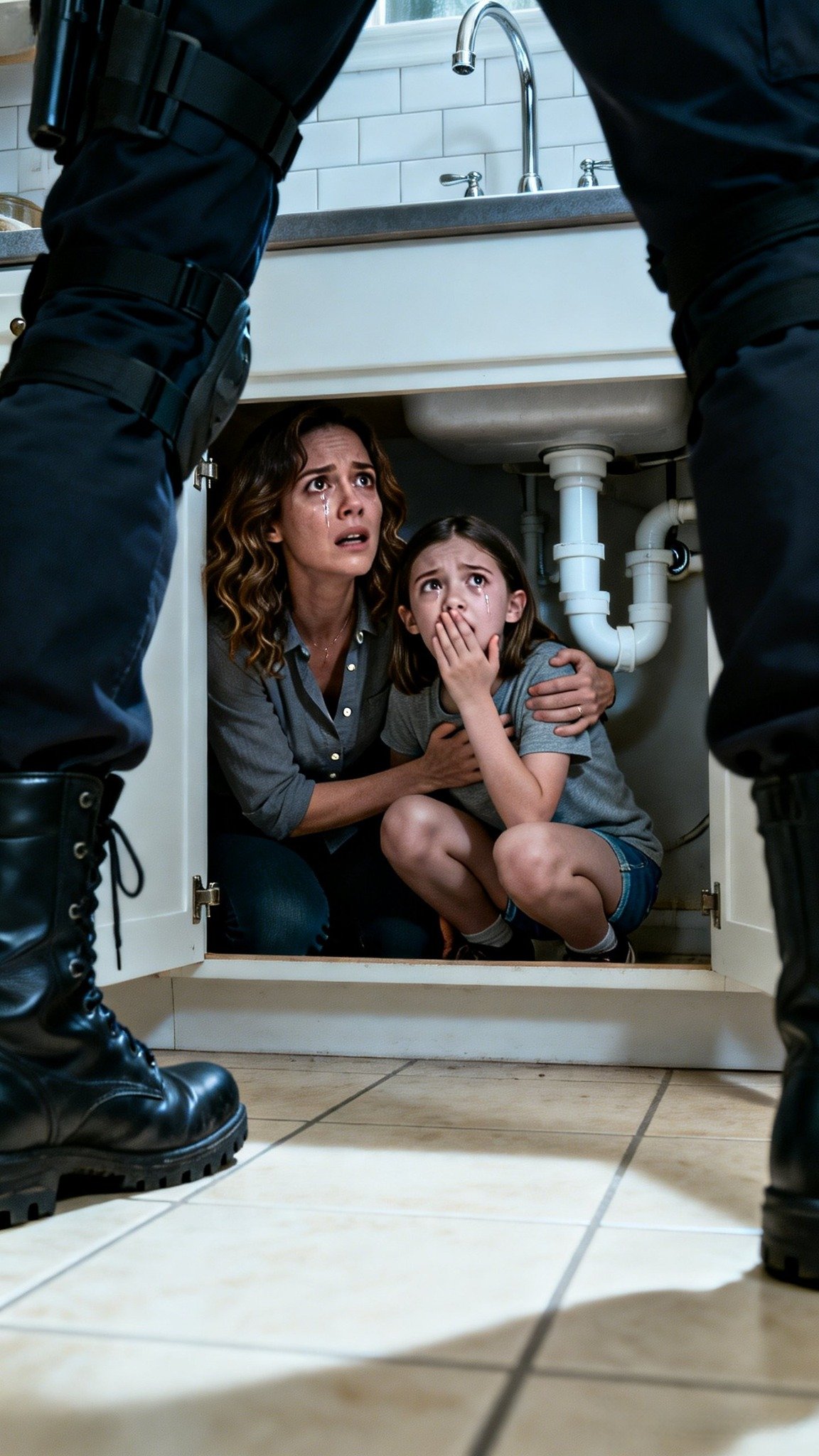
My husband came home from his business trip a day early. Moments later, someone knocked on the front door. “It’s Dad, Mom!” a voice called out. But my 8-year-old daughter squeezed my hand and whispered, “Mom… that’s not Dad. We need to hide.” I pulled her into the kitchen cupboard. What followed shattered everything I thought I knew.
The rain was the first thing to betray us. It had been hammering against the roof of our suburban sanctuary for hours, a relentless, drumming rhythm that masked the sound of tires on gravel. I was sitting in the living room, a half-read novel resting on my lap, while the storm turned the world outside our windows into a blurred watercolor of grey and black.
My husband, Daniel, was supposed to be in Chicago. He was closing a deal that had kept him awake for three weeks straight, a merger that promised to secure our financial future but had cost us his presence at the dinner table. I missed him. The house felt too large, too hollow without his heavy footsteps and the scent of his cologne—a mix of cedar and old paper—lingering in the hallway.
My phone buzzed on the coffee table, lighting up the dim room.
Daniel: Flight landed early. Skipped the layover. Home in ten.
I stared at the screen, a smile breaking through my fatigue. I read it twice, convinced I’d misread his message. Relief washed over me, warm and intoxicating. Daniel hated surprises, and I hated being alone at night with our eight-year-old daughter, Emily. The storm had made her anxious; she was currently building a fortress out of sofa cushions in the den, hiding from the thunder.
“Em!” I called out, standing up and smoothing my skirt. “Daddy’s coming home early!”
She popped her head up from behind a barricade of pillows, her eyes wide. “Really?”
“Yes, really. He just texted. He’ll be here in ten minutes.”
I went to the kitchen to put the kettle on. Daniel would want tea—Earl Grey, two sugars—the moment he walked through the door. I hummed to myself, the tension in my shoulders finally unknotting. The world felt right again. The protector was returning.
Exactly ten minutes later, a knock echoed through the house.
It was a sharp, authoritative rap. Knock-knock-knock.
“It’s Dad, Mom!” a voice called from outside the heavy oak door.
The voice sounded exactly like Daniel’s—the same baritone pitch, the same impatient rhythm he used when his hands were full of luggage. My heart leaped. I wiped my hands on a dish towel and hurried toward the entryway. My hand reached for the brass handle automatically, my body leaning into the motion of welcoming him home.
But before I could turn the lock, a small, cold hand clamped around my wrist with surprising strength.
I looked down. Emily was standing there, her face drained of all color. She wasn’t looking at the door; she was looking at me, her eyes wide with a terror so raw it stopped my breath in my throat.
“Mom… it’s not Dad,” she whispered, her voice trembling. “We have to hide.”
I laughed nervously, confusion clouding my mind. “Emily, don’t be silly. You heard him. Daddy just got home.”
“Claire, open up,” the voice called again, slightly muffled by the wood. “It’s freezing out here. Why are you taking so long?”
It was him. It had to be him. It was the specific cadence of his speech, the way he elongated my name.
“Honey, let go,” I said, trying to pry her fingers loose. “Daddy is cold.”
But she shook her head violently, tears pooling in her lashes. She didn’t let go. She pulled harder, her fingernails digging into my skin. “Please, Mommy. Trust me. That is not him.”
Something in her voice—a primal, animalistic panic—stopped me cold. Emily wasn’t dramatic. She wasn’t the kind of child who imagined monsters in the closet or lied for attention. She was observant, quiet, an old soul in a child’s body.
My heart started pounding against my ribs, a frantic drumbeat that rivaled the rain. The knock came again—harder this time. Angry.
“Claire! Open the damn door!”
I froze. Daniel didn’t swear at me. Not like that. Not with that specific edge of menace.
Emily pulled me toward the kitchen, her grip desperate. Without thinking, I followed. We moved silently, the adrenaline kicking my senses into overdrive. We squeezed into the cupboard beneath the sink, a cramped space meant for pipes and trash bags. We shoved ourselves back against the rear wall, knees pressed against bottles of bleach and window cleaner, the sharp chemical smell stinging my nose.
I pulled the cupboard door shut, leaving only the tiniest sliver of a crack open. I held Emily against my chest, my hand over her mouth, feeling her small heart hammering against her ribs like a trapped bird.
Then, we heard it.
The sound of keys.
Jingle. Slide. Click.
The front door opened.
A gust of wind swept through the house, carrying the scent of rain and wet earth. Then the door slammed shut.
“Hello?” the voice called out from inside the foyer. “Claire? Emily? Where are you girls?”
My chest tightened until it felt like it might snap. The footsteps began. They moved across the hardwood floor of the living room, heading toward the kitchen.
But the footsteps were wrong.
Daniel had shattered his ankle playing soccer in college. He walked with a distinctive, heavy drag on his right side—thud-slide, thud-slide. It was the rhythm of our marriage, a sound I had known for twelve years.
These steps were even. Measured. Light. Click-clack. Click-clack.
Emily buried her face in my shirt, silent tears streaming down her cheeks. She had known. Somehow, she had known before the door even opened.
Through the crack in the cupboard door, I saw a pair of shoes step into the kitchen.
They were heavy, black military-style boots, caked with fresh mud.
Daniel owned loafers. He owned running shoes. He did not own black combat boots.
Then, the phone in my pocket vibrated against my hip. The sound was a low buzz, but in the silence of the kitchen, it sounded like a gunshot.
The boots stopped moving.
I squeezed my eyes shut, praying, begging the universe for silence. I slowly, agonizingly, fished the phone from my pocket, shielding the light with my palm.
A text message lit up the screen.
Daniel: Just landed. Taxi line is huge. Be home in 45 mins. Love you.
My blood ran cold. The world tilted on its axis.
The man standing in our kitchen, five feet away from us, wasn’t my husband. He wasn’t Daniel.
And he had heard the phone vibrate.
The boots pivoted. He was facing the sink. He was facing us.
“Found you,” the voice whispered, low and amused.
The cupboard door handle slowly began to turn.
End of Part 1
The cupboard door creaked, a sound that screamed in the silence.
I didn’t wait. Instinct, sharp and violent, took over. I kicked the door open with both feet, putting every ounce of my hysterical strength into the blow.
It connected.
The door slammed into the stranger’s shins. He howled—a sound that was definitely not Daniel—and stumbled back, crashing into the kitchen island.
“Run, Emily! GO!” I screamed, grabbing her arm and yanking her out of the dark space.
We scrambled to our feet. I caught a glimpse of him as he recovered. He was tall, clean-shaven, wearing a leather jacket that looked almost identical to one Daniel owned. His hair was the same shade of brown, cut in the same style. From a distance, in the dim light, he was a perfect copy. But up close, the eyes were wrong. They were flat, dead things. Cold obsidian voids devoid of warmth or recognition.
He lunged for me.
I shoved Emily toward the back door and threw myself in his path. He grabbed my shoulder, his fingers digging into my trapezius muscle like steel claws. I twisted, screaming, and raked my nails across his face. He cursed, his grip slipping just enough for me to spin away.
“Mom!” Emily was at the back door, fumbling with the lock. Her hands were shaking so badly she couldn’t turn the latch.
The stranger recovered his balance. He wasn’t rushing anymore. He smiled, and that was the most terrifying part. It was a smile that didn’t reach his eyes. He reached into his jacket pocket and pulled out something that glinted silver in the kitchen light. A knife.
“You’re making this difficult, Claire,” he said, his voice shifting. He dropped the imitation of Daniel. His real voice was higher, scratchier. “I just wanted to be part of the family.”
“Open the door, Emily!” I shrieked, grabbing a heavy ceramic fruit bowl from the counter and hurling it at him.
He ducked, and the bowl shattered against the wall, sending shards of pottery raining down. The distraction bought us a second. I threw my body weight against the back door, aiding Emily’s small hands. The lock clicked.
We burst into the backyard.
The cold air burned my lungs. The rain was torrential now, turning the garden into a mud slick. We slipped and slid across the patio, heading for the gate that led to the neighbor’s yard, Mrs. Thompson’s.
“Don’t look back!” I shouted over the wind.
But the grass was slick. I lost my footing near the rose bushes, my feet flying out from under me. I hit the ground hard, the impact knocking the wind out of me.
“Mom!” Emily stopped, turning back.
“Go! Get help!” I wheezed, scrambling to my hands and knees.
Heavy boots pounded onto the patio stones behind us. He was coming. He moved with a terrifying athleticism, vaulting the patio railing.
He reached me before I could stand. He grabbed my ankle, dragging me backward through the mud. I screamed, kicking wildly, my other foot connecting with his chest, but he didn’t let go. He was strong—psychotically strong.
He dragged me back toward the house, away from the safety of the street. I clawed at the wet grass, tearing up clumps of earth, but there was nothing to hold onto.
“Emily, run!” I screamed one last time.
She didn’t run. She grabbed a garden shovel leaning against the shed—a heavy, rusted thing she could barely lift—and charged.
“Leave her alone!” she screamed, swinging the shovel with all her might.
It hit the man in the shoulder. It wasn’t enough to injure him, but it shocked him. He let go of my leg, turning his dead eyes toward my daughter.
“Bad girl,” he hissed.
He stepped toward her, raising the knife.
Then, the world exploded with light.
High beams cut through the darkness, blinding and brilliant. A car engine roared—a familiar, aggressive revving sound. Daniel’s SUV jumped the curb, smashing through the wooden garden fence in a shower of splinters and debris.
The car skidded to a halt ten feet away, mud spraying everywhere.
The driver’s door flew open.
Daniel—my Daniel—jumped out. He was still wearing his suit from the meeting, his tie undone, his face a mask of pure, unadulterated rage. He didn’t ask questions. He didn’t hesitate. He saw the man. He saw the knife. He saw his family in the mud.
“HEY!” Daniel roared, a sound so guttural it shook the ground.
The stranger froze, shielding his eyes from the headlights. That second of hesitation cost him everything.
Daniel hit him like a freight train.
He tackled the man into the muddy grass, the momentum carrying them both rolling toward the patio. The knife went flying into the darkness.
They fought with a savagery I had never seen in my husband. Daniel wasn’t a fighter; he was an accountant. But in that moment, he was a force of nature. He rained punches down on the stranger, screaming incoherently. The stranger fought back, gouging at Daniel’s eyes, biting, thrashing.
“Get inside! Lock the door!” Daniel yelled over his shoulder, struggling to keep the man pinned.
I grabbed Emily and we scrambled backward, but I couldn’t leave him. I looked around for a weapon, anything. My hand closed around a heavy stone decorative edging.
I ran forward, adrenaline overriding the pain in my ribs. As the stranger tried to roll Daniel over, I raised the stone and brought it down hard on the man’s shoulder.
He screamed, his arm going limp.
Daniel used the opening to deliver a final, crushing blow to the man’s jaw. The stranger slumped back into the mud, unconscious.
Daniel collapsed on top of him, chest heaving, gasping for air. He looked up at me, rain plastering his hair to his forehead, blood streaming from a cut on his lip.
“Are you okay?” he wheezed. “Claire? Em?”
I dropped the stone and fell to my knees, pulling Emily into my lap. “We’re okay. We’re okay.”
Sirens wailed in the distance, getting louder. Mrs. Thompson must have called them. Blue and red lights began to flash against the wet trees, painting the nightmare scene in surreal, strobe-light colors.
We sat there in the rain, the three of us huddled together over the body of the man who had worn my husband’s face, waiting for the world to make sense again.
End of Part 2
The hours that followed were a blur of flashing lights, police tape, and hot coffee that tasted like ash.
The police took the man away in handcuffs. He was awake by then, staring at us through the window of the cruiser with that same eerie, placid smile.
Detective Reynolds, a weary-looking man with kind eyes, sat with us in our living room later that night. The house was blazing with light; we had turned on every lamp, every hallway fixture. Darkness was no longer welcome here.
“His name is Julian Vane,” Reynolds said, closing his notebook. “He’s… a professional, in a sense.”
“A professional what?” Daniel asked. He was holding Emily on his lap, his knuckles white as he gripped her arm.
“Identity thief. But not the credit card kind,” Reynolds explained grimly. “He targets families. He stalks the father figure for weeks. Learns the schedule, the mannerisms, the voice. He practiced your walk, Daniel. He recorded your voice from those consulting videos you have on LinkedIn to master the timbre.”
I shuddered, pulling my blanket tighter. “He sounded exactly like him.”
“He had a voice modulator app on his phone, playing through a speaker in his collar,” Reynolds said. “Low tech, but effective through a door.”
“What was the plan?” I whispered.
“Get in. Subdue the family. Rob the place at leisure. Usually, he locks the family in the basement or a closet for days while he clears out the accounts.” Reynolds paused, looking at Emily. “He’s never been caught. He’s done this in three other states. You’re the first ones to spot him before he got inside.”
Daniel looked down at our daughter. “She knew,” he said softly. “She knew immediately.”
Reynolds nodded. “We found his kit in his car down the street. He had hair dye, contacts, lifts for his shoes. He had your itinerary, Daniel. He knew you were landing early. He must have hacked your airline account.”
“How did he beat me here?” Daniel asked.
“He didn’t need to beat you,” Reynolds said. “He just needed to beat your taxi. He was waiting down the street.”
When the police finally left, the silence that settled over the house was heavy. We didn’t sleep. We couldn’t.
Daniel went around the house checking every window, engaging every deadbolt. He dragged the heavy oak dresser in front of the front door.
I sat with Emily in her room. She was staring at her nightlight, a little plastic turtle that projected stars onto the ceiling.
“Em,” I said softly, brushing the hair from her forehead. “You saved us tonight. Do you know that?”
She didn’t look at me. “He didn’t tap.”
“What?”
She turned her gaze to me, her eyes looking older than they should have. “Daddy always taps his keys against his leg before he unlocks the door. Tap-tap-jingle. Then he unlocks it. That man just put the key in.”
Such a small detail. A micro-habit I had lived with for twelve years and never consciously processed. But Emily, from her vantage point of childhood observation, had cataloged it as a fundamental law of the universe. Dad taps the keys.
That realization stayed with me, lodging itself in my heart like a splinter.
We often talk about teaching kids to listen, to obey, to trust adults—but we don’t always teach ourselves to listen to them. Emily’s fear wasn’t imagination. It was observation. It was survival.
If I had ignored her… if I had let my desire for normalcy override her instinct…
The thought made me nauseous. The police had told us that Vane was violent when cornered. If we had opened that door, if we had let him walk in and close it behind him…
Daniel came into the room then. He looked exhausted, his face bruised, but he was there. The real him. He sat on the edge of the bed and pulled us both into his arms. We stayed like that for a long time, a tangle of limbs and fear and gratitude.
In the weeks that followed, life slowly returned to a version of normal—but “normal” felt different now. We installed security cameras. We got a dog, a large German Shepherd named Baron who barked at leaves. Emily slept in our bed for a month.
But more than that, something shifted between us. We realized how fragile our safety really was. We had nearly lost everything, not to a ghost or a monster, but to a man who exploited routine, trust, and distraction.
We learned that familiarity is not the same as safety.
I still think about that night when it rains. I think about the man standing in the mud, wearing my husband’s face. But mostly, I think about the small hand gripping my wrist, and the tiny voice that refused to be silenced.
I learned that instinct isn’t something to ignore, especially when it comes from a child. They see the world without the filters we adults build up. They see the cracks in the facade.
Julian Vane is in prison now, serving a life sentence. But his shadow lingers.
Since then, I’ve shared this story with friends, neighbors, other parents. Some laughed nervously. Some went silent. Many admitted they’d never thought about how easily familiarity could be faked.
If you’ve read this far, I want to ask you something—not as a storyteller, but as a parent, a partner, a human being trying to stay safe in a very real world:
Would you have opened the door?
Would you have trusted the voice you recognized… or the fear you didn’t understand yet?
If this story made you pause, even for a second, share it with someone you care about. Talk about it. Learn each other’s habits—not just out of love, but out of protection. Establish a code word. notice the way your partner walks, the way they tap their keys.
And if you have children, listen to them. Really listen. Sometimes, they notice the things that save lives.
If you want more stories like this, or if you’d like to share your thoughts about what you would have done in my situation, I’d love to hear from you. Your perspective helps these stories reach more people, so don’t be shy about commenting or sharing.