A 6-year-old girl refused to sit for days. When she fell in gym class, she begged, “Please don’t tell!” I lifted her shirt and saw the marks. “The chair has nails,” she whispered. Her uncle said judges were his friends. I dialed 911, thinking I was saving her, not knowing I had just started a war.
They say twenty years in a classroom gives you eyes in the back of your head. That’s a lie. What it actually gives you is a second heart, one that beats in sync with the twenty-odd souls entrusted to your care between the hours of eight and three. It gives you a terrifying intuition—a frequency attuned to the silent screams of children who haven’t yet learned the words for their pain.
As the morning sunlight filtered through the dust motes dancing in Room 7 of Willow Creek Elementary, I moved between the desks, listening to the familiar cadence of first-grade chatter. The smell of sharpened pencils and floor wax usually calmed me, but today, a discordant note vibrated in the air.
It was the new girl. Lily Harper.
It was her third day in my class, and she was standing. Again.
While the other children scrambled for their seats, eager to begin our morning story, Lily stood rigid beside her desk. Her fingers, pale and trembling, gripped the hem of a faded blue dress that seemed a size too large. Her chestnut hair fell in uneven waves, hiding a face that carried a stillness no six-year-old should possess.
“Lily, sweetheart,” I said, pitching my voice to that soft, non-threatening register I’d perfected over two decades. “Would you like to sit down for our morning story?”
The child didn’t look up. Her eyes remained fixed on the scuffed linoleum floor. “No, thank you, Miss Thompson. I just… I prefer standing.”
Her voice was barely a whisper, brittle as dried leaves. But it was her posture that made my stomach turn. She wasn’t just standing; she was hovering, shifting her weight from foot to foot with a minute, agonizing rhythm. It wasn’t defiance. It was endurance.
“Did something happen to your chair?” I asked, keeping my tone light, feigning ignorance.
“No, ma’am.” The response was practiced. Automatic.
I let it go for the moment, but the unease settled in my marrow. Throughout the day, I watched her. I watched how she leaned against the cool cinderblock walls during art, how she flinched when the bell rang, how she refused to sit even during lunch, claiming she wasn’t hungry. She was a ghost haunting her own life.
That afternoon, after the buses had rumbled away and the silence of the empty school settled around me, I heard a rustle from the reading corner.
Lily was there, crouched behind a bookshelf, clutching her backpack like a shield.
“Lily?” I knelt, keeping my distance. “Everyone has gone home, dear.”
Her head snapped up, eyes wide with a terror that stopped my breath. “Is it that late? I didn’t mean to… I’m sorry!”
“It’s alright,” I soothed, though my heart hammered. ” are your aunt and uncle coming?”
At the mention of her guardians, the blood drained from her face. “Uncle Greg… he doesn’t like waiting.”
“Lily, is everything okay at home?”
Before she could answer, a sharp, aggressive honk blasted from the parking lot. Lily’s body convulsed. It wasn’t a jump; it was a full-body flinch of anticipation.
“I have to go,” she gasped, scrambling to her feet and bolting for the door.
I watched her run toward a sleek, black SUV idling at the curb. I saw the window roll down, not to greet her, but to gesture impatiently. As she climbed in, I grabbed my notebook from my desk—a small, black ledger I kept for observations.
I opened it to a fresh page and wrote: Lily Harper. Day 3. Still standing. Terror evident.
The next week brought the rain, and with it, a darkening of the situation that I couldn’t ignore. Day 12. Lily arrived without a lunchbox again. She wore long sleeves despite the humid heat of the classroom. And still, she stood.
We were in the gymnasium when the dam finally broke. Coach Bryant had the children running drills, dodging between orange cones. Lily stood at the periphery, arms wrapped around herself, a small island of misery.
“Not feeling well, Harper?” the Coach boomed.
Lily flinched, stepping back so quickly she tripped over her own feet. She hit the floor hard.
“Lily!” I was there in a second, scooping her up.
She began to weep, not from the fall, but from a panic so raw it felt contagious. “I’m sorry, I’m sorry, don’t tell, please don’t tell!”
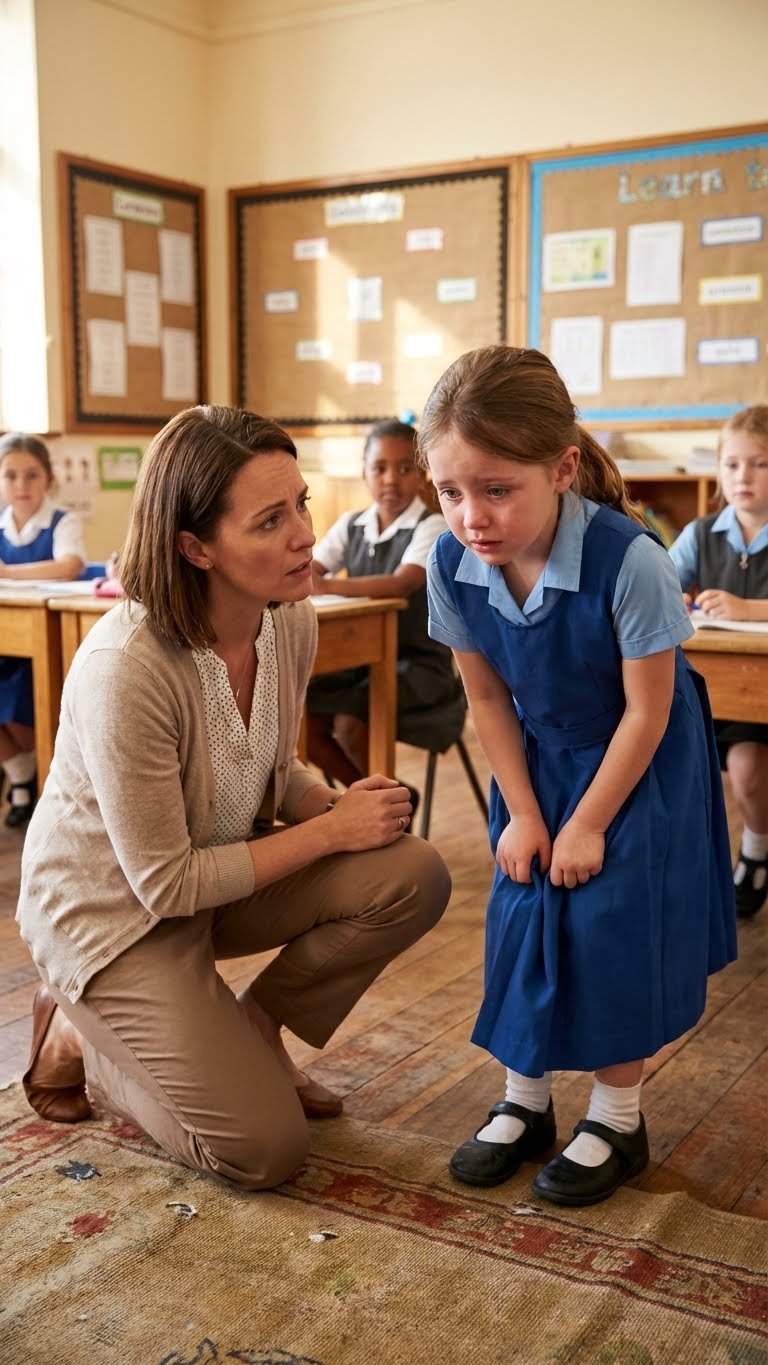
“It’s okay, you just tripped,” I whispered, walking her toward the girls’ locker room away from the staring eyes. “Let’s get you cleaned up.”
In the safety of the restroom, I grabbed some paper towels. “Did you hurt your arm?”
“My back,” she sobbed. “My shirt… it pulled up.”
“Let me help you fix it.”
I gently lifted the hem of her shirt to tuck it in. The breath left my body in a sharp hiss.
The skin of her lower back was a tapestry of violence. Deep, purple bruises overlapped with yellowing older ones. But it was the pattern that froze my blood—distinct, circular indentations. Punctures.
“Lily,” I choked out, fighting to keep my voice steady, fighting the urge to scream. “How did you get these marks?”
She froze. The silence stretched, heavy and suffocating, broken only by the distant thunder outside.
Finally, she whispered, “The punishment chair has nails.”
I closed my eyes, the horror washing over me. “The punishment chair?“
“At home,” she said, her voice trembling. “For bad children who don’t listen. Uncle Greg says sitting on it teaches us to behave. He says we have to earn the soft chairs.”
I gently pulled her shirt down, my hands shaking. “I believe you, Lily. And I am going to make sure you never have to sit in that chair again.”
“Uncle Greg says no one will believe me,” she whimpered. “He says I tell stories. He says the judges are his friends.”
“He’s wrong,” I said, pulling out my phone.
I didn’t call the principal. I didn’t call the parents. I dialed 911.
I thought I was saving her. I didn’t realize I was starting a war.
The fluorescent lights of the Willow Creek Police Department hummed with an indifference that grated on my nerves. I had been sitting on a hard plastic chair for three hours.
“Ms. Thompson,” Officer Drake sighed, sliding a lukewarm coffee across the metal table. “We appreciate your concern. Truly. But we have procedures.”
“Procedures?” I slammed my hand on the table, rattling the cup. “I saw the bruises, Officer. Puncture wounds. She told me about a chair with nails. A six-year-old doesn’t invent a torture device like that!”
“The child was examined by the school nurse,” Drake said, his eyes avoiding mine. “The bruises appear to be… older. Possibly from before she was placed with the Harpers. You know she came from a traumatic background? Car accident. Dead parents.”
“She has been with the Harpers for six months!” I snapped. “Those bruises were fresh.”
The door opened, and a woman in a sharp grey pantsuit entered. Marsha Winters, Child Protective Services. I felt a flicker of hope, which was extinguished the moment she spoke.
“Ms. Thompson, I’ve just come from the Harper residence,” she said, her voice smooth as oil. “The Harpers were fully cooperative. We toured the entire home. It was immaculate. Lily has a beautiful bedroom. There is no… punishment chair.”
“Of course there isn’t!” I stood up, incredulous. “They knew you were coming! Do you think they keep the torture devices out on the coffee table for guests?”
“Ms. Thompson,” Winters said, her eyes hardening. “False allegations are a serious matter. Greg Harper’s brother sits on the school board. This is a respected family. A pillar of the community.”
“What does his brother’s job have to do with the bruises on a child’s back?” I demanded.
“Lily recanted,” Drake interjected softly. “When we asked her about the chair, she said she made it up. She said she fell out of a tree.”
I felt the blood drain from my face. “Because she is terrified. She told me he threatened her!”
“Go home, Ms. Thompson,” Winters said, opening the door. “Let us do our jobs.”
I walked out into the rain, my car keys digging into my palm. I felt a sensation I hadn’t experienced since I was a child—total helplessness. But beneath it, a cold, hard rage began to crystallize.
They sent her back. They sent her back to the house with the nails.
The retaliation was swift. The next morning, Principal Warren called me into his office. He wouldn’t look at me.
“The board is concerned, Eleanor,” he mumbled, shuffling papers. “Richard Harper—Greg’s brother—is furious. He’s calling this harassment. Defamation.”
“I did my duty as a mandated reporter,” I said stiffly.
“You’re on thin ice. Just… teach your class. Leave the investigating to the professionals.”
But I couldn’t look away. Not when Lily returned two days later, a shadow of herself. She was moved to Ms. Wilson’s class—”to avoid conflict of interest,” they said. I saw her in the hallway, thinner, paler. When our eyes met, she looked away, terrified.
It was a week later when I found the note.
It was tucked into the attendance folder Ms. Wilson had inadvertently left in the staff lounge. A drawing. It was crude, done in hurried crayon strokes.
It depicted a house. Upstairs, stick figures smiled. But underneath, a black scribbled box labeled “BASEMENT.” Inside the box were tiny figures. Lots of them. Trapped.
And in the corner, in wobbly handwriting: Help them too.
I stared at the paper, my hands trembling. Them. Plural.
That night, a knock on my apartment door nearly made me jump out of my skin. It was late—past eleven. I looked through the peephole to see a disheveled man in a raincoat.
“Who is it?” I called, keeping the chain on.
“Detective Marcus Bennett,” the voice was gravely. “I’m with Willow Creek PD. I’m here about Lily Harper.”
I opened the door. He looked nothing like Officer Drake. He looked tired, haunted, and angry.
“Can I come in?” he asked, glancing down the hallway. “Off the record.”
Inside, he saw my kitchen table. It was covered in notes, timelines, and photocopies of public records I’d spent the last week gathering.
He picked up a photo of Greg Harper receiving a “Citizen of the Year” award. “I see you’ve been busy.”
“Are you here to arrest me for harassment?” I asked, crossing my arms.
“No,” Bennett said, pulling a chair out. “I’m here because three years ago, I handled a case involving a foster child placed with a friend of the Harpers. That child died. Ruled an accident. The coroner was Judge Blackwell’s cousin. The investigation was buried.”
He looked at me, his eyes intense. “When I saw your report—the punishment chair—I knew. It’s the same pattern. But the Captain shut me down. Said the case is closed.”
“So why are you here?”
“Because you found something they missed,” he said. “I saw the drawing you took from the lounge.”
My heart skipped a beat. “You were watching me?”
“I’m watching them,” he corrected. “And they are watching you. Eleanor, this isn’t just about one bad father. This is a network. Foster payments. State subsidies. Children go in, the checks clear, and the children… disappear or get recycled into the system.”
I showed him the drawing of the basement. “She wrote ‘Help them too.’ How many children, Bennett?”
“The Harpers are licensed for two,” he said grimly. “But looking at the water usage for that property? The food delivery receipts I pulled from their trash? It’s enough for an army.”
“We have to go in,” I said.
“We can’t. Judge Blackwell denied the warrant this afternoon. If we go in, it’s breaking and entering. It’s a felony. We lose our jobs, maybe our freedom.”
I looked at the drawing. I thought of the nails. I thought of the way Lily stood, enduring pain because she believed she didn’t deserve to sit.
“I don’t care about my job,” I whispered. “Friday.”
“What?”
“Lily told me once,” I recalled, the memory surfacing. “Uncle Greg says Friday nights are for the visitors. That’s when we have to be extra good.”
Bennett’s face darkened. “Friday visitors. Trafficking. Or exploitation rings.” He checked his watch. “Friday is tomorrow.”
“We go tomorrow night,” I said. “Authorized or not.”
Bennett looked at me for a long moment, then nodded. “Pack dark clothes. And pray we’re wrong.”
The Harper estate sat on the edge of town, surrounded by a dense thicket of oaks that screamed “old money.” The rain had returned, turning the ground into a slurry of mud that sucked at our boots as we crept through the treeline.
Bennett moved with a tactical grace I couldn’t mimic. I was just a teacher in a raincoat, clutching a flashlight like a weapon.
“Security cameras on the perimeter,” Bennett whispered, pointing to the red blinking lights. “We have a blind spot near the cellar doors. That’s our entry.”
My heart hammered against my ribs like a trapped bird. We reached the heavy cellar doors. Bennett pulled out a lockpick kit. His hands were steady. Mine were slick with sweat.
Click.
The door groaned open. The smell hit us first. Damp earth, mold, and something else—the sharp, unmistakable tang of ammonia and unwashed bodies.
“Oh god,” I breathed, pulling my scarf over my nose.
We descended into the darkness. Bennett clicked on his flashlight, keeping the beam low. We were in a finished basement, but it wasn’t a rec room. It was a prison.
The space was divided by makeshift plywood walls into cubicles. No doors, just curtains.
Bennett swept the light across the room.
Eyes reflecting the beam. Dozens of them.
They weren’t beds. They were mattresses on the floor, stained and thin. Huddled on them were children. Not two. Nine.
They ranged in age from toddlers to pre-teens. They didn’t scream when they saw us. That was the worst part. They were silent, conditioned to silence.
I rushed to the nearest mattress. A little boy, maybe four, looked up at me with dull, glassy eyes. He was shivering.
“It’s okay,” I whispered, tears blurring my vision. “We’re here to help.”
“Are you the Friday people?” a voice asked from the shadows.
I turned to see a girl, older, maybe ten. She was rocking back and forth. “Are you here for the pictures?”
“No,” Bennett choked out, his professional veneer cracking. “We’re the police. We’re getting you out.”
“Uncle Greg is upstairs,” the girl whispered. “With the camera men. And the Judge.”
Bennett stiffened. “The Judge is here?”
“He likes to watch,” she said simply.
Bennett grabbed his radio. “Dispatch, this is Bennett. I have a Code Zero at the Harper residence. Officer in distress. Multiple minors in immediate danger. Send the state troopers. Do not—repeat, do not—inform the local precinct.”
“We have to move them,” I said, reaching for the shivering boy. “Now.”
Suddenly, the door at the top of the stairs flung open. Light flooded the basement.
“What the hell is going on down here?”
Greg Harper stood at the top of the stairs, silhouetted by the warm light of the hallway. He wasn’t holding a camera. He was holding a shotgun.
Behind him, I saw the faces of “respected” men. I recognized the Mayor. I recognized Judge Blackwell.
“Ms. Thompson,” Greg sneered, raising the weapon. “You really don’t know when to sit down, do you?”
“Drop the weapon!” Bennett shouted, stepping in front of me and the children, his service pistol drawn. “State Police are three minutes out, Greg! It’s over!”
“You’re trespassing,” Greg spat, though the barrel of the gun wavered slightly. “These are my foster children. This is private property!”
“Nine children?” Bennett yelled back. “Locked in a basement? Look at them, Greg! You’re done.”
“Shoot them!” Judge Blackwell’s voice hissed from the hallway. “Get rid of them before the troopers get here!”
For a second, time suspended. I looked at the children—huddled, terrified, waiting for the violence they knew was inevitable.
Then, a siren wailed. Not local police. The distinct, high-pitched yelp of State Trooper cruisers.
The sound broke Greg’s resolve. He glanced back at his conspirators, and in that split second of distraction, Bennett lunged.
The shotgun discharged into the ceiling with a deafening boom. Plaster rained down. Bennett tackled Greg to the concrete floor, the two men grappling in the dust.
“Run!” I screamed to the children. “Up the stairs, now! Go!”
I grabbed the four-year-old and ushered the others toward the exit. The older girl, the one who had spoken, hesitated.
“Go!” I urged her.
“Lily is upstairs,” she whispered. “In the special room.”
My blood ran cold. I handed the boy to the girl. “Get outside. Run to the lights.”
I didn’t follow them out. I ran up the stairs, past Bennett who had Greg pinned and cuffed. I ran past the Judge, who was trying to flee through the kitchen, only to be met by a wall of uniformed troopers bursting through the front door.
I ran to the second floor.
“Lily!” I screamed. “Lily!”
I kicked open the doors. Guest room. Bathroom. Master bedroom.
At the end of the hall, a door was locked. I threw my shoulder against it. It didn’t budge.
“Lily, move away from the door!”
I backed up and kicked the lock with everything I had. The wood splintered.
The room was set up like a studio. heavy curtains, bright lights. And in the center, a chair. The chair. It was wooden, high-backed. And even from here, I could see the glint of metal protruding from the seat.
Lily was standing in the corner, pressing herself into the wallpaper as if trying to merge with it.
“Ms. Thompson?” she whimpered.
I crossed the room in two strides and fell to my knees, wrapping my arms around her. She was shaking so hard her teeth rattled.
“I didn’t sit,” she cried into my shoulder. “I promised I wouldn’t sit!”
“I know, baby. I know.” I held her tight, shielding her eyes from the equipment, from the chair, from the truth of what this room was. “You never have to sit there again.”
The weeks that followed were a blur of media vans and depositions. The “Basement of Willow Creek” became national news. The sheer scale of the corruption was staggering.
They found the videos. Hundreds of them. They implicated not just the Harpers, but the Judge, the Mayor, and two members of the school board. It was a ring of power that fed on the powerless.
I was suspended, of course. Richard Harper, desperate and cornered, filed lawsuits. He went on TV, calling me a vigilante, a liar, a woman obsessed. The local paper, owned by his cousin, ran headlines: ROGUE TEACHER ENDANGERS CHILDREN.
I sat in my apartment, blinds drawn, watching my career turn to ash.
But then, the tide turned.
The Special Prosecutor, a woman named Vanessa Chen from the Attorney General’s office, arrived. She bypassed the local courts entirely. She took the case federal.
The trial of United States v. Gregory Harper et al. began three months later.
I testified. I sat in the witness box and endured the defense attorney’s sneers. They tried to paint me as hysterical. They tried to say I broke the law.
“I did break the law,” I told the jury, looking Richard Harper in the eye. “And I would do it again. Because the law was protecting the monsters, not the children.”
But the nail in the coffin wasn’t my testimony. It was Lily’s.
She testified via closed-circuit video. She was small on the giant screen, but her voice was clear.
“Tell us about the chair, Lily,” Prosecutor Chen asked gently.
“It has sharp parts,” Lily said. “Uncle Greg said if we sat on it and didn’t cry, the men would give us candy. If we cried, we had to stay in the basement.”
A collective gasp sucked the air out of the courtroom.
“Who were the men, Lily?”
“The Judge,” she said. “And the man who gave me the award at school.”
The jury was out for less than four hours.
Guilty. On all counts. Trafficking. Child Abuse. Conspiracy.
Greg and Victoria Harper were sentenced to life without parole. Judge Blackwell received forty years. Richard Harper was disbarred and faced charges of witness intimidation.
As the verdicts were read, I looked across the aisle at Bennett. He looked tired, but for the first time since I met him, the ghosts in his eyes seemed to be resting.
One year later.
The morning sun filtered through the windows of Room 7. It looked much the same as it always had—dust motes dancing, the smell of crayons and potential.
But there were changes. A new principal. A new school board. And a new policy on reporting that I had helped write.
“Ms. Thompson?”
I looked up from my desk. Standing in the doorway was a woman I recognized—Lily’s new adoptive mother, a fierce social worker from the city. And beside her…
“Lily,” I breathed.
She looked different. Taller. Her hair was shiny and pulled back in a bright yellow bow. She wore jeans and a t-shirt that fit perfectly.
“Hi, Ms. Thompson,” she beamed.
“We were in the neighborhood,” her mother smiled. “Someone wanted to show you something.”
Lily walked into the classroom. The other children looked up. They didn’t know who she was, only that she was a visitor.
Lily walked to the center of the rug, where we had our morning meetings. She looked at me, a mischievous glint in her eye.
“Can I?” she asked.
“Anything you want,” I said, my throat tight.
Lily walked over to the teacher’s chair—my chair. The big, comfortable, spinning chair behind the desk.
She hopped up, spinning it around once, and then sat down. She leaned back, crossing her legs, looking comfortable, safe, and utterly at home.
“It’s soft,” she declared.
“It is,” I laughed, wiping a tear from my cheek.
She hopped down and ran to me, wrapping her arms around my waist. “I have a new chair at home,” she whispered. “It’s purple. And I sit in it to do my homework, and to eat dinner, and sometimes just because I can.”
“I’m so glad, Lily.”
She pulled back and handed me a piece of paper. It was a drawing.
It showed a classroom. Bright colors. Sunshine. And every single stick figure was sitting in a chair.
At the bottom, in neat, practiced handwriting, it read: In Ms. Thompson’s room, everyone gets to sit.
I pinned it to the board behind my desk, right next to the Teacher of the Year award they had tried to give me, which meant far less than this scrap of paper.
“Ready to go, Lily?” her mom called.
“Coming!” Lily yelled. She ran to the door, then stopped and looked back. “Ms. Thompson?”
“Yes, Lily?”
“Thank you for standing up for me,” she said. “So I could sit down.”
She waved and skipped down the hallway, her footsteps echoing—not fleeing, not hiding, just the sound of a child moving freely through a world that was finally, finally safe.
If you want more stories like this, or if you’d like to share your thoughts about what you would have done in my situation, I’d love to hear from you. Your perspective helps these stories reach more people, so don’t be shy about commenting or sharing.