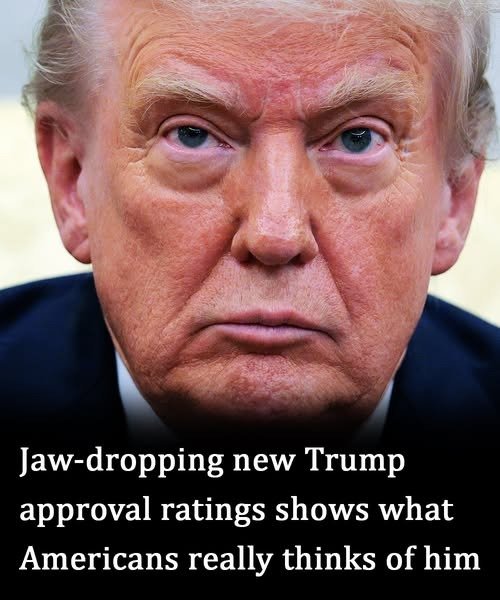
Donald Trump will tell you that everything is going really well. The former real estate tycoon and reality TV personality who is now president is promoting his “record-breaking success” in the areas of domestic affairs, foreign policy, and the economy ten months into his second term.
However, that optimism is not shared by the American public, according to the most recent CNN/SSRS national survey. After a sharp decline from 47% in February, Trump’s approval rating has fallen to 37%, one of the lowest levels of his presidency.
The study, which was completed by 1,245 persons nationally between October 27 and 30, reveals a profound sense of weariness and discontent that cuts across party lines.
The Public Attitude: Disillusionment and Economic Fear
A bleak national outlook is revealed by the facts. Just 32% of respondents said they believed things were going well, while 68% said they were “pretty or very badly” when asked how things were going in the nation as a whole.
The message is unmistakable: Americans are fed up with growing expenses, continuous political stalemate, and what many perceive to be a crisis in Washington leadership.
At 47%, voters’ main worries were the economy and cost of living, far outweighing national security (8%), immigration (10%), and other issues.
Working families are still feeling the pinch of inflation, and despite the low unemployment rate, salaries have not kept up with the skyrocketing costs of necessities like housing, food, and medical care.
These figures were devastating to Trump, who based his campaign on the promise of economic domination and “America First” prosperity.
Business circles previously praised his economic policies, which included aggressive energy growth, deregulation, and tariffs.
However, the story has changed from one of success to one of upheaval for many Americans who now face increased household expenses.
Public Attitude Turns Negative
The economy is just one aspect of Trump’s problems. According to the same CNN survey, only 27% of Americans felt his measures had improved the economy, while 61% claimed they had actually made it worse.
The dissatisfaction is equally noticeable when it comes to foreign policy: Of those surveyed, 32% think Trump has improved America’s standing abroad, while 56% think he has harmed it.
Trump’s foreign policy stance continues to polarize the American population as well as the international community, as evidenced by his trade disputes with China, sudden troop withdrawals, and contentious partnerships.
Furthermore, many voters believe that Trump has overreached himself in using his presidential authority, despite his frequent boasts about being a strong, decisive leader.
Citing executive orders, National Guard deployments, and foreign airstrikes carried out without congressional approval, 61% of respondents said he has overreached his power.
The Impact of Midterm Elections on Politics
The forthcoming midterm elections may be significantly impacted by these perceptions.
41% of respondents stated they would particularly vote against Trump when asked how his presidency would affect their congressional vote, compared to only 21% who indicated they would vote in his favor. The remaining 38% said that Trump had nothing to do with their vote.
According to political commentators, this trend is similar to the divisiveness that has characterized Trump’s political career. Although his core supporters are still fervently devoted, independents and moderate conservatives seem to be growing less convinced.
According to Georgetown University political scientist Dr. Elaine Hargrove, “Trump’s greatest strength is also his greatest weakness — intensity.” “He arouses passion, but passion reciprocates.” You either can’t stand him or you love him. Additionally, that volatility may backfire during an election.
Trump’s Reaction: “Fake News and Fake Polls”
Trump immediately retaliated, as usual. He called the surveys “phony” and accused mainstream media of falsifying statistics to undermine his presidency in a long post on Truth Social.
Trump added, “The Radical Left Media is showing a lot of fake polls that are heavily biased toward Democrats and far-left wingers.” “I have the best numbers I’ve ever had in the Fair Polls. I maintained low taxes and inflation, brought an end to eight wars, and built the greatest economy in history. Fake news won’t ever go away!
“As I look around my beautiful surroundings, I say to myself, ‘Oh, look, I’m sitting in the Oval Office!’” was his signature way of concluding the message.
Trump’s reaction was seen by his supporters as classic—defiant, self-assured, and unapologetic. Critics, however, saw it as another evidence of his detachment from reality and his unwillingness to accept the mounting discontent among the populace.
A President Under Constant Pressure
The federal government is facing what may turn out to be the longest closure in contemporary U.S. history, which coincides with the decline in approvals.
Millions of Americans are worried about possible cuts to essential services, and hundreds of thousands of federal employees are unpaid as a result of the stalled negotiations over spending priorities.
At the same time, tensions abroad are rising. Trump’s “America First” strategy has come under increasing scrutiny as a result of ongoing disagreements with Iran, economic volatility with China, and criticism from allies in Europe.
The White House is battling internal issues at home as well. According to reports, a number of senior officials have voiced their dissatisfaction with the administration’s decision-making process, and congressional critics charge Trump with putting political loyalty ahead of skill.
Greater Uncertainty, Deeper Divides
Not just Trump’s numbers, but also what they indicate about the general tone of the country, may be the most startling feature of the latest polling data. There is still a great deal of disagreement among Americans about the president and the course of the nation.
Trump’s resounding 82% approval rating among Republicans is proof of his ongoing domination in the party. But among Democrats, it falls to just 6%, and among independents, it falls to 31%.
Beyond Trump’s actions, this divisiveness permeates political discourse itself. 59% of Americans, according to the survey, “rarely or never” trust political news from opposing opinions. Experts caution that this degree of mistrust could further undermine democratic discourse.
Journalist Marianne West, who has covered political polarization for more than ten years, claims that America is living in two distinct worlds. “Every criticism is false information to Trump fans. All of Trump’s defenses are propaganda to his opponents. There is no longer any intermediate ground.
What Happens Next
Trump has a tightrope to walk as 2024 approaches. He is still a powerful political figure, but it will take more than ferocious speeches and posts on social media to keep the public’s trust.
His administration’s tenacity and his capacity to win over doubtful voters will be put to the test by the obstacles that lie ahead: economic uncertainty, global turmoil, and internal discord.
However, history has demonstrated that Trump performs best under duress. After high-profile rallies or significant policy announcements, his approval ratings have before dropped and then rebounded. It’s unclear if that can occur once more.
As of right now, the statistics are clear: about two-thirds of Americans are unhappy with Donald Trump’s handling of the presidency. The question is whether the nation’s perception of one of its most divisive leaders has changed over time, or if the rejection is just a passing phase of annoyance.
The answer may depend on whether the nation is prepared to give Trump another chance as well as what he does next, as the White House prepares for another stormy winter.