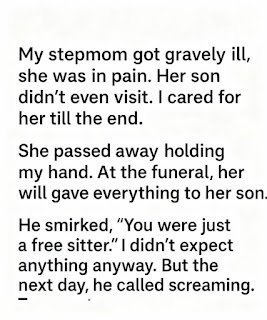
Sickness entered our home softly, like a shadow lengthening across the floor. My stepmother needed care, and her son, despite living nearby, was conspicuously absent. I made excuses for him at first—life is complicated, grief is strange. But the empty chair by her bed demanded to be filled, so I filled it. I learned to navigate the medical jargon, to fluff pillows just so, to simply sit in companionable silence when words were too heavy. We talked of insignificant things, of baking and birds, building a fragile normality in an abnormal time. The “step” in our relationship dissolved. I was simply the person who was there.
Her decline was a gradual letting go. The expectation of her son’s visit faded from her eyes, replaced by a grateful focus on the small comforts I could provide. Her hand would seek mine during difficult moments, a silent communication more eloquent than speech. At the very end, with the rain whispering outside, she held on as if my hand were a tether to this world. Her passing was gentle, and in its wake, I felt a clean, deep sorrow intertwined with purpose. I had witnessed something sacred.
The funeral was a pageant of obligation. Her son appeared, impeccably dressed and emotionally distant, a spectator to the consequences of his absence. He inherited everything material—the keys, the deeds, the jewelry. I watched the proceedings without envy. As the gathering dispersed, he offered me a glib, cutting remark, reducing months of vigil to a strategy. I met his words with silence, a choice that felt powerful and right. Love that keeps score is not love at all.
Then, in the cold light of the next morning, the phone rang. His voice was ragged, breathless. He had discovered a personal letter from her, a final testament of a different kind. It cataloged the reality of her last days: the names of those who sat through the nights, and the stark absence of others.
It also laid upon him specific, personal obligations he had never considered. Suddenly, the inheritance felt like a chain. “What do I do?” he pleaded. My answer was simple. “You face what you avoided.” Hanging up, I felt a profound clarity. He received the property, the money, the things. But I had received the enduring truth that compassion is a legacy that lives in the giver, a quiet strength that no probate court can ever award or take away.