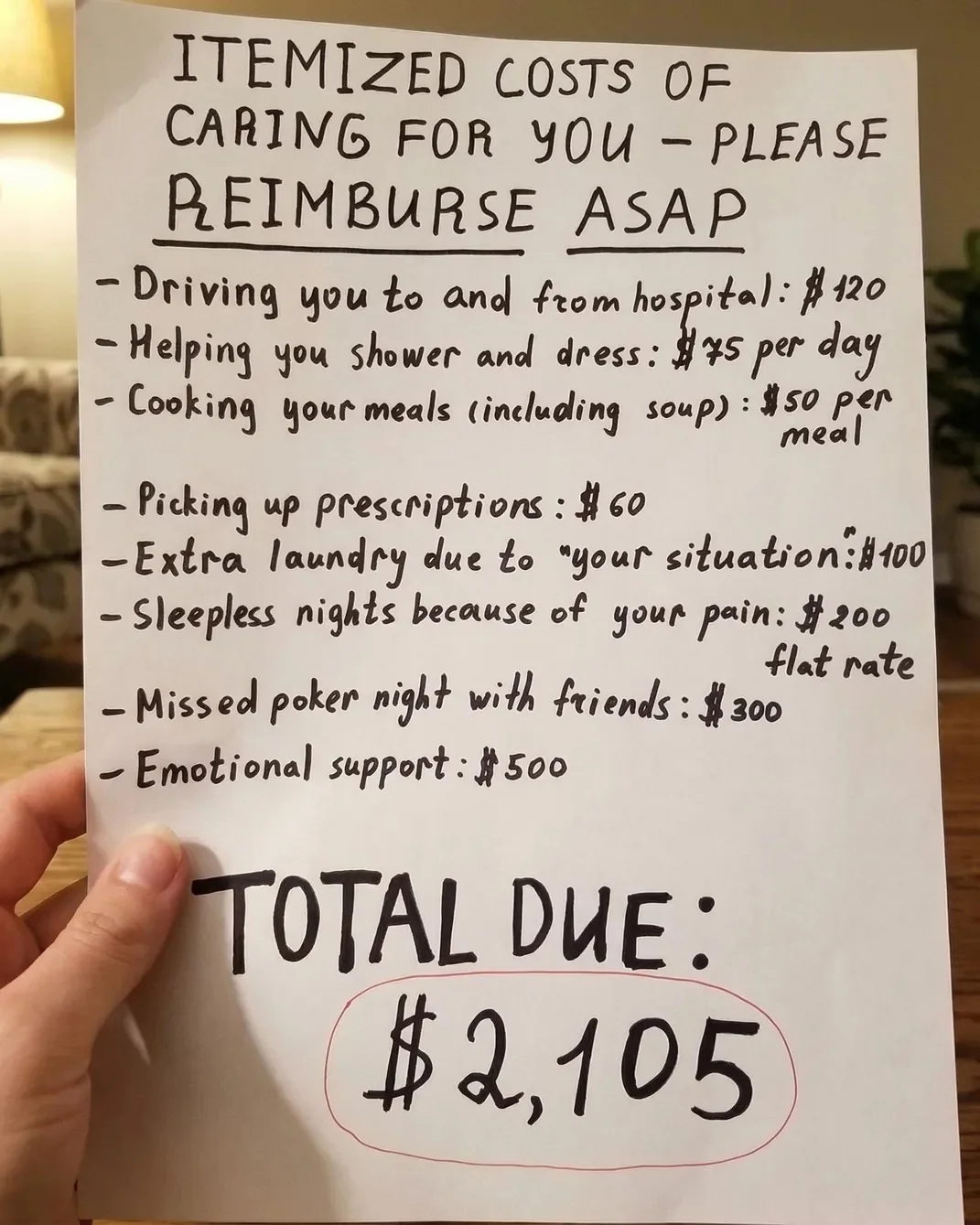
Recovery is a fragile time, a period when you learn to rely on others for the most basic things. I was in that space, three days post-surgery, shuffling through my own home like a guest, when I saw the paper on the refrigerator. Assuming it was instructions or a kind note, I leaned in. Instead, I found an invoice. My husband had itemized his care for me: a charge for each ride to the doctor, a fee for every meal he prepared, a deduction for hours taken off work. The numbers swam before my eyes. In my weakened state, this was not a list; it was a betrayal, reducing the sacred covenant of “in sickness and in health” to a petty balance sheet.
Our marriage had always felt like a calm harbor. We were partners who split chores and supported each other’s dreams, or so I thought. The surgery had already forced me to grieve my former self and the future we’d planned. His words had been my comfort; he’d held my hand and said, “We’re a team. I’ve got you.” To then discover that this “team” had a running tab shattered my understanding of everything we had built. The pain was less about money and more about the profound loneliness of realizing my partner saw my need as a burden to be managed, not a call to love more deeply.
After the initial shock dissolved, a steely resolve took its place. I thought about the economy of our marriage, one I had participated in generously and without record. I was the architect of our home’s rhythm—the one who remembered, who organized, who anticipated needs. I had offered endless emotional support through his career stresses and family dramas, never once considering it a withdraw from a shared account. His list had given me a terrible new language, and I decided to speak it fluently.
I created my own document, a ledger of seven years. I calculated the hours of homemaking, the mental load of household management, the market value of a full-time personal assistant, therapist, and chef. The total was not just large; it was a stark illustration of a profound imbalance. When I showed it to him, his face shifted from defensiveness to dawning horror. He was not just looking at a number; he was seeing, for the first time, the invisible labor that had propped up his life, now quantified in the cold, hard terms he himself had validated.
The confrontation was painful but purifying. He broke down, explaining how fear about medical bills and my long-term dependency had warped his thinking into something miserly and small. It was a confession, not an excuse. That moment forced us to a crossroads: continue keeping score and watch our love wither, or tear up the ledgers entirely. We chose the latter, embarking on therapy to rebuild a partnership based on grace, not debt. The note on the fridge became the most expensive free lesson we ever received, proving that love, when measured, always disappears.