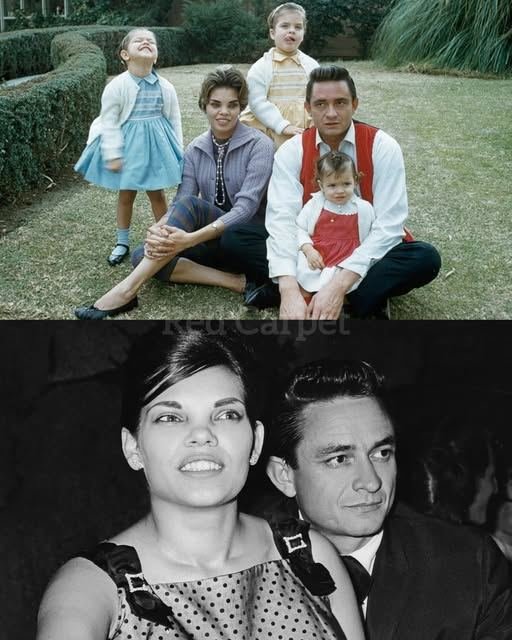
The narrative of Johnny Cash is often framed as a journey from darkness to light, with June Carter famously credited as his savior. But what of the woman who was there during the dawn, who helped build the life from which that darkness later erupted? Vivian Liberto Cash’s story is not a prologue to a greater romance; it is a complete and compelling saga of love, fortitude, and survival in its own right. She was Johnny’s first wife, the mother of four of his children, and the keeper of the home front during his tumultuous ascent, a role that demanded a heroism rarely acknowledged.
Their connection was forged in the earnest intimacy of pen pals. While Johnny served in the Air Force, he and Vivian built a relationship through letters, a bond that felt destined. They married in 1954, full of hope. Vivian quickly became the family’s cornerstone. While Johnny traveled endlessly, chasing the dream that would soon become a phenomenon, she was the constant—paying bills, attending school functions, and tucking their daughters into bed. The iconic song “I Walk the Line” was his musical love letter to her, a public pledge of loyalty born from the private world they were building together.
But fame is a centrifugal force, and Johnny was pulled to its outer edges. The road’s loneliness led to pill addiction, and the devoted husband in the letters became an increasingly absent and unreliable partner. Vivian endured this slow unraveling while also battling a sinister public attack. Her dark complexion, inherited from her Sicilian ancestry, led bigots to assume she was Black. She and her family were subjected to racist threats and harassment, a cruel reality she faced with immense courage, often while Johnny was too far away or too compromised to offer protection.
The love that once inspired a classic song could not withstand the compound fractures of addiction, distance, and public vitriol. In 1967, Vivian chose divorce. This decision is frequently misinterpreted as a failure or a passive exit. In truth, it was her most powerful act. She walked away from the chaos of Johnny’s world to claim peace and sanity for herself and her children. It was the ultimate demonstration of her strength: the strength to let go.

History has a tendency to streamline complex lives into simple legends, and in the process, Vivian was unfairly minimized. She was far more than “Johnny Cash’s first wife.” She was his first great love, his early anchor, and the mother who single-handedly maintained a stable home for his children amidst the storm of his fame. Her resilience in the face of personal heartbreak and public hatred forms a crucial, human counterpoint to the myth. Vivian Liberto Cash’s legacy is one of dignified endurance, a reminder that behind every great, turbulent legend stands someone who held the real world together.