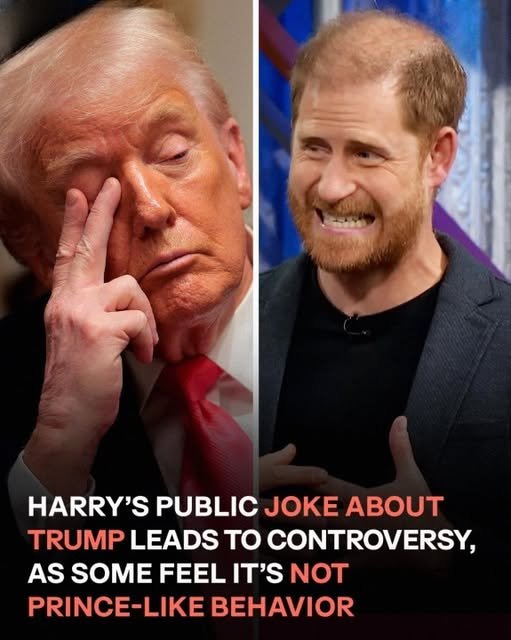
In a move that fused British royalty with American political satire, Prince Harry turned a lighthearted segment on The Late Show into a headline-grabbing event with a single, pointed joke. Stephen Colbert’s setup about holiday movie tropes was perfectly primed for Harry’s surprise appearance, which the Duke played into with self-aware humor. The dynamic shifted, however, when Harry referenced the American practice of “choosing a king,” a clear and cheeky allusion to Donald Trump’s past embrace of monarchical imagery. The moment was brief, but its reverberations were immediate and loud, highlighting the impossible tightrope Harry walks as he builds a life in a country deeply fascinated by, and often critical of, his every move.
The joke worked because it was layered. On the surface, it was a simple play on Colbert’s premise about royal Christmas movies. Just beneath, it was a sharp, cultural observation about American politics and personality. And at its core, it was a personal retort, however veiled, to a former president who has publicly commented on Harry’s marriage and legal standing in the U.S. This ability to pack multiple meanings into a late-night one-liner showcased a media savvy that Harry has developed through necessity, using the platform to speak back to power without uttering a direct, confrontational word.
As expected, the court of public opinion was in session within minutes. Social media platforms became battlegrounds, with Instagram feeds filling with scorn from traditionalists who saw the bit as beneath the dignity of his birthright. The words “cringe” and “embarrassing” trended among detractors, who view his comedic turn as proof of a tragic decline. Meanwhile, on other forums, the reaction was celebratory, with fans applauding his cleverness and apparent comfort in the informal setting. This stark dichotomy is now a permanent feature of Harry’s public persona; he exists in a state of perpetual controversy, where neutrality is seemingly impossible.
The context of recent weeks gave the joke its strategic weight. With Trump’s comments on Harry’s visa and his marriage still echoing, and with the memory of the crowned Trump image firmly embedded in pop culture, Harry’s line was perfectly pitched. It allowed him to acknowledge the noise surrounding him without giving it undue gravity, deflecting with humor—a classic talk show host tactic now employed by the guest. It was a demonstration of turning the media’s obsession into a punchline, however temporarily.
This event is a snapshot of the Sussexes’ relentless news cycle. Even their attempts at private family moments, like a Thanksgiving charity event, spiral into bizarre public dissections of hairstyles and children’s heights. Harry’s decision to engage through a pre-taped comedy show, where he could control the message and the medium, represents a strategic choice in this endless war of perception. He is actively participating in shaping his narrative, one joke at a time, understanding fully that in today’s world, a laugh in a late-night studio can be as powerful, and as divisive, as any formal statement.