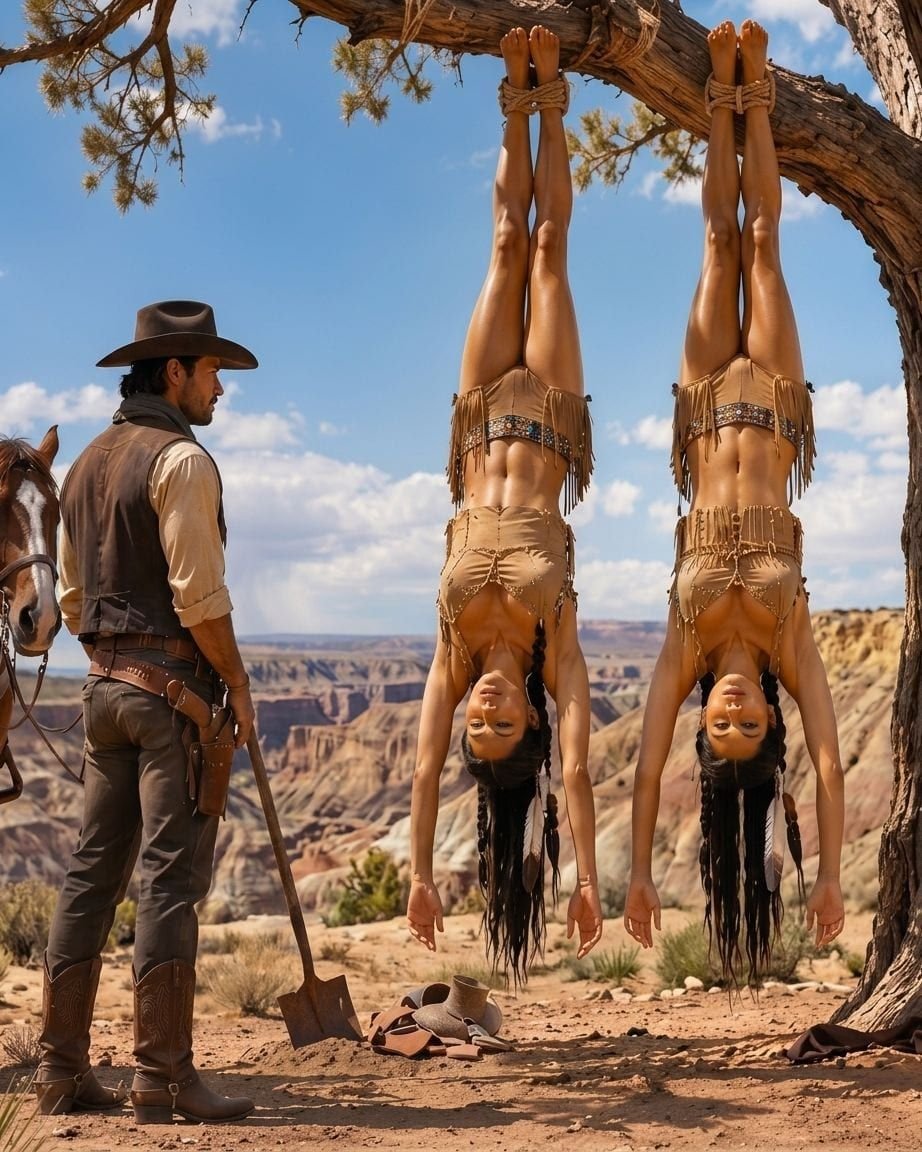
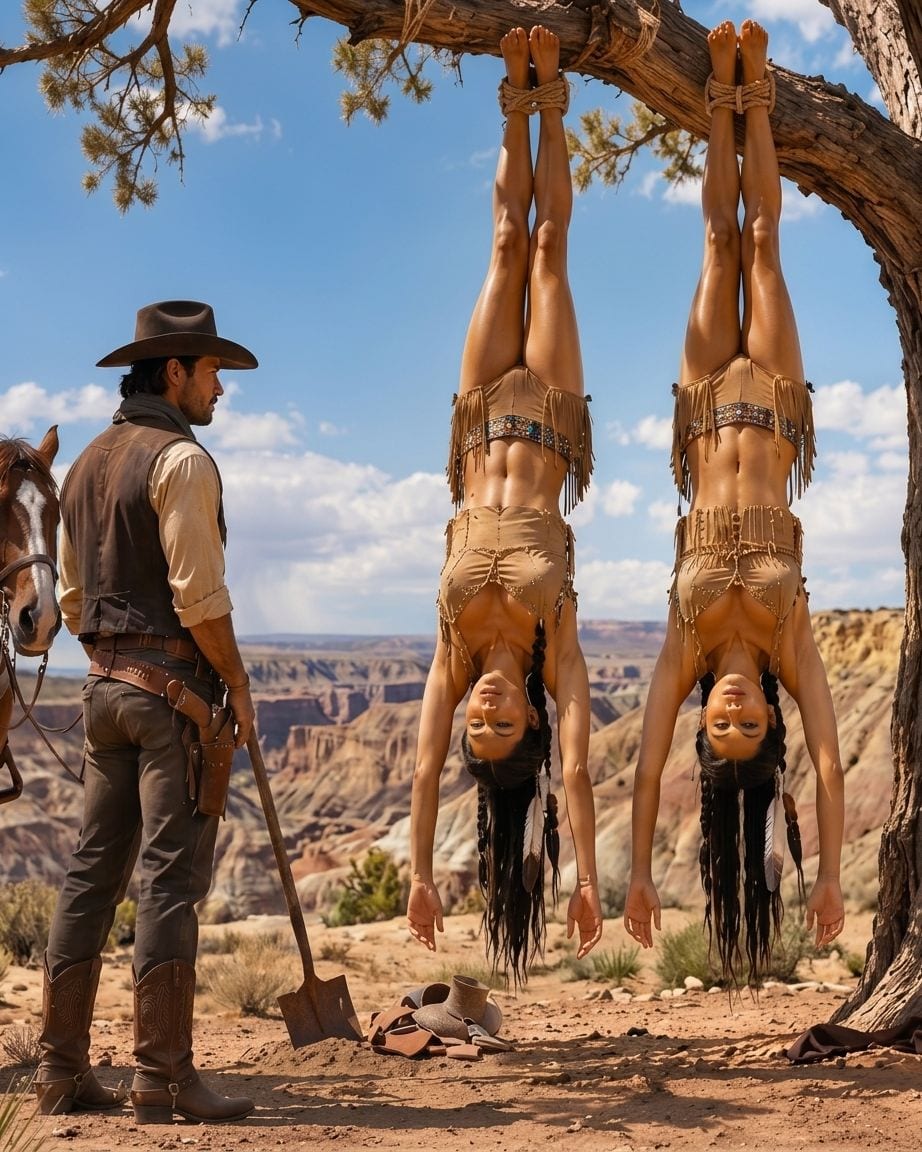
The silence that followed had actual weight to it. The baker shuffled backward.
The deputyâs hand drifted away from his gun. I walked to the wagon.
I pulled the knife I keep in my left bootâold habit from years I donât discussâclimbed up beside the women and cut the rope binding their wrists.
Not the neck ropes. Yet. The wagon needed to stop swaying first.
When it steadied, I worked the loops over their heads. About thirty seconds each.
Felt like the better part of an hour.
The younger woman was trembling so violently I had to grip her arm to keep her steady stepping down.
The older one stepped down herself, but when her feet hit the dirt, her legs buckled just for a moment, and I caught her by the elbow.
She looked at my hand on her arm, the way you look at something that surprises you.
Not fear, just something unexpected.
âYouâre all right,â I said, which was a stupid thing to say, because she clearly was not.
But it was all I had. She said something in Apache. I didnât catch.
âShe says you smell like horse and trail dust,â the younger woman said.
Her English was precise, careful, like sheâd learned it from reading. âShe means it well. It means you are real.â
We cleared Cuervo Creek before sundown. I had no plan beyond that.
Chester couldnât carry all three of us, so the older womanâher name was Nadiârode, and the younger one, Isa, walked alongside me while I led Chester by the reins.
We went south because south felt more open than any other direction, and sometimes thatâs the whole of a decision.
About two miles out, when the town was fully behind us and there was nothing but sage and scrub and the particular hush of the desert going to evening, Isa said, âWhere are we headed?â
âStill working that out,â I said. âDo you have a home?â I turned that over a moment.
âIâve got a piece of landâGuadalupe foothills. Been sitting empty about two years.
Roofâs probably got some holes in it by now.â âWhy is it empty?â I didnât answer right away.
The truth was it had been my fatherâs land, and my father had died, and Iâd been moving ever since, because moving hurt less than staying.
Forty-three acres of scrub, pine, and limestone. A two-room adobe house. A well that worked. Last I checked.
Iâd been meaning to sell it. Had been meaning to for two full years without ever quite getting there.
âIt just is,â I said. Nadi said something from atop Chester. Isa listened, then cut me a sideways look.
âShe wants to know if you do this oftenâride into towns and cut people down.â âFirst time,â I said.
Nadi spoke again. âShe says that explains why you were so nervous.â âI wasnât nervous.â Isa looked at me.
âI was cautious,â I said. Nadi made a sound.
I would spend the next several weeks learning to recognize a single short exhale through her nose, eyes going briefly flat: âYouâd miss it if you werenât paying attention.â
âI was paying attention.â We made camp that night at the base of a dry wash.
I had cornmeal, dried beef, and a battered coffee pot that produced the worst coffee anywhere in the Southwest.
I laid out my second bedroll for the women and put myself on bare ground near the horses.
Around the fire, with the darkness pressing close and the stars coming out enormous, the way they only do in desert sky, Isa told me some of what had happened to them.
She and Nadi werenât related.
Theyâd come from different bands, both handed over as wives to Anglo settlers through a government-encouraged arrangement that the bureau men called cultural integration and that the women called something Isa translated roughly as being given away to strangers.
Nadiâs husband had been fifty-four and mostly absent.
When three years passed without a child, he blamed her, though Isa said Nadi had her own theory, based on things sheâd observed, about where that particular problem actually resided.
Isaâs husband had been twenty-eight and cruel in a quiet, methodical way.
Not the kind of man who commits one large atrocity, the kind who commits a hundred small ones steadily until the person receiving them can barely recall who they were before.
When both husbands decided to send the women awayâaway, meaning a reservation, three hundred miles distant, no horses, no provisionsâsomeone in town had floated hanging as a cleaner solution to the inconvenience of two Apache women nobody wanted.
I sat and listened and didnât say much, because what was there to say?
After a while, I asked, âWhat do you want after all this? Is there somewhere youâre trying to get to?â
Isa was quiet a moment. Nadi watched the fire. âNadiâs mother died two winters past,â Isa said.
âHer father arranged the first marriage. Thereâs a cousin, perhaps near the Rincon Mountains.â âPerhaps.â A pause.
âMy own family, I donât know if theyâd take me back.
When a woman is sent away, sometimes it becomes easier for everyone if she simply stays away.â
She said it without bitterness, just reporting facts like weather. Somehow, that made it worse.
âYou could come to the land,â I said. âFor a while at least. Figure out what comes next.â
Nadi looked up from the fire.
In the firelight, she was, Iâll say it plainly, strikingânot that word gets used in magazinesâsomething more durable than that.
She had a face that had long since decided it would not perform anything. It didnât mean.
She said something to Isa. âShe wants to know what you get out of this,â Isa said.
I turned the coffee pot in my hands.
There was a crack up the side Iâd been meaning to seal for months. âCompany, maybe,â I said.
âThe landâs quiet. Too quiet.â Nadi held my gaze for a long moment, like she was reading very small print.
Then she nodded: once. Final. Four more days to reach the Guadalupe land.
Four days of walking and riding and swapping turns on Chester.
Four days of me slowly relearning what it meant to exist near other people after two years of near total solitude.
I had forgotten, for instance, that you canât simply stop walking when youâre tired if others are walking alongside you.
I had forgotten that a shared fire means negotiating who sits nearest the heat.
I had forgotten how to make conversation at meals instead of just eating in silence and staring at nothing.
Isa was patient about it. Sheâd ask me careful, specific questions: Where had I ridden?
What was that bird on the ridge? What did the land office letter actually say?
And Iâd answer, and sheâd tell me something in return, and gradually, clumsily, like two people trying to turn over a cold engine, we learned each other.
Nadi communicated mostly through Isa those first days, not from shyness, but because she was watching.
That was her nature, I came to understand.
She observed everything with this slow, complete attention, and she formed her judgments carefully and, once formed, she kept them.
On the third morning, I woke before dawn to find her already up, sitting on a boulder above camp, facing east.
The sky was that deep, still blue it goes in the minutes before sunrise.
She had her knees pulled to her chest, and she was perfectly still.
I didnât say anything, just sat down on a nearby rock.
We watched the sun come up together without a word passing between us.
When it was fully light, she stood, went back to camp, and began rebuilding the fire.
Like that was simply a thing weâd agreed toâa new standing arrangement.
The adobe house was worse than Iâd allowed myself to remember.
Part of the roof had caved in at the back corner. Mice had claimed the bedding.
The well rope had rotted, and the bucket had gone down with it.
Somethingâcoyotes, most likelyâhad gotten through the shutters and destroyed what had been my fatherâs chair.
I stood in the doorway and felt that particular kind of exhaustion that isnât about the size of a problem, but about how long itâs been sitting there being a problem.
Nadi walked past me and started moving wreckage just like that.
Picked up a section of fallen roofing and carried it outside. âYou donât have to,â I started.
She gave me a look.
I picked up some debris and carried it outside to Isa, who had a practical intelligence that expressed itself as the ability to look at any broken thing and immediately identify what was wrong with it.
Crouched by the well, she examined the mechanism and said, âI need rope, sturdy rope, and a new bucket or something that will serve.â
âTownâs fourteen miles,â I said. âThen Iâll need your horse tomorrow,â she said, as if this were already settled.
I realized with some surprise that it was. That first month is difficult to describe. Uncomfortable, exhausting, occasionally maddening.
Three people who didnât know each otherâs rhythms, crammed into a small house with considerable work to do and not enough tools or money to do it properly.
I am not a patient man by nature.
When frustrated, I go quiet rather than speaking directly, a character flaw my father named for me repeatedly and correctly.
I burned the cornmeal twice in the first week. I left tools out, and they rusted overnight in unexpected rain.
I walked directly through Isaâs seedlings along the south wall without noticing, until she pointed at my boot and said, âThose were tomatoes,â with a quiet devastation that made me feel about two inches tall.
But things happened that I hadnât anticipated. Nadi turned out to have an extraordinary way with animals.
Not mere comfort around them. Something closer to an actual conversation.
Chester had been a difficult horse for three years running, had bitten two men I knew of, threw strangers as a matter of principle.
On the second day, she walked straight up to him and put her face against his cheek.
After that, he trailed her around the yard like a dog.
She traded a dayâs fencing labor with a passing settler family for a rooster and a hen, coming home with one tucked under each arm, looking entirely unsentimental about the whole arrangement.
Isa fixed the well, then the south wall where the adobe had crumbled.
Then she began constructing something along the east fence, just started building it without announcing it.
When I finally said, âWhatâs that going to be?â
she said, âA proper kitchen,â in a tone that made clear this was self-evident and I should have anticipated it.
I mostly stayed out of their way, fixed the roof and shutters, and tried not to step on anything that mattered.
But in the evenings, when the work was done, weâd sit outside in the last of the daylight, the house still being small and smoky when the wind came from the wrong direction, and those evenings were unlike anything Iâd had in years.
Around week three, Nadi started speaking to me directly, not through Isa to me.
Her English was rough, and she knew it, and she didnât appear to mind. Sheâd say a word and wait.
If I didnât follow, sheâd approach it from another angle. She never seemed frustrated by the gaps.
She wasâand this is the best I can doâundefended.
She said what she meant, without the layer of performance and misdirection most people wrap around their meaning.
It was jarring at first. Then it became the most straightforwardly refreshing thing I had ever encountered.
She asked me once directly whether Iâd been lonely before they came. I said, âYes.â
She asked if I had always been lonely or only recently.
I said honestly that I wasnât sure those were two different things anymore. She sat with that for a minute.
Then she said, âLonely is not a bad thing.
It means you have a space inside you for someone that has not yet been filled. That is not emptiness.
That is room.â I sat with that for a long time after she went inside.
I should tell you about the men from Cuervo Creek, because they did come back. Iâd known they would.
About six weeks in. Three of themâPrine, the deputy, and two others I hadnât gotten clear looks at before.
They rode up mid-morning while I was out checking the far fence line, and I didnât hear until I was already walking back toward the house.
They were in the yard. Prine was telling Nadi and Isa to get on the horses heâd brought.
Nadi was standing in the kitchen doorway with a knife in her hand, not threatening anyone with it.
Sheâd just been in the middle of cutting something when they arrived.
But Prine didnât know that, and he looked uneasy.
Isa had gone very still in the particular way she did when she was running through options.
I came around the corner of the house with my rifle.
Disclaimer: This story was generated with AI and is entirely fictional. It is intended for entertainment purposes only. Names, characters, businesses, places, events, and incidents are either products of the author’s imagination or used fictitiously. Any resemblance to actual persons, living or dead, or actual events is purely coincidental.