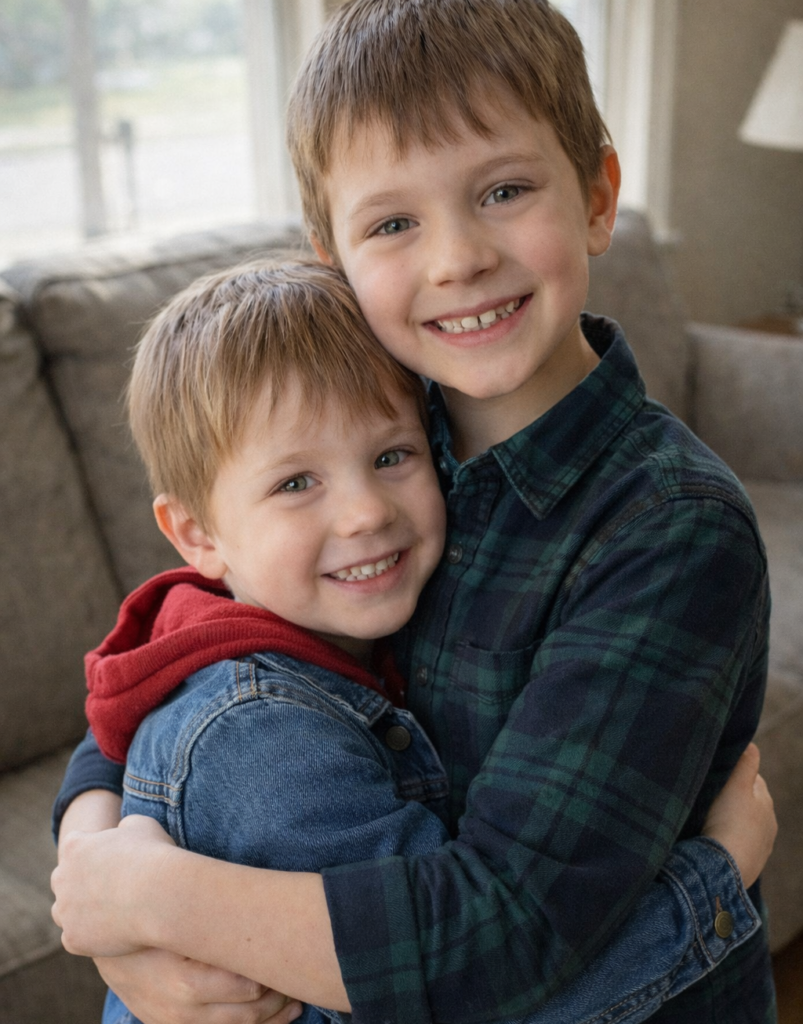
My son had only just returned to kindergarten after six months when he climbed into the car and said, “Mom, Ethan came to see me.” Ethan had been gone for half a year. Later, at the cemetery, Noah took my hand, stared at his brother’s grave, and whispered, “But Mom… he isn’t there.”
Six months had passed since my oldest son passed away.
It was a Tuesday at kindergarten pickup. Parents clustered by the gate, coffee cups in hand, eyes on their phones. I stood apart, keys clenched, watching the door as though it might swallow my child.
Then Noah ran out grinning.
“Mom!” he shouted, slamming into my legs. “Ethan came to see me!”
The air left my chest. I forced my face to behave.
“Oh, honey,” I said, smoothing his hair. “You missed him today?”
“No.” Noah frowned. “He was here. At school.”
I held his shoulders. “What did he say?”
Noah’s grin returned. “He said you should stop crying.”
My throat tightened so fast it hurt. I nodded like it was normal and buckled him into the car.

On the drive home, Noah hummed and kicked his heels. I stared at the road and saw another one—two lanes, a yellow line, a truck drifting.
Ethan had been eight. Mark was driving him to soccer practice. A truck crossed into their lane.
Mark lived. Ethan didn’t.
I never identified the body. The doctor told me, “You’re fragile right now.” As if grief disqualified me from being his mother one last time.
That night, I stood at the sink with the water running. Mark came in quietly.
“Noah okay?” he asked.
“He said Ethan visited him,” I replied.
Mark’s face flickered. “Kids say things.”
“He said Ethan told him I should stop crying.”
Mark rubbed his forehead. “Maybe it’s how he’s coping.”
Ethan’s headstone still looked too new.
“Maybe,” I said, though my skin prickled.
Mark reached for my hand. I pulled back without thinking. He froze.
“I’m sorry,” I said.
He nodded, eyes wounded. The distance stayed.
Saturday morning, I took Noah to the cemetery. I brought white daisies. He carried them with both hands, solemn.
“Mom… Ethan isn’t there.”
I knelt, brushing leaves from the stone. “Hi, baby,” I whispered.
Noah didn’t come closer.
“Come here,” I said. “Let’s say hi to your brother.”
Noah stared at the stone, stiff.
“Sweetheart?” I asked.
“He told me.”
He swallowed. “Mom… Ethan isn’t there.”
“What do you mean he isn’t there?”
Noah pointed past the stone. “He’s not in there.”
I stood slowly. “Ethan is here.”
Noah flinched.
I lowered my voice. “Sometimes people say someone isn’t there because we can’t see them.”
“Ethan came back.”
“No,” he whispered. “He told me. He said he’s not there.”
“Who told you?”
Noah’s eyes widened. “Ethan.”
My hands went cold. “Okay,” I said too quickly. “Let’s go get hot chocolate.”
Noah nodded fast, relieved. “It’s a secret.”
On Monday, he climbed into the car and said it again. “Ethan came back.”
I paused with the seatbelt halfway across his chest. “At school?”
He nodded. “By the fence. He talked to me. He said stuff.”
“What stuff?”
Noah’s eyes slid away. “It’s a secret.”
My heart kicked hard. “Noah, we don’t keep secrets from Mommy.”
“He told me not to tell you,” Noah whispered.
I gripped the seatbelt. “Listen. If any person tells you to keep a secret from me, you tell me anyway. Okay?”
Noah hesitated, then nodded.

That night, I sat at the table with my phone. Mark hovered in the doorway.
“I’m calling the school,” I said.
“It’s an adult.”
Mark came closer. “What happened?”
“Someone is talking to Noah. And they’re using Ethan’s name.”
Mark went pale. “You’re sure?”
“He said Ethan told him not to tell me. It’s an adult.”
Mark swallowed. “Call.”
The next morning, I walked into the kindergarten office without removing my coat.
“My son is being approached. Show me.”
Ms. Alvarez appeared, polite smile fading when she saw my face.
“Mrs. Elana,” she said. “Is Noah—”
“I need security footage,” I cut in. “Yesterday afternoon. Playground and gate.”
Her brows lifted. “We have policies—”
“My son is being approached. Show me.”
She held my gaze, then nodded. “Come with me.”
Her office smelled of coffee and toner. She clicked through camera grids, pulled up video.
At first, it was normal—kids running, teachers pacing. Then Noah wandered to the back fence. He stopped, tilted his head, smiled, waved.
“Zoom,” I said.
She zoomed in. A man crouched on the other side of the fence. Work jacket. Baseball cap. Low, hidden from sightlines, leaning forward to talk.
Noah laughed, answered him like this wasn’t new. The man slipped a hand through the fence, passed something small to Noah.
My vision tunneled. “Who is that?”
Ms. Alvarez’s mouth opened. “That’s one of the contractors. He’s been fixing the exterior lights.”
I didn’t hear “contractor.” I saw a face I’d refused to study in the crash file.
I dialed 911. “That’s him. The truck driver. The one who hit them.”
Two officers arrived quickly. One spoke to Ms. Alvarez, the other to me.
“I’m Officer Haines,” he said. “Show me what you saw.”
I showed him the video. His face hardened. “Stay here. We’ll locate him.”
My legs went weak. I sat.
A teacher brought Noah into the office. He clutched a plastic dinosaur. “Mom? Why are you here?”
I pulled him close. “I needed to see you.”
Noah patted my shoulder. “It’s okay. Ethan said—”
“Noah,” I interrupted. “Who talked to you?”
“Ethan.”
“What did the person look like?”
“A man.”
“Did he touch you?”

“No,” Noah said quickly. “He gave me this. He said it was from Ethan.”
Officer Haines crouched. “Did he tell you his name?”
Noah shook his head. “He said he was sorry.”
“For what?”
Noah whispered, “For the crash.”
They found him near the maintenance shed. He was cooperating.
I demanded to see him.
The man sat at a table, cap removed, thin hair, red eyes, hands clasped tight.
“Mrs. Elana,” he said hoarsely.
Hearing my name from him made my skin crawl.
“Do not speak to the child,” Haines warned.
Noah pressed into my side. “That’s Ethan’s friend.”
I swallowed hard. “Noah, go with Ms. Alvarez.”
Noah clung to me. “But—”
“Now,” I said.
The door shut with a click that felt final.
I turned to the man. “Why were you talking to my son?”
He flinched. “I didn’t mean to scare him.”
“You used Ethan’s name. You told my child to keep secrets.”
His shoulders collapsed. “I know.”
Haines said, “State your name.”
“Raymond,” he whispered.
He admitted he’d sought the repair job on purpose. He couldn’t sleep. He had syncope—fainting spells—and had driven anyway.
“So you chose the risk,” I said flatly. “And my son died.”
Raymond’s face crumpled. “Yes.”
He confessed he’d approached Noah to soothe his own guilt.
I leaned forward. “So you used my living child to soothe your guilt.”
Raymond’s voice broke. “Yes.”
“You don’t get to climb into my family. You don’t get to hand my child secrets and call it comfort.”
Raymond sobbed silently, head bowed.
Haines looked at me. “Ma’am, we can pursue a no-contact order.”
“I want it,” I said. “And I want him banned from this property. And I want the school’s protocol changed.”
Outside the glass, Ms. Alvarez flinched.
Raymond lifted his head, eyes raw. “I don’t expect forgiveness. I just needed you to know I didn’t wake up wanting to hurt anyone.”
“You still did,” I said. “And wanting doesn’t change harm.”
Raymond nodded, like a man accepting a verdict.
Ms. Alvarez brought Noah back in. His eyes were red. He held the dinosaur like a shield.

I knelt. “Noah. That man is not Ethan.”
Noah’s lip trembled. “But he said—”
“I know,” I said. “He said something untrue. He was wrong to talk to you.”
“He was sad.”
“He was. But grown-ups don’t put their sadness on kids. And they don’t ask kids to keep secrets.”
Noah blinked hard. “So Ethan didn’t tell him?”
“No,” I said, and it hurt. “Ethan didn’t.”
I told him the short version.
Noah started to cry. I pulled him into my arms and held him until his breathing slowed. Officer Haines escorted Raymond out. Raymond kept his eyes on the floor.
When we got home, Mark was waiting in the driveway, pale and shaking.
“What happened?” he asked.
I told him the short version—the fence, the video, the man, the reason.
Mark’s face twisted with rage, then he looked at Noah and forced it down.
“I should’ve been the one.”
That night, after Noah fell asleep, I sat at the table with the no-contact paperwork. Mark stood behind my chair.
“I should’ve been the one,” he whispered. “Not Ethan.”
“Don’t,” I said.
“I can’t stop thinking it.”
“I can’t stop thinking about anything. But we have Noah. We don’t get to drown.”
Mark’s hands tightened on the chair back. “You did the right thing.”
“I know. And I still feel sick.”
“I’m sorry I couldn’t say goodbye.”
Two days later, I went to the cemetery alone. I set daisies at Ethan’s stone and traced his name with my fingertip.
“Hi, baby,” I whispered. “I’m sorry I couldn’t see you. I’m sorry I couldn’t say goodbye.”
My eyes burned. I let them.
“I can’t forgive him,” I continued. “Not now. Maybe not ever. I’m done letting strangers speak for you. No more secrets. No more borrowed words.”
I pressed my palm to the cold stone, then stood and breathed until my chest stopped shaking.
It still hurt. It always would. But it was the clean hurt of truth. And I could carry it.
Source: amomama.com
Note: This story is a work of fiction inspired by real events. Names, characters, and details have been altered. Any resemblance is coincidental. The author and publisher disclaim accuracy, liability, and responsibility for interpretations or reliance. All images are for illustration purposes only.