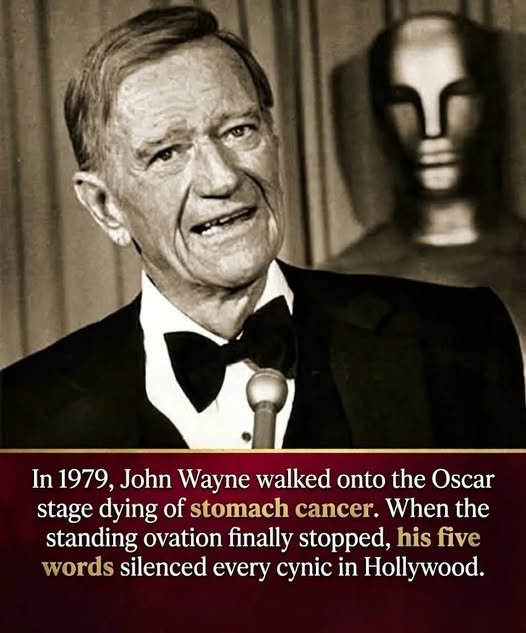
The 1979 Academy Awards ceremony reached an emotional peak not with the announcement of a winner, but with the entrance of a presenter. When John Wayne stepped into the lights, the entire theater erupted in a spontaneous, unanimous standing ovation. It was the heartfelt response to seeing a giant in a weakened state. Just months after a grueling cancer operation, The Duke was frail, a stark visual departure from the robust heroes he portrayed. Yet, his mere presence on that stage was a declaration of war against his own infirmity.
This was a man intimately familiar with such battles, having defeated lung cancer years earlier. His decision to appear was a testament to his indomitable spirit. He wanted to look Hollywood in the eye one last time, not from a sickbed, but from its grandest stage. The industry’s reaction was immediate and visceral—a torrent of applause that transcended mere celebrity worship, becoming a raw acknowledgment of his perseverance and iconic status.
When the room finally quieted, Wayne delivered a line that would echo through history. Gazing out at the crowd that had just honored him, he said, “That’s about all the medicine a fella’d ever really need.” The five words were disarmingly simple, transforming the ovation from a compliment into a lifeline. He publicly acknowledged that the love and respect of his audience held a healing power that rivaled any medical treatment.
He continued with the task at hand, presenting the Best Picture award with his typical dry wit, making light of his own advanced years in the business. The crowd laughed, but the gravity of the moment was inescapable. It was a farewell performance, delivered with the same steady nerve he had shown in countless films. He was a man clearly engaged in a final, personal conflict, yet he stood as a pillar of resolve.
John Wayne passed away soon after, but that final Oscar appearance immortalized him in a new way. It is remembered not for glamour, but for its breathtaking humanity. The institution that bears his name continues his fight against cancer, but his greatest lesson was taught that night. He demonstrated that enduring strength is measured not by our invincibility, but by our grace and courage when we are at our most vulnerable. The medicine he received was applause, but the legacy he left was a masterclass in mettle.