I buried my husband 14 years ago.
Or at least… that’s what I believed.
Then, last week, he showed up on my porch and calmly asked for his twin sons back.
And somehow, that still wasn’t the worst part.
The worst part was the way he said it—so casually, so carelessly.
“Thanks for taking care of them.”
As if I had been watching his dog for a weekend… not raising two boys from the ruins he left behind.

I stood frozen in the doorway, my hand still gripping the doorknob, staring at a man I had mourned, resented, forgiven, and buried a hundred different ways over the past 14 years.
Beside him stood a woman.
I recognized her instantly, even though we had never met back when it mattered. Back then, she had only been an idea—“proof he wasn’t alone.”
Now she was real.
And she was standing on my porch like we were neighbors.
Worse… she had my sons’ eyes.
For a brief, dizzying moment, I was no longer on my porch. I was back on that sidewalk, staring at the charred remains of what had once been our home, while a police officer spoke gently beside me.
“We found signs your husband may not have been alone when the fire started. There was a woman with him.”
“What do you mean, there was a woman?”
“The fire department recovered jewelry fragments alongside his watch. A neighbor reported seeing a woman arrive earlier that evening.”
“Oh, my God.” My knees had buckled, and I collapsed onto the pavement. “Are there any… survivors? Bodies?”
He shook his head slowly. “I’m sorry, ma’am. The damage was too severe.”
That was all I had back then.
A burned house.
And a husband presumed dead.
My entire life had turned to ash while I was away on a business trip, three states from home.
When it was over, I had nothing left—except my grandmother’s lake house, two hours north.
A week after I moved in, my phone rang.
It was social services.
The woman on the other end spoke carefully.
“There are children involved.”
I sat down at my grandmother’s kitchen table, my fingers tightening around the phone. “What children?”
She hesitated. “The woman who was with your husband… she had twin boys. They’re four years old.”
“My husband’s?”
“According to their birth certificates, yes.”
I swallowed hard. “And now what?”
“They need placement. There doesn’t appear to be any family willing to take them.”
A hollow laugh escaped me. “So you’re calling me because his mistress died in the fire, and now no one wants the children he had behind my back?”
She sighed softly. “I’m calling because you are their closest legal connection through him.”
I should have said no.
Any reasonable person would have.
I had just lost everything—my home, my marriage, the life I thought I had.
But instead, I heard myself say, “I’ll come in.”

The first time I saw them, they were sitting in a small office.
Two little boys. Identical, except for a faint scar near one boy’s eyebrow.
They were quiet. Too quiet for children their age.
And they clung to each other as if letting go meant disappearing.
I crouched in front of them.
“Hi,” I said softly.
They looked up at me with wide, dark eyes—eyes that had already seen far too much.
I glanced at the social worker. “Do they know?”
“Only that their parents are gone.”
I looked back at them.
One boy had his fist twisted tightly into his brother’s shirt. The other was trying—failing—to be brave.
And then the thought came, sharp and undeniable:
None of this is their fault.
I swallowed, my chest tight.
The decision didn’t feel difficult anymore.
If anything… it felt inevitable.
“I’ll take them.”
The social worker blinked. “Ma’am, you don’t have to decide right now.”
“I already have. I can’t just walk away from them.”
Their names were Eli and Jonah.
The first few years were hard.
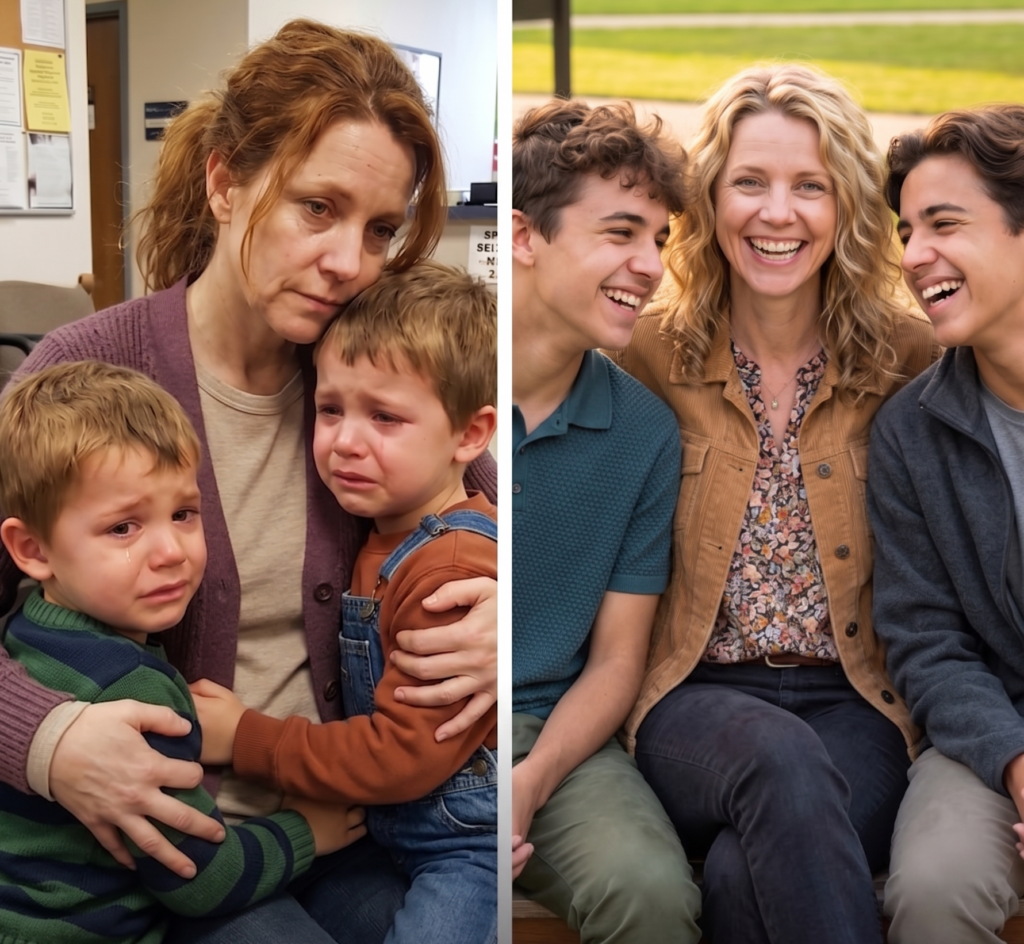
They had nightmares—terrible ones. Some nights, I would wake to quiet sobbing and find them curled up together. Other nights, they would sleep on the floor beside my bed, wrapped in blankets like shields.
It wasn’t easy.
And it only got harder when the questions started.
They were eight when Eli asked, “What was our mom like?”
“She loved you,” I said.
It was the truth… or at least the part of it I chose to hold onto.
“What about Dad?”
That question was harder.
I never lied.
But I never poisoned them with bitterness either.
“He made choices that hurt a lot of people,” I would say.
They didn’t deserve to carry his mistakes like a burden.

The years passed the way they do when you’re too busy surviving to notice time slipping by.
Shoes grew larger. Voices deepened.
And one day, without even realizing when it had happened, they started calling me “mom.”
I worked endlessly—sometimes to the point of exhaustion—to give them everything they needed.
Their walls filled with certificates, team photos, and college brochures.
Eventually, I sat them down and told them the truth about their parents.
They listened in silence.
“And you took us in anyway?” Jonah asked.
I nodded.
“Didn’t you ever…” Eli started, then trailed off.
But I understood.
“You were never responsible for your parents’ choices,” I said gently. “And I never wanted you to feel like you were. I took you in because, the moment I met you, it felt right.”
I reached across and placed my hand over his.
“I love you. It’s that simple.”
By the time they turned 18, they had grown into good men.
Eli wanted to study engineering.
Jonah planned to go into political science—because he loved arguing, and unfortunately, he was very good at it.
When their college acceptance letters arrived, we opened them together at the kitchen table.
“We did it,” Jonah said.
I laughed through tears. “No. You did it.”
They both looked at me.
“We,” Eli said quietly.
I drove them to campus myself.
Then I sat in my car afterward… and cried for twenty minutes straight.
I thought we had made it.
I thought the hardest part was behind us.
Three days later, someone knocked on my door.
And there he was.
The husband I had buried 14 years ago.
Standing beside the woman with my sons’ eyes.
He looked me up and down, then smiled.
“Well. Thanks for taking care of our boys.”
“If it weren’t for you,” the woman added, “we wouldn’t have been able to live the life we wanted. Travel, build connections… You know how expensive kids are.”
For a moment, I couldn’t even process it.
They were alive.
Alive.
And thanking me like I had been a babysitter.
Then Josh said, “We’ll be taking them back now.”
That snapped something in me.
“You can’t be serious.”
“Oh, we are. We need to present as a proper family now,” he said smoothly. “It’s important for my upcoming CEO position. Optics matter.”
Not love.
Not regret.
Not even curiosity.
Just… appearances.
I wanted to slam the door in their faces.
I wanted to scream.
But I didn’t.
Because something told me… that wouldn’t be enough.
If I was going to stop them, I had to do it properly.
I looked him straight in the eyes.
“Okay… you can have them.”
Their expressions lit up instantly.
Then I added, “On one condition.”
He frowned. “What condition?”
“Wait here.”

I went inside, retrieved a folder from my desk, and returned to the door.
“Fourteen years,” I said. “Food, clothes, dental work, school supplies, prescriptions, braces, therapy, sports, applications, tuition.”
He looked irritated. “What is this?”
“I’d have to calculate the exact number, but with interest, you owe me approximately 1.4 million dollars.”
He laughed. “You can’t expect us to pay that.”
“You’re right,” I said calmly. “I don’t.”
Then I pointed to the ring camera above the door.
His face changed instantly.
The woman noticed a second later—and went pale.
I held his gaze.
“What I do expect is that the life insurance company, your board, and every journalist online might be very interested in hearing a dead man explain why he abandoned his children… and only came back when he needed a family image for a CEO role.”
“You wouldn’t dare,” the woman snapped.
“Oh, I would,” I said, closing the folder. “You admitted everything. And my camera recorded it all.”
For the first time, he had nothing to say.
That was when a car pulled into the driveway.
Laughter. Doors slamming.
The boys were back—with friends.
I watched as Eli and Jonah took in the scene.
Two strangers.
My expression.
The tension.
Then recognition hit.
Jonah stepped forward, his voice cold. “Get off our mother’s property.”
Eli stood beside me.
The woman tried to smile. “Boys, we’re your—”
“You’re nothing to us,” Eli said.
Josh looked between them, as if expecting confusion. Curiosity. Some kind of bond he could use.
There was none.
“We came to bring you home,” the woman said weakly.
Eli didn’t even blink.
“I am home.”
No one spoke after that.
They turned and left.
That night, I sent the footage—and the old police report—to every journalist I could find.
A week later, an article appeared: a CEO appointment delayed due to “background concerns.”
That evening, the three of us sat at the kitchen table.
Jonah looked at me. “You knew we’d choose you, right?”
I reached across and took their hands.
“You already did,” I said softly. “Every day.”
Because family isn’t built through grand gestures or dramatic returns.
It’s built through packed lunches, late-night talks, fever checks… and showing up again and again until love becomes something steady. Something ordinary.
Something real.
They thought they could come back and take a family.
But a family isn’t something you reclaim when it’s convenient.
It’s something you earn.
And they never did.
Source: amomama.com
Note: This story is a work of fiction inspired by real events. Names, characters, and details have been altered. Any resemblance is coincidental. The author and publisher disclaim accuracy, liability, and responsibility for interpretations or reliance. All images are for illustration purposes only.